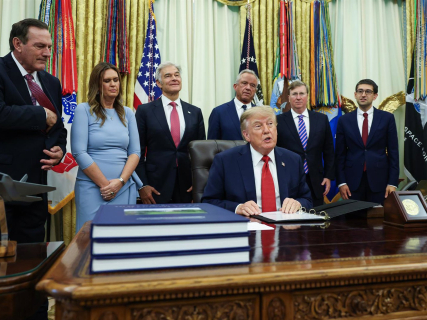
All the keys about the agreement between Trump and Greenland: what the US gains without buying the island

The agreement on Greenland expands U.S. military access and limits the presence of its adversaries, but maintains Danish sovereignty. The pact announced by Trump still needs to complete its parliamentary processing.

fotonoticia 20260919021742 1920

fotonoticia 20260919021742 1920

Add DEMÓCRATA to Google

Ask FREN

Published

Last updated

2 minutes

Most read

Elecciones 29N · Encuestas

La media de las encuestas

Media a 10 de noviembre de 2026 · 14 institutos

  • PP31,4 %
  • PSOE26,7 %
  • Vox19,1 %
  • Frente Amplio6,3 %
  • ERC2,5 %
01020304050ene 2024jul 2024ene 2025jul 2025ene 2026jul 2026

Media del último estudio de cada instituto en 30 días y su evolución semanal desde el 23J. Partidos con al menos un 2 %.

Todas las encuestas

Elecciones generales del 29 de noviembre · Demócrata

The Trump agreement on Greenland reinforces the ability of the United States to militarily use the island without turning it into U.S. territory. Washington obtains guarantees of access and security, while Denmark and the Greenlandic authorities maintain that the pact respects sovereignty and the right to self-determination.

This difference explains the different ways of presenting the announcement. Trump describes it as a decisive advance for the control of the territory's security. For Copenhagen and Nuuk, it is about strengthening defensive cooperation without accepting the acquisition of the island that the U.S. president had proposed.

What the United States gets

The pact includes permanent rights of military access, establishment of facilities, and overflight, according to information released by Reuters. Its goal is to ensure that Greenland remains within the U.S. defense apparatus in the Arctic.

In practical terms, an agreement of this type affects the ability to deploy personnel, operate aircraft, and sustain military infrastructure. It does not equate to buying the territory or incorporating its inhabitants into the political system of the United States.

The U.S. presence does not start now either. Washington already has the Pituffik base and a framework for defensive cooperation with Denmark. The new pact expands and consolidates that relationship.

What happens with China and Russia

Another key point is the exclusion of an adversarial military presence and the restrictions on sensitive investments. China and Russia are among the countries that are intended to be prevented from obtaining strategic positions on the island.

The importance of these limitations depends on their specific scope: it is not the same to prevent a military base as to subject certain investments to authorization. The final text must specify which facilities, activities, and operations are subject to those rules.

Greenland does not become American

Danish and Greenlandic authorities maintain that the agreement preserves the sovereignty of the Kingdom of Denmark and the ability of Greenlanders to decide their future. Therefore, the announcement does not constitute a territorial transfer.

The distinction also affects the word control. The United States can expand its influence over the defense of Greenland without assuming all the powers over its government, its population, or its economy.

Trump has employed a broad formulation about U.S. powers, but the initial announcement did not detail all the conditions of application.

What is needed for the pact to be effective

The agreement still needs to go through the corresponding parliamentary procedures and requires ratification from Denmark and Greenland.

Until the complete text is known and that process concludes, questions remain pending such as the scope of the authorizations, the potential construction of new facilities, and the conditions for exercising the announced access rights.

More key points, information and questions with FREN

AI-GENERATED CONTENT

What is the status of the parliamentary ratification process of the agreement between the United States, Denmark, and Greenland?

With the information available up to September 19, 2026, there is no public record that the security agreement between the United States, Denmark, and Greenland related to the U.S. military presence on the island (including the Pituffik/Thule base) has already initiated a formal parliamentary ratification process in any of the three parties. What is known is a political agreement closed at the government level, still pending legal formalization and the corresponding internal procedures.

The most direct source on the pact is a piece from Demócrata titled “Denmark and Greenland endorse the pact with Trump and emphasize shared security on the island” , published on September 18, 2026. It explains that the Danish Prime Minister, Mette Frederiksen, politically “ratifies” the agreement reached with the United States to strengthen “shared security” in Greenland, but this is a political ratification, not a parliamentary act.

According to that text, U.S. President Donald Trump announced that Washington will assume “permanent control” of security on the island, a formulation that the Danish government does not confirm in those terms. Frederiksen highlights that the agreement “recognizes the sovereignty and territorial integrity” of Denmark and the “right of the Greenlandic people to self-determination,” insisting that it is an understanding that, in her opinion, strengthens the security of the Arctic and the North Atlantic and also benefits NATO and Europe.

The Prime Minister of Greenland, Jens-Frederik Nielsen, is quoted in the same article emphasizing that the agreement “benefits all parties” and that “we are about to celebrate an agreement that guarantees and strengthens the security of Greenland, Denmark, the United States, and the Western alliance.” A relevant fact is that it is expressly indicated that the formal signing by the three parties “is scheduled for next week in New York during the UN General Assembly.” That is, at the date of the news, the agreement was not even legally signed yet, but in a political pre-agreement phase.

Other contextual information also confirms that it is still a little detailed understanding before public opinion. For example, another analysis by Demócrata on how Denmark prepared to prevent a possible military escalation in Greenland notes that on January 21 a “framework agreement on Greenland” was reached with the NATO Secretary General, “whose details have not been disclosed” ( link ). This opacity is consistent with the fact that a clear treaty text has not yet been channeled to the parliaments.

In parallel, the consulted documentation shows intense diplomatic and parliamentary activity in Europe defending Danish sovereignty over Greenland and Arctic stability (joint declarations of the European Council and the Commission, resolutions of the European Parliament, etc.), but none of these pieces detail a specific ratification phase of the tripartite agreement nor mention debates or specific votes on that text in the Danish Folketing, the Greenlandic parliament (Inatsisartut), or the U.S. Senate/Congress.

Based on these elements, what can reasonably be concluded is the following: (1) there is a political security agreement between the United States, Denmark, and Greenland, linked to the U.S. military presence on the island; (2) as of mid-September 2026 it was in a pre-agreement phase, with signing planned at an international event; and (3) in the reviewed public sources, the translation of that text into a formal parliamentary approval procedure in the three involved countries does not yet appear, nor are commissions, reports, or votes already held on that instrument described.

Looking ahead, it is foreseeable that once signed and drafted as a treaty or international agreement, each party must follow its own internal procedures (in the Danish and Greenlandic cases, very likely passing through their parliaments, since it affects defense and sovereignty issues; in the United States, presumably through Congressional oversight mechanisms). However, these steps are not yet reflected in the available information and, therefore, it is not possible to state that the parliamentary ratification process is already underway nor, much less, in what precise phase it is.

In summary, today one can speak of a political agreement announced and endorsed by the executives of the United States, Denmark, and Greenland, but not of an advanced and publicly documented parliamentary ratification process. Any fine monitoring of processing statuses (registration in the Folketing, debates in the Inatsisartut, or consideration by the U.S. Senate) will require waiting for the text to be formalized and officially submitted to those chambers.

What are the powers and functions of the President of the United States in foreign policy and defense?

In the U.S. constitutional system, the president concentrates very broad power in foreign policy and defense, but always framed within a system of checks and balances with Congress and, to a lesser extent, the courts. The Constitution is brief and ambiguous on this point, so many powers have been defined through political practice and subsequent legislation.

Constitutional basis

The 1787 Constitution assigns the president several key functions:

  • He is Commander in Chief of the Armed Forces.
  • He has the power to negotiate treaties with other countries, which require the approval of two-thirds of the Senate.
  • He can appoint ambassadors and other high officials in foreign policy and defense, with the Senate’s “advice and consent.”
  • He is responsible for “receiving ambassadors and other public ministers,” which has been interpreted as the power to recognize governments and states.

Added to this are general executive powers (administration management, issuing executive orders, etc.) that extend over these areas.

Foreign policy powers

In practice, the president is the main architect of U.S. foreign policy. His most relevant functions are:

  • Diplomatic leadership: sets the broad lines of foreign policy, decides geographic and thematic priorities (for example, relations with China, the Middle East, climate change, or international trade), and defines positions in multilateral forums.
  • Negotiation of treaties and international agreements: leads or oversees negotiations of formal treaties (defense, trade, environment, arms control) and numerous executive agreements that, without being Senate-ratified treaties, politically bind the United States.
  • Appointment and leadership of the foreign policy team: selects the Secretary of State, the ambassador to the UN, and key ambassadors, thus defining the style and priorities of foreign action. Although the Senate ratifies many appointments, the initiative is presidential.
  • Recognition of states and governments: decides when to recognize a new state or government and whether to establish or cut diplomatic relations. This has great symbolic and practical weight (opening or closing embassies, sanctions, etc.).
  • Imposition of sanctions and other measures: through executive orders and delegated legislation, can impose economic sanctions, visa restrictions, or embargoes, often in coordination with Congress.
  • Management of international crises: leads the response to conflicts, coups, attacks, humanitarian crises, or pandemics, coordinating the State Department, Treasury, Defense, and intelligence agencies.

Although Congress has relevant powers (declaring war, regulating foreign commerce, approving treaties and budgets), the initiative and visibility almost always rest with the president.

Defense and security powers

In defense, the president combines his civilian role as head of the Executive with that of Commander in Chief:

  • Supreme military command: sets the general national security strategy, approves relevant military plans, and can order the deployment of forces abroad, special operations, targeted strikes, or deterrence and support missions.
  • Defense appointments: appoints the Secretary of Defense, the Chairman of the Joint Chiefs of Staff, and combatant commanders. This allows him to influence the strategic culture and priorities of the Armed Forces.
  • Management of the nuclear arsenal: has the ultimate authority to order the use of nuclear weapons, within a highly regulated chain of command and with technical and procedural controls, but with a very concentrated decision margin.
  • Direction of the intelligence community: through the Director of National Intelligence and heads of the CIA, NSA, and other agencies, receives classified information, sets intelligence priorities, and authorizes certain covert operations.
  • Participation in military alliances: represents the U.S. in NATO and other alliances, decides the degree of involvement in joint operations and commitment to the mutual defense article, always conditioned by treaty frameworks and domestic legislation.

Congressional checks and balances

Despite this concentration of power, Congress exercises decisive controls:

  • Budget and authorizations: without credits approved by Congress, there is no funding for wars, bases, or weapons programs.
  • Treaty ratification: formal treaties require a supermajority in the Senate, forcing the president to negotiate internally.
  • War Powers Resolution: establishes that, except in case of attack or emergency, the president must inform Congress of the use of force and withdraw troops if, after a period, there is no legislative authorization.
  • Political oversight: committees on Foreign Affairs, Armed Services, or Intelligence hold hearings, investigate actions, and condition appointments, generating continuous oversight.

In summary, the President of the United States is the central actor in foreign policy and defense, with a very broad margin of initiative and decision, but constitutionally subject to budgetary, legislative, and political control by Congress, as well as certain legal limits supervised by the courts.

What international legislation regulates the military presence of third countries in autonomous territories like Greenland?

The military presence of a third country in an autonomous territory like Greenland is not regulated by a single specific international treaty, but by a framework of general international law norms and, above all, by specific bilateral or multilateral agreements between the sovereign state and the state deploying forces. In the case of Greenland, this is mainly articulated through agreements between Denmark (sovereign state) and the United States, framed within NATO.

1. Principle of sovereignty and consent

The starting point is state sovereignty, enshrined in the United Nations Charter. Article 2.1 affirms the sovereign equality of states, and 2.4 prohibits the use of force against the territorial integrity or political independence of any state. This implies that:

  • A foreign state cannot deploy armed forces on the territory of another (including autonomous territories) without the consent of the sovereign state.
  • That consent is normally embodied in a treaty or international agreement that defines the scope, duration, rights, and obligations of the military presence.

The autonomous territory (Greenland, Faroe Islands, etc.) is part of the territory of the state in the international sense, although it has internal self-government. Therefore, legally the key to consent lies with the sovereign state, without prejudice to internal requirements for consultations or agreements with autonomous authorities.

2. Right to self-determination and non-autonomous territories

Greenland has been considered for decades a non-self-governing territory within the UN framework, and the right to self-determination is relevant:

  • The UN Charter (articles 1.2 and 55) and General Assembly Resolution 1514 (XV) on decolonization recognize the right of colonial peoples to free determination.
  • The International Covenants on Human Rights of 1966 (common article 1) enshrine the right of all peoples to freely determine their political status.

Although these norms do not directly regulate military bases, they politically condition agreements: a military presence that clearly and persistently contravened the will of the territory’s people could be considered incompatible with the genuine exercise of self-determination, at least politically and, in extreme cases, legally.

3. Defense treaties and base agreements

In practice, concrete regulation is given through:

  • Bilateral defense treaties or military cooperation agreements, which may include authorization to install bases, use infrastructure, or deploy troops in a given territory.
  • Status of Forces Agreements (SOFA), which set the legal regime of foreign troops (criminal jurisdiction, taxation, entry and exit of material, etc.).

In the NATO environment, the basic instrument is the 1951 NATO Status of Forces Agreement (NATO SOFA), which establishes a general framework for forces of a member state stationed in the territory of another member state. However:

  • The NATO SOFA does not oblige acceptance of bases; it only regulates the legal status of forces when present with consent.
  • For a specific territory (like Greenland), additional agreements or protocols are needed to specify conditions and location.

4. Domestic law, autonomy, and division of powers

The degree of participation of the autonomous territory in the decision on military presence is defined by the domestic law of the sovereign state:

  • In Greenland, acts related to defense and foreign affairs remain formally the competence of the Kingdom of Denmark, although political agreements increasingly require the participation of the Greenlandic government.
  • From the perspective of international law, internal conflicts of competence do not excuse other states: Denmark is internationally responsible for what is agreed.

Thus, if Danish law requires the consent of the Greenlandic Parliament for a substantial expansion of the military presence, that requirement binds Denmark internally, but externally the basic legal link remains the treaty between states.

5. Other relevant frameworks

Additionally, the following may have an impact:

  • International humanitarian law if the base or military presence is related to armed conflicts.
  • International environmental law when facilities affect fragile ecosystems, especially relevant in the Arctic.
  • Regional regimes, such as the Arctic Council, which, although it does not directly regulate military bases, creates expectations and norms of conduct on security and cooperation in the region.

In summary, the military presence of third countries in autonomous territories like Greenland is governed by the general principle of sovereignty and state consent (UN Charter), nuanced by the right to self-determination and concretized in bilateral or multilateral defense treaties and status of forces agreements. The territory’s autonomy influences the political and constitutional internal plane, but in the strictly international plane the decisive legal actor remains the sovereign state.

Play

Test your knowledge with FREN!

How much do you know about this topic? Answer the following 3 questions.

What does the new agreement between the United States and Greenland allow?

Question 1 of 3

Which countries are intended to be excluded from military presence or strategic investments in Greenland according to the agreement?

Question 2 of 3

What is one of the steps remaining for the agreement between the United States and Greenland to become effective?

Question 3 of 3