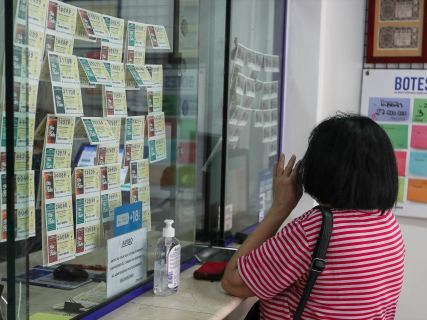
Euromillions today: result of Friday, September 18, numbers and stars

Check the result of Euromillions today, Friday, September 18, 2026, with the five numbers, the two stars, and El Millón.

1 minute

euromillones

euromillones

Add DEMÓCRATA to Google

Ask FREN

Published

Last updated

1 minute

Most read

The Euromillions of today, Friday, September 18, puts into play a jackpot of 29 million euros in its new draw. The winning combination will consist of five numbers and two stars.

The draw takes place tonight and will also reveal the code of El Millón corresponding to Spain.

Result of Euromillions today: pending the draw.

Result of Euromillions of Friday, September 18

Numbers: pending the draw.

Stars: pending the draw.

El Millón: pending the draw.

Euromillions Jackpot

The first category prize starts this Friday at 29 million euros. The amount will be distributed among the winners who get the five numbers and the two stars of the combination.

What time is Euromillions

The Euromillions draw takes place this Friday and its results will be available once the extraction is finished. In Spain, in addition to the European combination, the code of El Millón will be known.

More key points, information and questions with FREN

AI-GENERATED CONTENT

What legal requirements must operators meet to organize lottery draws like Euromillions in Spain?

In Spain, state-level lottery draws like Euromillions are heavily regulated and, in practice, reserved for operators designated by law. A private operator cannot "set up their own Euromillions" as a state lottery open to the general public unless they strictly fit within the licenses and reservations provided by gaming regulations.

The basic framework is found in:

  • Law 13/2011, on gaming regulation (text in BOE), which establishes the general regime for state-level games of chance (including lotteries).
  • Royal Decree 1614/2011, which develops Law 13/2011 regarding licenses, authorizations, and registries (BOE).
  • Specific regulations for SELAE and ONCE (Statute of ONCE, resolutions, and regulations of their products), issued “in accordance” with Law 13/2011.
1. Reservation of state-level lottery activity

Law 13/2011 defines lotteries as games where the prize depends on a draw over combinations of numbers or signs and expressly establishes that:

  • State-level lotteries are reserved for operators designated by the Law itself.
  • The exclusive reservation is maintained for the State Society of Lotteries and State Bets (SELAE) and ONCE as operators of state lotteries, subject to strict public control and specific regulations.

This means that an “official” Euromillions can only be marketed by SELAE (and, where applicable, ONCE in its own modalities), under authorization from the competent Ministry and the corresponding international agreements.

2. Enabling title: licenses and authorizations

Apart from reserved lotteries, any state-level gaming activity regulated by Law 13/2011 requires a prior enabling title:

  • General licenses (for major types of games: bets, contests, other games).
  • Specific licenses for each particular modality within the general license.
  • Authorizations for occasional games or activities subject to specific reservation.

Royal Decree 1614/2011 develops the procedure:

  • Only public limited companies whose exclusive corporate purpose is the organization, marketing, and operation of games can apply for general licenses under a competitive bidding regime.
  • They must apply for the enabling title before the state gaming regulatory authority, with registration in the General Registry of Gaming Licenses.
3. Operator solvency and guarantees requirements

Law 13/2011 and Royal Decree 1614/2011 establish demanding entry requirements:

  • Technical, economic, and financial solvency, accredited by:
    • Statements from financial entities.
    • Annual accounts filed in the commercial or official registry.
    • Overall business volume of recent years.
    • Experience and specific technical and human resources to operate games of chance.
  • Minimum paid-up share capital, in the amount set by each license call.
  • Establishment of financial guarantees (bond, insurance, etc.) linked to each license, with amounts detailed in Annex I of Royal Decree 1614/2011, to cover obligations towards participants and the Public Treasury.
4. Technical requirements and participant protection

Law 13/2011, in its sections on “General provisions,” “Enabling titles,” and “Activity control,” imposes:

  • Minimum technical requirements for gaming systems, which must:
    • Guarantee the integrity of the game and the randomness of draws.
    • Prevent access by minors, incapacitated persons, or those registered in the General Registry of Access Prohibitions to Gaming.
    • Allow traceability of bets, deposits, prizes, and claims.
  • Consumer protection:
    • Clear information about rules, prizes, probabilities, and claims.
    • Limits on deposits and management of gaming accounts.
    • Compliance with subjective prohibitions (minors, self-excluded persons, those linked to the operator, referees, athletes in bets, etc.).
  • Prevention of fraud and money laundering, coordinated with Law 10/2010 and the Executive Service of the Commission for the Prevention of Money Laundering.
5. Advertising, prohibitions, and sanctioning regime

Law 13/2011 establishes:

  • Rules on gaming advertising in connection with the General Advertising Law and protection of minors.
  • Objective prohibitions (games that offend dignity, encourage crime, etc.) and subjective prohibitions (who cannot play).
  • A very severe regime of infractions and sanctions, including heavy fines, suspension of activity, and license termination in case of serious breaches.

In summary, Euromillions-type draws are reserved as state lotteries to SELAE (and ONCE in its scope), and any operator intending to organize similar games in Spain must comply with Law 13/2011, obtain general and specific licenses under Royal Decree 1614/2011, demonstrate high solvency, meet strict technical and player protection requirements, and submit to the state control and sanctioning regime.

What are the competencies of the lottery regulatory body in Spain?

In Spain, the regulation of lotteries and other state-level games is mainly structured through the General Directorate for the Regulation of Gambling (DGOJ), as the regulatory authority, and the State Society of Lotteries and State Bets (SELAE), as the public operator of state lotteries. Although the term “lottery regulatory body” is often used in the singular, in reality, functions are divided between the regulator (DGOJ) and the operator (SELAE).

1. Competencies of the General Directorate for the Regulation of Gambling (DGOJ)

The DGOJ, integrated within the Ministry of Social Rights, Consumer Affairs, and Agenda 2030, is the state-level gambling regulatory authority. According to Article 8 of Royal Decree 209/2024, of February 27, and Law 13/2011 on gaming regulation, it exercises, among others, the following competencies (collected in resolutions such as those of July 7, 2025, BOE-A-2025-14687 and August 6, 2025, BOE-A-2025-16820):

  • Regulation of state-level gambling activity, including drafting and proposing rules that develop Law 13/2011, as well as technical criteria and requirements for different games (lotteries, bets, online games, etc.).
  • Authorization of gambling activities subject to state license: grants general and specific licenses to private operators and controls conditions for operating different game modalities.
  • Supervision, coordination, and control of the state gambling market, verifying that operators—including SELAE—comply with legal, technical, and user protection requirements.
  • Sanctioning power against violations of gaming regulations, both for private and public operators. The DGOJ’s own database records sanctions against operators, including SELAE, when obligations such as controlling access of self-excluded players are breached.
  • Ensuring integrity, security, reliability, and transparency of gaming operations and compliance with current regulations, as recalled by Law 13/2011 and cited in DGOJ resolutions.
  • Since the 2021 reform of Law 13/2011, a specific function of combating fraud in gambling and sports betting, including collaboration with competent authorities to prevent and prosecute fraud and competition manipulation (for example, through the “Global Betting Market Investigation Service,” BOE-A-2024-13314, link).
  • Controlling that operators apply consumer protection and responsible gaming measures, especially online (see, for example, actions against platforms like Polymarket, described in journalistic analyses by Demócrata).

In summary, the DGOJ is the entity that defines the rules of state gambling, authorizes who can operate, and ensures everyone complies with the law, including regarding state-level lotteries.

2. Competencies of SELAE as operator of state lotteries

The State Society of Lotteries and State Bets (SELAE) is a public company attached to the Ministry of Finance. Law 13/2011 reserves state-level lotteries to operators designated by the State; its first additional provision designates, among them, ONCE and SELAE, as reflected in various resolutions on lottery products (BOE-A-2025-9805 and similar ones).

According to official information and the summary collected by the newspaper Demócrata, SELAE essentially has the following competencies:

  • Manage, operate, and market state-owned lotteries: National Lottery (including Christmas Lottery and Niño Lottery), La Primitiva, Bonoloto, El Gordo de la Primitiva, Euromillions, La Quiniela, and other games in its catalog.
  • Design and manage draws: issuance of tickets and shares, holding draws, determining prize categories and distribution systems, and publishing official results.
  • Organize the sales network: set operating conditions for lottery offices and points of sale, as well as commercial relations with them (commissions, distribution obligations, in-person and online sales procedures, etc.), as described by Demócrata in its analysis of the conflict between SELAE and lottery retailers.
  • Manage prize payments, applying established procedures and controls (see, for example, references to prize collection and control protocols in judicial reports on winning tickets in A Coruña).
  • Channel revenues to the State: profits from state lotteries are integrated into public accounts; SELAE acts as an instrument for State financing and, in some cases, supports social purposes through agreements (for example, with the Spanish Association Against Cancer, noted by Demócrata).

Therefore, SELAE is not the regulator but the public operator subject to regulation and supervision by the DGOJ. Its “competencies” refer to the business and operational management of lotteries reserved to the State by law.

3. Summary: who regulates and who operates

In the field of state-owned lotteries:

  • The DGOJ exercises regulation, authorization, supervision, and sanctioning of state gambling, including the activity of SELAE and other operators.
  • SELAE is the entity that organizes and materially operates state lotteries, manages draws and the sales network, and channels economic results to the State and, where applicable, to social projects.

When referring to the “lottery regulatory body” in Spain, the strictly regulatory reference is the General Directorate for the Regulation of Gambling, without prejudice to SELAE, as a public operator, having a central role in managing state lotteries under that regulatory framework.

How has the revenue and prize distribution of Euromillions evolved in recent years?

Available information indicates that Euromillions revenue in Spain has followed a path of moderate growth in recent years within the overall portfolio of games of the State Society of Lotteries and State Bets (SELAE), and that the percentage of revenue allocated to prizes remains stable, set by the game’s own rules: approximately half of the revenue is distributed in the European common Euromillions fund and around 60% in the local part associated with the complementary draw of El Millón. However, recent public data detailed by game are partial, so the view is more qualitative than exhaustively statistical.

Recent evolution of revenue

There is no complete series broken down by years solely for Euromillions in the sources consulted, but two clear clues about its trend within SELAE’s catalog are offered:

  • An analysis by Demócrata with data from SELAE’s 2025 accounts notes that Euromillions was “one of the big winners of the year”, with a sales increase of 5.62% compared to the previous year. The growth is linked to longer jackpot cycles and higher average prizes, which tend to boost participation.
  • The same text recalls that other games show flatter behavior or even slight declines, highlighting that Euromillions is among the products that perform best within the state offering after the pandemic.

At an aggregate level, SELAE’s 2025 accounts — cited in that article — record total sales of 10.586 billion euros across all its games, a record or near-historical high. Although it is not detailed how much corresponds exactly to Euromillions, it is noted that the Christmas Lottery usually concentrates around a third of that turnover, and Euromillions is among the products contributing most growth to the rest of the business.

The regulatory context also confirms the economic relevance of prizes managed by SELAE. The Resolution of May 8, 2025 of the Joint Commission for Relations with the Court of Auditors, on the audit report of SELAE’s prize control system (2022 fiscal year), mentions, for example, 3.539 billion euros in unclaimed prizes in 2022 and demands improvements in traceability and control of these amounts. Although the document does not break down what part corresponds to Euromillions, it illustrates the magnitude of resources moved by the state society’s draws as a whole.

What part of revenue returns as prizes

The prize distribution of Euromillions is defined by its rules and has been stable in recent years. Based on information collected by Demócrata about the game rules:

  • Euromillions allocates approximately 50% of the revenue from the main game to prizes in its community part (the common jackpot shared by participating countries).
  • In Spain, there is also the associated game El Millón, automatically linked to each Euromillions bet validated in the country. For this local component, the percentage allocated to prizes is higher, around 60% of El Millón’s revenue.

Looking at SELAE as a whole, the 2025 accounts cited in the same analysis indicate that, of the 10.586 billion euros sold, 6.775 billion corresponded to prizes and prize provisions. That is, just over 60% of all sales is accounted for as returns to players in the form of prizes or prize funds. Euromillions is slightly below that percentage in its European component (50%), but partially compensates with the El Millón portion, which approaches the overall average.

Conclusions on the evolution

With the available information, several cautious conclusions can be drawn:

  • Moderate and sustained growth: in recent years for which commented data exist (up to 2025), Euromillions increases its sales in Spain — at least 5.62% in 2025 — suggesting an upward trend after the pandemic years.
  • Stable prize model: the percentages of revenue allocated to prizes are set by regulation and no relevant recent changes are observed: approximately half of the amount played in the European draw is distributed as prizes, and 60% in the national part of El Millón.
  • Large volume of prizes managed: reports from the Court of Auditors on SELAE show that, in 2022 alone, unclaimed prizes amounted to billions of euros, pushing for strengthened controls over their management and destination.
  • More detailed official information: for a complete year-by-year numerical series, SELAE publishes reports and annual accounts on its corporate website, where revenue and prize distribution for each game can be consulted in a disaggregated manner.

In sum, Euromillions consolidates as one of the best-performing gaming products within SELAE, with a relatively generous but defined prize distribution scheme, and in recent years subject to increasing institutional scrutiny over the management of undistributed amounts.

Play

Test your knowledge with FREN!

How much do you know about this topic? Answer the following 3 questions.

How much is the Euromillions jackpot in the draw on Friday, September 18?

Question 1 of 3

How many numbers and stars make up the winning Euromillions combination?

Question 2 of 3

What additional code is drawn in Spain along with Euromillions?

Question 3 of 3

Hola, soy Fren. ¿Cómo te ayudo?