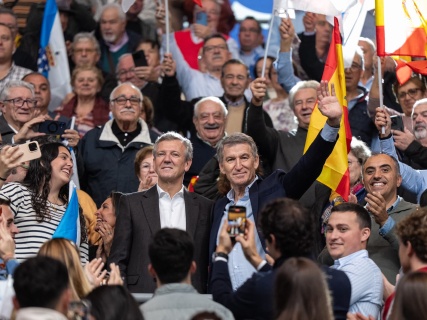
Survey of the general elections in Galicia: the PP rises to 14 seats and Vox stays out, according to Sondaxe

The PP would get six out of every ten Galician deputies in the elections on 29N. With eight days until the polls, Sondaxe’s tracking for La Voz de Galicia improves the forecast for the Conservatives by one seat and leaves Vox without a seat in all four provinces.

feijoo rueda santiago2

feijoo rueda santiago2

Add DEMÓCRATA to Google

Ask FREN

Published

Last updated

2 minutes

Most read

Elecciones 29N · Encuestas

La media de las encuestas

Media a 21 de noviembre de 2026 · 19 institutos

  • PP30,9 %
  • PSOE27,9 %
  • Vox19,0 %
  • Frente Amplio6,3 %
  • ERC2,6 %
01020304050ene 2024jul 2024ene 2025jul 2025ene 2026jul 2026

Media del último estudio de cada instituto en 30 días y su evolución semanal desde el 23J. Partidos con al menos un 2 %.

Todas las encuestas

Elecciones generales del 29 de noviembre · Demócrata

The distance between the first two forces would reach 13.6 points. The PP of Alberto Núñez Feijóo would obtain 41.8% of the votes, compared with 28.2% for the PSOE. The advantage would be greater in the Congress, where the conservatives would seat two deputies for each one of the socialists. The BNG would occupy third place in Galicia with 15.2% of the vote and would complete the distribution with two representatives.

Sondaxe poll for the general elections in Galicia. Estimate published November 21, 2026
Party Estimated vote Seats in Congress for Galicia
PP 41.8 % 14
PSOE 28.2 % 7
BNG 15.2 % 2
Vox 7.8 % 0

The table lists the four candidacies with available percentage. Galicia elects 23 deputies.

The PP would take six out of every ten Galician seats with 41.8% of the vote

The Sondaxe projection allows measuring how much the PP would benefit from its advantage at the polls. With a little more than four out of every ten votes, it would obtain 60.9% of the Galician seats. Its 14 representatives would exceed by five the nine that PSOE and BNG would add. For its part, the socialists would gather 28.2% of the votes and 30.4% of the deputies.

Vox would end up on the other end. Although close to eight out of every one hundred Galician voters would choose its ballot paper, the Santiago Abascal party would not achieve representation in A Coruña, Lugo, Ourense, or Pontevedra. The 23 deputies are allocated in four provincial allocations. That is why the 7.8% of the vote across Galicia may leave a candidacy without an act if its support is insufficient to win the last seat in each province.

What would change compared with 23J in Galicia

Deputies elected by Galicia on 23J of 2023 and Sondaxe projection for 29N of 2026
Candidacy Seats 23J Estimated seats 29N Variation
PP 13 14 +1
PSOE 7 7 0
BNG 1 2 +1
Vox 0 0 0
Other candidacies 2 0 −2
Total Galicia 23 23 0

The two seats from 2023 grouped in «Other candidacies» corresponded to Sumar.

In the general elections of July 2023, the PP won 13 deputies in Galicia, the PSOE obtained seven, Sumar won two, and the BNG, one. The survey from November 21 draws two advances of one seat compared with those polls: the PP would go from 13 to 14 and the BNG, from one to two. The PSOE would keep its seven seats. [

The difference between the two comparisons matters especially for Vox. The seat it lost appeared in campaign projections. In the polls on 23J, it also failed to obtain Galician representation. For the BNG, instead, repeating the two deputies that its tracking had already attributed to it would mean going into election night with the expectation of doubling its representation from 2023.

United Left would also be left out of the distribution. A Coruña and Pontevedra are two of the constituencies on which the candidacy has focused its campaign. This very week, its spokesperson, Pablo Bustinduy, asked for the vote in A Coruña with the argument that its list was contesting the last deputy for Vox. The Galician estimate published this Saturday would leave both parties without a seat and concentrate all representation of the community in three candidacies: PP, PSOE and BNG.

More key points, information and questions with FREN

AI-GENERATED CONTENT

What are the next steps in the parliamentary process after a general election in Spain?

After a general election, the main steps are to constitute the new Chambers, organize their bodies, and hold the investiture of the President of the Government. It is important to distinguish this institutional start from the legislative process: they are not a single procedure, nor do all their steps have to wait until a new Government exists.

1. Constitution of the Congress

The Congress holds its constitutive session on the day and time established in the royal decree calling the election. According to articles 1 to 4 of the Congress Regulations, it is initially presided over by the oldest elected deputy, assisted by the two youngest: this is called the Age Table.

The call, the list of elected members, and the electoral appeals submitted are read. To fully acquire their status, deputies must present their credentials, complete the declaration of activities, and swear or promise to uphold the Constitution.

2. Election of the Board

In that same session, the Board of the Congress is elected, the body that organizes the work of the Chamber. It is composed of the Presidency, four Vice Presidencies, and four Secretariats.

  • The Presidency requires an absolute majority in the first vote. If no one achieves it, the two most voted candidacies compete and the one with more votes wins.
  • The four Vice Presidencies are elected jointly: each deputy writes a name and the four most voted persons are elected.
  • The four Secretariats are elected using the same system.

Afterwards, the oath or promise is taken and the Congress is declared constituted. Its Presidency communicates this to the King, the Senate, and the Government. The solemn opening of the legislature is a separate act, scheduled within the following fifteen days.

3. Parliamentary groups and internal organization

Parliamentary groups, which organize the deputies' actions, must be constituted within five days following the constitutive session. As a general rule, they need fifteen deputies; they can also be formed with five seats if they meet the electoral percentages of article 23. Those who do not join another group go to the Mixed Group.

The spokespersons form the Board of Spokespersons. The Board schedules activity after hearing them, and the Presidency agrees with them on the agenda of the Plenary. The Regulations foresee constituting the permanent commissions within ten days following the constitutive session. Regulatory deadlines by days are counted, unless otherwise provided, in working days.

4. Candidate proposal and investiture

The King's consultations and the candidate proposal belong to the framework of article 99 of the Constitution. Upon receiving the proposal, the Presidency of the Congress calls the investiture Plenary: the debate in which it is decided whether to grant confidence to the candidate.

The candidate presents their program without time limit and then the groups intervene. The vote is public by roll call: each deputy expresses their individual vote.

  • First vote: an absolute majority of the members of Congress is needed.
  • Second vote: if the first fails, it is held forty-eight hours later and a simple majority suffices, that is, more favorable than opposing votes.

If confidence is obtained, the Presidency communicates it to the King for appointment. If not, new candidacies may be processed. The decisive deadline is two months from the first investiture vote, not from the elections: if exhausted without success, the Cortes are dissolved and elections are called.

5. What happens to pending laws?

The general rule is that pending matters expire with the dissolution, with exceptions. Therefore, they are not automatically resumed where they left off. The Permanent Deputation reports to the new Congress on decisions made during the interval.

What are Alberto Núñez Feijóo's powers and functions as president of the PP?

Alberto Núñez Feijóo, president of the Popular Party since April 2, 2022, exercises the political representation and leadership of the party. His powers include coordinating the organization, presiding over its main national bodies, and proposing appointments. It is important to distinguish these internal attributions from his parliamentary responsibilities: presiding over the PP does not, by itself, grant him powers of the Government of Spain.

Political representation and leadership

The framework of his powers is article 44 of the PP Statutes approved at the XXI National Congress of 2025. The consulted information identifies the following central functions:

  • Politically and legally represent the PP before institutions, other parties, organizations, and third parties. He thus acts as the party's main representative in its external relations.
  • Coordinate the political action of its bodies and structures. This includes harmonizing the national orientation with territorial organizations and parliamentary groups.
  • Execute the agreements of the National Congress and other competent bodies, adopting necessary measures to fulfill and develop them.
  • Authorize declarations made on behalf of the PP or that may politically commit the party, an attribution linked to the coherence of its official communication.
Presidency of bodies and appointments

Feijóo presides over the National Board of Directors and the National Executive Committee. In both, he has a casting vote when there is a tie: his vote resolves that equality in decision-making.

He also proposes to the Executive Committee the appointments of the General Secretariat, General Coordination, vice-secretariats, coordinators, secretaries, and the General Directorate of Finance and Organization. The distinction is relevant: proposing an appointment does not mean approving it unilaterally; the body to which the Statutes assign the decision intervenes.

Likewise, he can propose the presidency and members of the Electoral, Rights and Guarantees, and Membership Committees. His capacity to shape the leadership team is exercised through the corresponding internal procedures.

Parliamentary groups and internal organization

The Statutes assign him the presidency of the PP groups in the Congress, the Senate, and the European Parliament, according to their respective regulations. This function connects party leadership with its parliamentary action but must be distinguished from the daily work of spokespersons and the individual faculties of its parliamentarians.

The consulted information also includes powers to initiate disciplinary proceedings, provisionally suspend certain internal responsibilities, and delegate functions, always within statutory limits. Initiating a procedure should not be confused with resolving it or imposing any sanction without intervention of competent bodies.

Practical scope and limits

In practice, the presidency gathers strategic orientation, public representation, territorial coordination, and electoral leadership. Feijóo intervenes in candidate configuration and relations with other forces, but these tasks do not eliminate the powers of collegiate bodies.

A concrete example is exceptions to the internal incompatibility regime: according to article 12 cited by Demócrata, their approval corresponds to the National Executive Committee, not exclusively to the president. Also, the 2025 reorganization placed international powers under the presidency, according to this information from Demócrata.

In short, he is the main political authority of the PP, but does not have unlimited power: he must act according to the Statutes, regulations, and internal agreements. His leadership of the opposition is a distinct political dimension and does not make him holder of executive State powers.

What legal requirements must parties meet to obtain representation in the Congress for a province?

To obtain representation in the Congress for a province, a party must present a legally valid candidacy, reach at least 3% of the valid votes in that province, and win a seat through the electoral distribution. The key is that reaching 3% does not guarantee a deputy: it allows participation in the distribution, but the result also depends on the votes of other candidacies and how many seats are chosen.

1. Present a valid candidacy

The main rule is the Organic Law of the General Electoral Regime, known as LOREG. Its articles 44 to 47 and 169 regulate the presentation and proclamation of candidacies. Among the requirements are:

  • The party or federation must be registered in the corresponding registry. If running in coalition, it must notify its constitution to the competent Electoral Board within ten days following the call.
  • The list must be submitted to the Provincial Electoral Board between the fifteenth and twentieth days after the call.
  • It must include as many candidates as deputies to be elected in the province, with their acceptance and documents proving their eligibility. No person may appear on multiple candidacies or run in more than one constituency.
  • The candidacy must respect gender parity: women and men must appear alternately, applying the rule to the whole of titular and substitute candidates.
  • It must meet the support signature requirements applicable according to article 169.3.

Each formation can only present one list per constituency for the same election. The Board communicates detected irregularities and grants 48 hours to correct them. Candidacies that fail to meet legal requirements cannot be proclaimed.

2. Reach the 3% provincial threshold

Article 163.1.a establishes that candidacies that do not obtain "at least 3 percent of the valid votes cast in the constituency" are excluded from the distribution. Therefore, the percentage is calculated in the province, not in all of Spain. A national percentage is not required to obtain that provincial seat.

Valid votes include those obtained by candidacies and blank votes. Null votes do not count for calculating that threshold; abstentions neither, because they are not cast votes. Blank votes count to determine the minimum required but do not receive seats.

3. Obtain a seat with the D’Hondt system

Once the threshold is passed, the D’Hondt system is applied, the formula of article 163 to distribute seats:

  • The votes of each candidacy admitted to the distribution are divided by 1, 2, 3, and so on, up to the number of deputies to be elected.
  • Seats are assigned to the highest results of those divisions, ordered from highest to lowest.
  • If there is a tie between quotients, the candidacy with more total votes is favored. If they also coincide, the first tie is resolved by lottery and the following alternately.

Therefore, there is no fixed number of votes that guarantees a deputy. The effective minimum can exceed 3%. In fact, the example included in the law itself shows candidacies above that percentage that do not obtain representation.

4. Allocation and territorial exception

Obtained seats are assigned to candidates in the order of the list. Then, the Electoral Board proclaims the elected and issues their credentials. To fully acquire the position, they must swear or promise to uphold the Constitution and meet other applicable requirements.

Ceuta and Melilla have a different rule: in each, the candidate with the most votes is elected, according to article 163.2.

Play

Test your knowledge with FREN!

How much do you know about this topic? Answer the following 3 questions.

What percentage of Galician votes would the PP obtain according to the Sondaxe survey for the 2026 general elections?

Question 1 of 3

Which party would double its seats in Galicia compared to the 2023 general elections according to the Sondaxe projection?

Question 2 of 3

What would be Vox's fate in Galicia according to the Sondaxe survey published on November 21, 2026?

Question 3 of 3