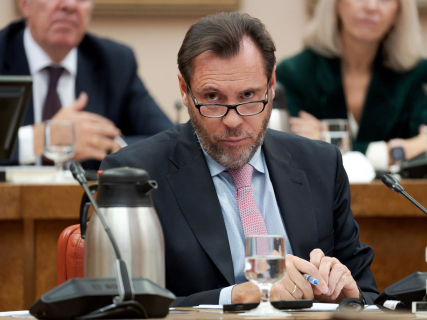
Survey on Urda: two out of every three Spaniards are calling for more resignations after the train accident and 42% of PSOE voters as well, according to GAD3

82% consider adequate the performance of Óscar Puente in Transportes, according to the GAD3 poll for ABC. Support for his resignation reaches 73% of the Socialist electorate, although the majority of these voters rejects new government departures.

fotonoticia 20261104142719 1920

fotonoticia 20261104142719 1920

Add DEMÓCRATA to Google

Ask FREN

Published

Last updated

3 minutes

Most read

Elecciones 29N · Encuestas

La media de las encuestas

Media a 7 de noviembre de 2026 · 11 institutos

  • PP31,0 %
  • PSOE26,2 %
  • Vox19,5 %
  • Frente Amplio6,6 %
  • ERC2,4 %
  • SALF2,2 %
  • Podemos2,1 %
01020304050ene 2024jul 2024ene 2025jul 2025ene 2026jul 2026

Media del último estudio de cada instituto en 30 días y su evolución semanal desde el 23J. Partidos con al menos un 2 %.

Todas las encuestas

Elecciones generales del 29 de noviembre · Demócrata

Óscar Puente’s resignation is not enough to close the demand for political accountability following the Urda accident. Two out of every three Spaniards believe that there should be more resignations in the Government, according to the GAD3 survey for ABC, conducted from November 3 to 5 through 1,502 telephone interviews.

The poll distinguishes two issues: the assessment of the departure of the Transport minister and the request for new resignations within the Executive. The first receives broadly majority support among voters of all the groups analyzed. The second opens a gap between PP and Vox voters and PSOE and Sumar voters.

In addition, only 31% of those surveyed consider the explanations provided about what happened to be sufficient. This percentage measures satisfaction with the information received, an issue distinct from the demand for resignations.

82% back Óscar Puente’s resignation

Eight out of ten respondents -82%- consider Puente’s departure from the Ministry of Transport to be appropriate. Support reaches its highest point among those who voted for Vox in the general election of July 23, 2023, at 97%, followed by PP voters, at 90%.

The assessment is also majority among voters of the parties that make up the Government. 75% of those who voted for Sumar and 73% of those who voted for PSOE believe that Puente should have left the post.

GAD3 FOR ABC · NOVEMBER 2026 Who backs Puente’s resignation? Percentage that considers his departure from Transport to be appropriate
Voting record Support
Total surveyed 82%
Vox 97%
PP 90%
Sumar 75%
PSOE 73%
Nationalists 71%

Source: GAD3 for ABC. Fieldwork: November 3–5, 2026. Total sample: 1,502 interviews. Groups according to voting record from July 23, 2023. «Nationalists» includes ERC, Junts, EH Bildu, PNV, BNG, Coalición Canaria and CUP.

Among socialists, 23% argue that it should have continued. Therefore, support for his departure far exceeds support for his staying within his own electorate.

In the group that the publication groups under the category of nationalists, 71% also backs his resignation. This category includes voters of ERC, Junts, EH Bildu, PNV, BNG, Coalición Canaria and CUP.

42% of PSOE voters call for more Government resignations

Consensus around Puente breaks when asked about new resignations. They are demanded by 94% of Vox voters and 92% of PP voters.

GAD3 FOR ABC · NOVEMBER 2026 Who is calling for more resignations after Urda? New departures from the Government, in addition to Óscar Puente’s
Vote recall Calls for more resignations
Total respondents Two out of every three
Vox 94%
PP 92%
PSOE 42%
Sumar One out of every three
Nationalists 31%

Source: GAD3 for ABC. Fieldwork: 3–5 November 2026. Vote recall from the 23J 2023 elections. The expressions «two out of every three» and «one out of every three» from the published information are maintained, which does not provide those exact percentages. This is not a vote estimate.

Among PSOE voters, 42% call for more departures, compared with 56% who reject them. The figure reflects a relevant split, although the majority position continues to be opposed to expanding resignations.

In Sumar, one out of every three voters calls for new resignations and 64% oppose them. Among nationalists, the percentages are 31% and 64%, respectively.

The contrast makes it possible to distinguish two attitudes: considering Puente’s resignation necessary does not necessarily imply calling for the departure of other members of the Executive.

A survey on political responsibilities, not on voting intention

The results describe citizens’ opinions after Urda. They do not, by themselves, allow us to conclude that those who call for more resignations have stopped supporting the Government electorally or that they will change parties.

The breakdowns use vote recall from the 2023 elections. They also do not identify, in the published information, which other members of the Executive should resign according to respondents.

Assessing political responsibilities must also be distinguished from the technical or judicial determination of the causes of the accident.

See here the technical sheet and the entire survey in ABC

More key points, information and questions with FREN

AI-GENERATED CONTENT

What is the parliamentary process for demanding political accountability or promoting the resignation of Government members in Spain?

In the Spanish parliamentary system, there is no "single procedure" to legally force a Government member to resign, but there are several political instruments that allow Parliament to demand accountability and generate intense pressure for resignation or dismissal. Some affect the entire Government (or the president), others specific ministers.

1. Ordinary control instruments

The first level is the daily political control exercised by Parliament over the Government, especially the Congress of Deputies:

  • Oral and written questions: deputies and senators can ask questions to the Government, in Plenary or in committee. The objective is to request explanations about facts, decisions, or conduct, leaving a public record of possible political responsibilities.
  • Interpellations: these are broader debates than a simple question. A parliamentary group interpellates the Government about its actions on a matter and, after the minister's response, may propose a motion (non-legislative) urging policy changes or, indirectly, the assumption of responsibilities.
  • Appearances: parliamentary committees (and sometimes the Plenary) can demand the presence of Government members to explain their management. A very critical appearance, followed by a report or a motion of censure, can politically weaken a minister significantly.

These mechanisms do not by themselves produce dismissal, but build the political case to demand resignations by documenting management failures, contradictions, or lack of transparency.

2. Investigation committees

When it comes to serious matters (corruption scandals, crisis management, use of public funds, etc.), the Congress or the Senate can create investigation committees:

  • They are approved by agreement of the chamber, usually at the initiative of a parliamentary group.
  • The committee can summon Government members, senior officials, and others involved to testify, and request documentation.
  • At the end, it approves a report with political conclusions; this report may include an explicit request for resignation or dismissal of those responsible.

The report has no direct legal effects (it does not dismiss anyone), but its political and media force can make a person's continuation in office untenable, especially if the conclusions have broad majority support.

3. Motions of censure

In recent years, motions of censure against specific ministers have become widespread:

  • They are parliamentary initiatives through which the chamber declares disapproval of a Government member's actions and often urges their resignation or dismissal.
  • They can be approved in the Congress or the Senate, in Plenary or in committee, depending on the case.
  • They do not legally oblige the president to dismiss the minister, but represent a very severe political wear: the chamber supporting the Government has expressly declared it no longer trusts that member.

In practice, a repeated parliamentary censure or one supported by the majority backing the Government is usually a strong trigger for resignation or replacement in a cabinet reshuffle.

4. Motion of no confidence against the Prime Minister

If political responsibility is projected onto the entire Government, the key instrument is the motion of no confidence against the president:

  • It can only be presented by the Congress and must be constructive: including an alternative candidate for the Presidency of the Government.
  • It requires the support of an absolute majority of deputies to succeed.
  • If approved, the president is dismissed and the proposed candidate is appointed president, free to form a new Government.

It is not a mechanism to force the resignation of an isolated minister, but to change the president and, with that, the entire Executive. However, the mere announcement or processing of a motion of no confidence can increase pressure for partial dismissals or corrections.

5. Vote of confidence and voluntary resignation

The Prime Minister himself can submit to a vote of confidence, asking the Congress to ratify its support. If lost, he is obliged to resign and the king must open a new investiture round. Although this instrument is activated by the Government, parliamentarily it functions as a global political trial of its management.

In all cases, it is worth remembering two key ideas:

  • Parliament does not directly dismiss ministers or the president (except through a motion of no confidence); what it does is express political trust or distrust.
  • Resignations and dismissals are formal decisions of the Government member themselves (resignation) or the president (dismissal), but closely conditioned by the pressure accumulated through these control procedures.

Thus, the "process" to demand political accountability combines the strategically intensive use of parliamentary control tools with Parliament's capacity to withdraw or deny its trust to the Government when the situation requires it.

Can you explain in more detail how a motion of no confidence works in Spain and what formal requirements it has? What are the differences between an investigation committee and a simple appearance of a minister in Congress? How does the political responsibility of a minister differ from their possible criminal or legal responsibility?

What are the powers and functions of the Minister of Transport according to Spanish legislation?

The Minister of Transport exercises the political and administrative leadership of the department: proposes and executes the Government's policy on infrastructure and transport services under state competence. Their scope includes sustainable mobility and other matters, such as postal regulatory organization and state geographic services. It is important to distinguish their leadership functions from the specific powers that regulations assign to State Secretariats, general directorates, and public entities.

1. Legal framework and department leadership

The main organizational reference is Royal Decree 253/2024, of March 12. Its article 1 assigns to the Ministry the proposal and execution of policies on infrastructure, regulation of transport services, and investment planning, aiming to guarantee safe and sustainable mobility based on social justice criteria.

Under the minister's leadership act the State Secretariat for Transport and Sustainable Mobility and the Undersecretariat. The holder directs the department and participates in the Council of Ministers' decisions; they do not personally carry out all technical management nor concentrate all administrative decisions of the sector.

2. Infrastructure and transport under state competence

The minister's political responsibility includes these blocks, developed through competent bodies:

  • Roads: planning, construction, maintenance, and operation of the State Road Network; management of road assets and supervision of concessions. Includes infrastructure safety, without replacing Interior's traffic powers.
  • Railway: planning and evaluation of the General Interest Railway Network, investment programming, service regulation, and drafting of regulatory proposals. These functions must respect the powers of railway administrators and the National Commission of Markets and Competition.
  • Road transport: regulation of the state market, regulation, authorizations, and coordination with autonomous communities regarding delegated powers.
  • Air and maritime transport: leadership of departmental policy on these modes and their state infrastructures, including port planning and investments in ports of general interest.
3. Planning, investments, and public entities

The minister guides the department's priorities, while the State Secretariat formulates and monitors strategic planning, programs investments, and coordinates their execution. Regulations prioritize safety, maintenance, daily mobility, technification, and connection between different transport modes.

Through that State Secretariat, strategic direction, evaluation, and control of results of State Ports, port authorities, ADIF, Adif-High Speed, Renfe-Operator, and Enaire are articulated. This relationship does not mean the minister directly manages each entity or service.

4. Sustainable mobility and cooperation

The department promotes decarbonization, active mobility — such as walking or cycling — and integration of transport modes. It also promotes aid and economic instruments and cooperates with territorial administrations in sustainable urban mobility plans. International relations, especially with the European Union, are coordinated with Foreign Affairs.

5. Crises, victims, and other matters

Royal Decree 690/2025, of July 29, strengthened supervision and coordination of emergencies, crisis prevention, and attention to victims and families. These tasks are channeled through the State Secretariat, without displacing direct management of sectoral bodies nor the functions of the independent accident investigation authority.

Finally, the Ministry also assumes postal regulatory organization and leadership of state services of astronomy, geodesy, geophysics, and cartography. All these powers are exercised within the state scope and respecting the attributions of other ministries and administrations.

What legal requirements must be met for a Government minister to resign or be dismissed?

In Spain, a minister can resign without alleging a specific legal cause, and the Prime Minister can promote their dismissal without needing to prove an infraction. In both cases, the departure must be formalized by Royal Decree of the King, at the proposal and with the countersignature of the Prime Minister, and published in the Official State Gazette. The public announcement of a resignation does not replace this formalization.

1. The constitutional rule

Article 100 of the Constitution states: "The other members of the Government shall be appointed and removed by the King, at the proposal of its President." This provision, developed by article 12 of Law 50/1997, of the Government, distributes functions: the president makes the political decision and proposes the removal; the King formalizes it.

Therefore, the King cannot decide on his own initiative to dismiss a minister. Nor does the Council of Ministers collectively accept the resignation or authorize the presidential proposal.

2. Requirements to submit resignation

Resignation is the voluntary expression of the minister's desire to leave office. The Constitution does not require a solemn formula, a public appearance, or a letter with predetermined content. What matters is to communicate that will to the Prime Minister so that the separation is formalized.

  • There is no fixed cause: personal, political, health reasons, or disagreements with Government action may be invoked.
  • No investigation or conviction is needed: resigning does not require having committed an infraction nor acknowledging legal responsibility.
  • No parliamentary authorization is required: Congress does not vote on the acceptance of individual resignation.

The ordinary sequence is to communicate the resignation to the president, who politically accepts it and proposes dismissal to the King, and the corresponding royal decree is issued and published. Until that formalization, a statement to the media or a public letter alone is not enough to extinguish the office.

3. Requirements for dismissal by presidential decision

The president can propose the removal of a minister due to loss of confidence, Executive reorganization, or political disagreements. Consent of the minister is not needed nor a prior vote of the Cortes.

It is not required to process a sanctioning file, hold a prior hearing, or prove illicit conduct. It is a political confidence decision, not an administrative sanction. Therefore, the royal decree does not need to extensively explain the reasons for the replacement, although the decision must respect the legal system.

4. Form, countersignature, and effects

The royal decree identifies the dismissed person and the office, records the presidential proposal, and bears the King's signature and the countersignature of the president. According to article 64 of the Constitution, the countersignature attributes responsibility for the act to the signer.

The decree is published in the BOE. To determine the exact moment of effect, the terms of the act itself must be considered, without automatically equating the date of the political announcement with the formal dismissal date.

5. What happens afterward

The departure of a minister does not imply the resignation of the entire Government. A replacement can be appointed by another royal decree or the temporary handling of the department's affairs can be entrusted to another Executive member, according to article 13 of the Government Law. This assignment does not make the temporary substitute the holder of the vacant ministry.

Play

Test your knowledge with FREN!

How much do you know about this topic? Answer the following 3 questions.

What percentage of respondents support Óscar Puente's resignation as Minister of Transport?

Question 1 of 3

When was the GAD3 survey for ABC about the Urda accident conducted?

Question 2 of 3

Which group of voters most supports Óscar Puente's resignation?

Question 3 of 3