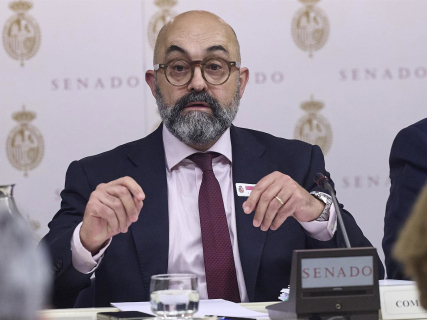
Dangerous liaisons: the support of the “Government sources” also does not save Adif’s president

The “Government sources” get it right again, but the other way around. On Tuesday they ruled out the resignation of Puente and the dismissal of Adif’s president. The minister left that night and now Pedro Marco de la Peña is coming down. Read afterward, those assurances of continuity seem like a preview of the departures: it was enough to reverse the forecast, as DEMÓCRATA anticipated

fotonoticia 20261102191503 1920

fotonoticia 20261102191503 1920

Add DEMÓCRATA to Google

Ask FREN

Published

Last updated

4 minutes

Most read

Elecciones 29N · Encuestas

La media de las encuestas

Media a 4 de noviembre de 2026 · 15 institutos

  • PP31,0 %
  • PSOE26,3 %
  • Vox19,5 %
  • Frente Amplio6,5 %
  • ERC2,5 %
  • Podemos2,2 %
  • SALF2,2 %
01020304050ene 2024jul 2024ene 2025jul 2025ene 2026jul 2026

Media del último estudio de cada instituto en 30 días y su evolución semanal desde el 23J. Partidos con al menos un 2 %.

Todas las encuestas

Elecciones generales del 29 de noviembre · Demócrata

The stepping down of the president of Adif completes the correction of the continuity guarantees that sources from the Government relayed earlier before Óscar Puente’s resignation. Carlos Cuerpo replaces Pedro Marco de la Peña and opens another stage in managing the rail crisis. The question left by that sequence is how much those who dismissed the exits knew and why they presented them as impossible.

The president of Adif was not going to be dismissed either. That was one of the guarantees that sources from the Government conveyed on Tuesday, along with the continuity of Óscar Puente at Transportes and at the head of the Socialist Party’s candidacy for Valladolid. The minister announced his resignation that night.

The information it intended to close the discussion about political responsibilities ends up instead as the record of two decisions that the Executive had ruled out. First the minister came out. Then came the person in charge of the public company that manages the rail infrastructure.

Demócrata noticed that second guarantee before the outcome was known: if Puente’s continuity had lasted so little, the president of Adif had reasons to try his luck. It was an interpretation of the fragility of that support, not information about a decided dismissal.

The arrival of Carlos Cuerpo has changed who makes decisions at Transportes. It also forces the Government to explain what has changed so that a replacement that was not on the table ends up being one of the answers to the crisis.

A guarantee with two names

The Tuesday message was specific, to "sources from the Government" and filtered to specialized media and to the EFE agency: Puente would not resign, Pedro Sánchez would not dismiss him, and the PSOE would keep its candidacy in Valladolid. The same information added that dismissing Adif’s president was also not on the table.

It was not only confidence being communicated in the minister’s management. His conduct was being anticipated and a decision about another senior post was being ruled out. The argument accompanying those certainties was that assuming responsibilities required remaining in charge, attending to those affected, and regaining trust in the railways. When Puente announced his resignation, the departure began to be presented as an exercise in dignity and political responsibility.

Both decisions can find an explanation. But the Government—or, at least "its sources"—must account for the change, especially after having defended so firmly that the first one was the right one.

Agitation in the backrooms

The matter of settling political responsibilities after the second tragedy in the high-speed line over the course of a year did not present much political difficulty alongside the enormous human drama: to dismiss immediately the minister and whoever was in charge of the infrastructure operator, that is, Adif. However, again, the “reflection.” For several days, while explanations were being given and the victims were being attended to, there was no assumption of responsibilities. What was the explanation? According to various journalists and, finally, “government sources,” who, it turns out, that there would be none.

The president wanted it to continue: it is understood that both he and the president of Adif—strange the doublet—and he would have asked to stay. This was “sold” to various media; many choked on their dinner when they saw Puente’s resignation live. And it seems that, in parallel with the Government “ensuring” his continuity and that of the leader of Adif, the minister himself would have avoided sharing his plans to prevent them from convincing him of it. At least two media outlets claim that Puente did not want to convey his decision in advance to avoid interference, not even from his own “boss” and party leader.

From here, you have to think well or badly. Being benevolent, the government sources, which guaranteed Puente’s staying on, could know Sánchez’s will and not know that of the now former minister. If they are not like that, there is a solitary and independent “operator” criterion of Puente, in which he decides the timing.

Political miscoordination in the face of the catastrophe

If the president wanted Puente to continue until the elections, but the minister decided to leave and warned him with a message instants before announcing it, it explains why Moncloa could have been unaware of the decision; it also describes a president with no room to intervene in the departure of one of his main ministers.

The problem is not that Puente might resign against Sánchez’s criterion. A minister can decide not to continue. The coordination problem appears when the Government guarantees his staying on while he prepares to leave, and when the president ends the day by praising a decision that, according to those same reconstructions, he had tried to avoid.

A coordinated exit would have allowed communicating the resignation, explaining its reasons, and presenting the transition without the Executive, at night, denying what it had assured in the morning. What has been published describes another sequence: Puente controls the timing of the announcement and Moncloa then adapts its explanation. Remaining was a responsibility; leaving becomes dignity.

Some of the sources consulted by the media after the resignation speak of “surprise,” but they leave the president facing an uncomfortable dilemma. If they knew of the decision and guaranteed the opposite, they would have spread a falsehood knowingly. If they did not know it, they spoke with a certainty that their information did not allow.

The Body receives the portfolio and reviews the decisions

Sánchez announced on Wednesday that Carlos Cuerpo would assume the powers of Transportes after Puente’s resignation. The choice allows maintaining management within the cabinet and places the economic vice president at the head of the response to the rail crisis.

Cuerpo cited Pedro Marco de la Peña this afternoon. The meeting placed the continuity of the president of Adif among the first issues that the new head of Transportes had to address and as well as yesterday DEMÓCRATA declined, the decision of his departure is not very surprising

Puente’s resignation and the eventual dismissal of the president of Adif should not be counted as if they were the same decision. The minister announced a resignation that, according to the reconstructions published, Sánchez did not want. A dismissal at Adif would be a decision by the Executive.

More key points, information and questions with FREN

AI-GENERATED CONTENT

What are the powers of the president of Adif according to Spanish legislation?

The president of Adif has powers of representation, executive management, personnel, contracting, and legal defense of the entity. Its main regulation is in article 23 of the Statute approved by the Royal Decree 2395/2004. He does not concentrate all decisions: the Board of Directors retains the superior management and certain powers that cannot be delegated.

Legal framework

The Statute must be interpreted together with the Law 38/2015 of the railway sector and the general legislation applicable to the public sector. Although it retains references to Law 39/2003 and the former Ministry of Development, these should not be read in isolation from the subsequent legal framework. Furthermore, it is important to distinguish the functions of Adif as an entity from the powers personally attributed to its president.

Powers specific to the president

  • Institutional and legal representation. Represents Adif in court and out of court, in any act or contract and before natural or legal persons, public or private. He also agrees on the exercise of actions and appeals before administrations and courts to defend the interests of the entity.
  • Chairmanship of the Board. Calls its meetings, sets the agenda, chairs the meetings, and directs the deliberations. In case of a tie, he has the casting vote. Likewise, he ensures compliance with the Statute and the Board's agreements and is responsible for executing them.
  • Management and supervision. Holds the highest authority over all personnel, exercises high inspection of services, and monitors the development of Adif's activity. These powers operate within the guidelines and competencies of the Board.
  • Organization and staffing. Proposes the organizational structure to the Board and determines the staff according to the criteria and guidelines approved by it.
  • Appointments and personnel contracting. Agrees on the appointment and dismissal of management personnel, informing the Board. Contracts non-management personnel and sets their remuneration according to the Board's criteria and, when applicable, the collective agreement.
  • Economic planning. Proposes to the Board the multi-year action program and the operating and capital budgets. Also presents program contract proposals for approval: his role is to promote and formulate these decisions, not to replace collegiate approval.
  • Rates and fees. Submits to the Board the rates that it must approve or modify, those that must be elevated to the Administration, and proposals for modification and updating of railway fees, according to the applicable sectoral framework.
  • Public contracting. Acts as the contracting body within the economic scope established by the Statute, without prejudice to the powers reserved to the Board. Article 23 refers to previous contracting legislation, so that reference must be applied together with the current contracting regulations.

Limits, delegations, and urgent decisions

Articles 16 and 17 delimit the powers of the Board and its possibilities of delegation. Among the matters that cannot be delegated are the entity's structure, initial budget approval, annual accounts, borrowing operations, asset inventory, and declaration about the network.

Regarding assets, the president's representation does not equate to an unlimited power of disposal: the Statute assigns decisions such as approving real estate acquisitions and disposals and agreeing on the disaffection of public domain assets to the Board. Delegations may complement the distribution; there is an agreement published through the Resolution of May 26, 2025, whose scope must be checked for each specific action.

Finally, article 24 allows that, exceptionally and out of urgent necessity, the president may adopt decisions reserved for the Board. He must communicate them at the next ordinary meeting for ratification. This exceptional power does not eliminate the control of the collegiate body.

What is Carlos Cuerpo's professional and political background before assuming the Transport portfolio?

Carlos Cuerpo assumed the responsibilities of Transport with a background focused on public economy, European institutions, and State financial management, not in a partisan career nor in transport administration. Previously, he had been an economic analyst, executive at AIReF, Secretary General of the Treasury, Minister of Economy, and First Vice President. It should be noted that on November 4, 2026, he temporarily assumed the ordinary office of Transport, without being appointed minister of the department as such, according to Demócrata's information.

Education and early steps in the Administration

Born in Badajoz in 1980, he graduated in Economics from the University of Extremadura in 2003. He completed a master's degree in Economics at the London School of Economics in 2004 and obtained a PhD in Economics from the Autonomous University of Madrid in 2017. In 2008, he entered by competitive examination into the Senior Corps of State Commercial Technicians and Economists. These data appear in the profile of his career published on the occasion of his access to the Vice Presidency.

Between May 2008 and April 2011, he worked as an analyst in the Directorate General for Macroeconomic Analysis and International Economy. His activity was linked to the study of the Spanish economy, forecasts, and the international context. It was the beginning of an administrative career specialized in analyzing economic evolution and supporting public policy design.

European Commission and AIReF

Between May 2011 and April 2014, he served as an analyst and national expert in the Directorate General for Economic and Financial Affairs of the European Commission. There he worked on economic supervision and the macroeconomic imbalance procedure, the European mechanism to detect problems such as excessive debt or loss of competitiveness.

In May 2014, he joined the Independent Authority for Fiscal Responsibility, then chaired by José Luis Escrivá. First, he was Deputy Director of Public Debt until October 2016; then, Director of the Economic Analysis Division between November 2016 and January 2020. This stage strengthened his experience in forecasts, debt, and sustainability of public finances. The chronology is detailed in this Demócrata profile.

From macroeconomic analysis to the Treasury

In February 2020, he returned to the Ministry of Economic Affairs and Digital Transformation as Director General of Macroeconomic Analysis, under the direction of Nadia Calviño. He held that responsibility until August 2021, during the economic impact of the pandemic.

Then he became Secretary General of the Treasury and International Financing, a position he held until December 2023. His responsibilities included State financing, public debt, and international financial relations. He also participated, alongside Calviño, in negotiations on the reform of European fiscal rules.

Entry into Government and political profile

On December 29, 2023, he was appointed Minister of Economy, Trade, and Business, replacing Calviño after her appointment to chair the European Investment Bank. The next promotion came in March 2026: he was appointed First Vice President by Royal Decree 258/2026, maintaining Economy.

His political career has therefore mainly developed within the Executive. He had not held elected positions nor developed an organic career in the PSOE before entering the Council of Ministers, according to published profiles. When temporarily receiving Transport after Óscar Puente's resignation, he brought economic and European experience but not a prior leadership career in that sector.

What are the necessary parliamentary steps for the dismissal of senior officials in public companies like Adif?

There is no general parliamentary procedure to directly dismiss the heads of public entities like Adif. The Cortes can oversee their management, investigate actions, and request their dismissal, but a parliamentary resolution does not replace the decision of the competent body to agree on it. It is important to distinguish between demanding political responsibility and adopting the legal act that ends the position.

1. Identify the position and who can dismiss it

Before promoting an initiative, it must be distinguished between presidency, board members, management personnel, and employees: they do not necessarily have the same regime. To determine who agrees on the dismissal in Adif, one must refer to its organizational regulations and the specific position. The Congress Regulations regulate parliamentary control instruments but do not establish a general power to dismiss heads of public companies or entities.

2. Request information and appearances

The first political step may be to clarify the facts, although it is not a mandatory prior requirement to request a dismissal:

  • Documentation: deputies can request data and reports through the Presidency of the Congress. Article 7 provides that the Administration must provide them or communicate the legal reasons that prevent it.
  • Appearances: according to article 44, committees can request the presence of the responsible minister, authorities, or other competent persons. The appearance is requested, its holding is agreed upon, and the informative session is held.
  • Questions and interpellations: allow demanding explanations from the Government. The interpellation addresses the reasons or purposes of its policy and may lead to a motion.

These instruments allow oversight of management but do not by themselves produce dismissal.

3. Approve a request for dismissal or censure

The most direct way to express that demand in the Congress is a non-legislative motion: a resolution proposal that requests an action from the Government, without executing the dismissal. According to articles 193 to 195, it follows these steps:

  1. A parliamentary group submits the document to the Board.
  2. The Board decides its admission, orders its publication, and determines its processing in Plenary or committee.
  3. Groups may submit amendments up to six hours before the session.
  4. The debate is held and the text with the amendments accepted by the proposer is voted on.

A motion following an interpellation is also possible. Article 184 requires it to be submitted the day after the interpellation is processed; if admitted by the Board, it is included in the next plenary session. A request for dismissal or censure expresses a political position: its approval does not automatically make the position vacant.

4. Create an investigative commission

If there are facts of public interest to clarify, article 52 allows the Plenary to create a commission at the proposal of the Government, the Board, two groups, or one-fifth of the deputies. Then the work plan is approved, documentation is requested, and appearances are required.

The conclusions are set out in a report debated by the Plenary. Approved reports are published and communicated to the Government; they may be forwarded to the Public Prosecutor when appropriate. They can support a request for dismissal but do not replace it nor determine criminal responsibilities.

5. Distinguish it from a motion of no confidence

The motion of no confidence is directed against the Government, not against an Adif executive. It requires the signature of one-tenth of the Congress and an alternative candidacy for the Presidency. The Senate also oversees the Government but does not maintain that confidence relationship, as explained in STC 124/2018.

In summary: there is no mandatory parliamentary sequence for dismissal: there may be control, investigation, and political request; dismissal requires a separate decision by the competent body.

Play

Test your knowledge with FREN!

How much do you know about this topic? Answer the following 3 questions.

Who has taken over the Transport portfolio after Óscar Puente's resignation?

Question 1 of 3

What decision did the president of Adif make after the railway crisis?

Question 2 of 3

What political problem was revealed by the sequence of resignations and dismissals in the Government?

Question 3 of 3