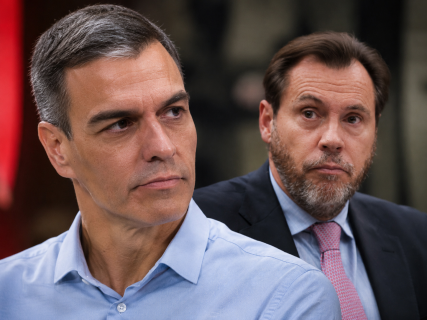

This Friday, Pedro Sánchez has returned to the pre-election campaign in Valencia with an argument that would have been much more difficult to defend just four days earlier. Before thousands of supporters, the president of the Government has claimed the resignation of the former Minister of Transport, Óscar Puente, as an exercise in political responsibility and has contrasted it with the PP’s actions in the face of other crises, with Carlos Mazón and the dana as an inevitable reference. "The exercise of dignity that he has done is not practiced by the PP and Vox in any crisis", Sánchez has proclaimed.
However, when the PSOE announced the rally on Monday, Puente was still in charge of Transport and Moncloa defended his continuation after the Urda rail accident. On Tuesday 3, just a few hours before his resignation, Government sources assured EFE and other media that the minister would not resign, that Sánchez would also not dismiss him, and that he would continue to head the Socialist list for Valladolid on 29N. That same night, Puente unexpectedly announced his resignation at the end of his appearance before Congress.
In political communication there is a concept to describe messages that only certain recipients know how to interpret: dog whistle, literally “dog whistle,” a coded signal whose meaning goes unnoticed to everyone else. Could the call for the Valencia rally have been one of those signals?
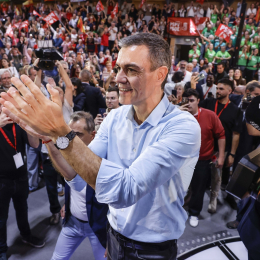
The phrase had special meaning in Valencia, where the socialists have turned the management of the dana into one of their main arguments against the popular parties. But it also invited reviewing what had happened during the previous days. The rally had been announced on Monday, November 2, when Puente was still in charge of Transport and the Government rejected that he would have to leave the post.
Between that call and Sánchez’s Friday intervention, something decisive happened: the minister resigned, apparently, of his own will and against Sánchez’s. A decision that the Executive had ruled out until just a few hours before ended up providing the PSOE with one of its main electoral arguments.
A rally called while Puente was still in the Government
The Urda rail accident occurred on Wednesday, October 28, and left 69 deaths. Five days later, on Monday, November 2, the PSOE announced that Sánchez would resume his electoral schedule the following Friday in Valencia.
The announcement arrived at an especially delicate moment. The Government had decreed three days of official mourning, the investigation into the accident remained open, and Puente had accumulated calls for his resignation from both the opposition and several parliamentary partners.
Moncloa, however, maintained its support for the minister. On Friday, October 30, sources close to the Executive told that Sánchez was not considering dismissing him. The argument was that Puente had to continue at the head of crisis management, explain what had happened, and adopt the necessary measures to strengthen rail safety.
Hemos dado la cara con absoluta transparencia y hemos asumido la responsabilidad política con la dimisión de un gran político como es @oscar_puente_.
— Pedro Sánchez (@sanchezcastejon) November 6, 2026
Un ejemplo de dignidad que jamás han practicado el PP y Vox ante ninguna crisis o tragedia que ellos hayan podido gestionar. pic.twitter.com/5d4Ze9g603
On Monday 2, when the rally was announced, that was still the official position. Nevertheless, within the PSOE there were already doubts about the political cost of reaching the elections of November 29 with Puente still in the Council of Ministers.
The contradiction was evident. Sánchez was preparing to return to the campaign precisely in Valencia, where the PSOE had demanded political responsibilities from Mazón for the DANA, while defending the continuity of his own minister after two deadly train accidents in less than a year.
The event could be held. Another question was what Sánchez could say from that lectern.
A resignation decided from day one, but communicated at the last minute
On the night of Tuesday 3 November, after more than four hours of appearing before the Standing Committee of the Congress, Puente announced to everyone’s surprise that he was leaving the Ministry of Transport and also resigning from heading the Socialist candidacy for Valladolid.
The minister explained that he had made the decision in the first moments after the Urda accident, although he had preferred to continue during the most difficult days of the emergency.
But his resignation was not improvised. Puente had the speech with which he would say goodbye to the post prepared, and, according to information published later by laSexta, he had written the WhatsApp message on Monday with which he would communicate his decision to the president. That is to say, the same day that the PSOE announced the Valencia rally, Puente was already preparing his farewell.
According to Puente’s own account, Sánchez did not learn his final decision until a few minutes before he announced it in Congress. Government sources corroborated that version and said that the president had maintained his trust in the minister until the very last moment.
The information published by laSexta provides an especially revealing detail. Puente asked Sánchez in that message not to interpret his resignation as a betrayal. The president, according to the same information, replied by asking him not to resign.
If that sequence was exactly as described by its protagonists, the departure did not respond to a prior agreement to facilitate the campaign. It was a personal decision by the minister that ended up benefiting the Government politically.
But the outcome allows another question to be raised: to what extent was it foreseeable that Puente would end up leaving the post before Sánchez returned to the rallies?
The political responsibility that on Tuesday Moncloa did not demand
Hours before the resignation, the Government continued to defend that Puente should remain in charge of Transportes. The explanation was that leaving the post in the middle of a crisis did not necessarily amount to a responsible response and that the priority was to clarify the causes of the accident. The resignation altered that argument.
Since that night, Sánchez and his circle began to claim precisely the decision to leave as a demonstration of political dignity. The minister who was supposed to continue to manage the emergency became instead an example of how a leader can assume responsibilities without there being a direct attribution of blame.
Valencia and Mazón, the scenario that gave meaning to the comparison
Puente’s resignation allowed Sánchez to go to Valencia with an argument that would have had a much more limited reach if the minister had stayed in office.
The PSOE could claim that one of its officials had resigned six days after a rail tragedy, while Mazón had taken a year to leave the Presidency of the Generalitat after the dana and still kept his seat in Les Corts.
The contrast was already starting to be used before the rally. On Wednesday, 4 November, Pilar Bernabé defended that Puente had given explanations and assumed responsibilities, as opposed to what she considered Mazón’s lack of political response.
On Friday, Sánchez took that comparison to the electoral stage. The resignation thus resolved one of the most obvious problems for the socialist discourse. With Puente still in Transportes, any criticism directed at the PP for not having assumed responsibilities after the DANA would have found an immediate rebuttal in the situation of the Government itself.
Without Puente, the PSOE could use his resignation to argue that it had acted differently.
The coincidence that fuels the questions
There are facts that make it possible to reconstruct the sequence without having to attribute intentions that have not been established.
On Monday, the PSOE announced the rally and Puente prepared the message of his resignation. On Tuesday, Moncloa still defended his continuity and the minister left his post unexpectedly. On Wednesday, the Government began to claim his resignation as an example of political responsibility. On Friday, Sánchez used that argument in Valencia to contrast his actions with those of the PP.
The political dimension of what happened cannot be ignored. The resignation came when the PSOE needed to regain control of the electoral agenda, after a week dominated by a railway tragedy and with a rally already scheduled in a community where demanding accountability for another catastrophe occupied a large part of political debate.
The result was extraordinarily convenient for the socialist narrative. Maybe everything happened as its protagonists describe. Maybe the resignation was a strictly personal decision that ended up fitting into the electoral calendar better than anyone had anticipated. Or maybe, and only maybe, the coincidences are too many.