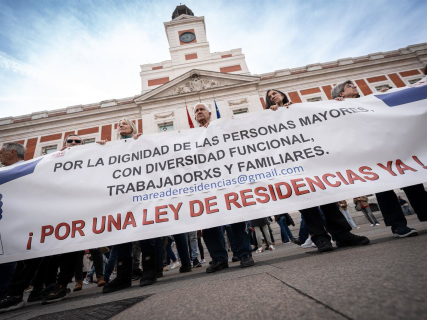










The Board of Judges of the Provincial Court of Madrid has decided to send again to the holder of the Court of Instruction No. 3 of Madrid, Isabel Durante, the responsibility for deciding on the possible accumulation of the proceedings opened in different courts of the Community due to the deaths of residents during the Covid-19 pandemic linked to an alleged offense of discrimination in healthcare assistance.
As legal sources told Europa Press, the Board has not managed to reach a consensus on the matter raised by the magistrate and has chosen to return the case file to her so that she can determine whether or not the cases should be accumulated.
Isabel Durante had raised an issue before the Presidency of the Provincial Court of Madrid, headed by Juan Pablo González, after detecting disparate rulings by various sections of the Court regarding the suitability of investigating jointly the complaints related to the non-hospital referral protocols applied in care homes during the health crisis.
At the meeting, in which around 80 magistrates from the criminal sections of the Provincial Court took part, the matter was analyzed within a legal debate aimed at unifying criteria, as the newspaper "El País" advanced.
However, the issue raised referred to a specific procedure, so it was understood that the Board of Judges can set general guidelines for legal interpretation, but cannot directly resolve a particular dispute of this kind.
The judge already rejected grouping the cases in 2025
The decision thus returns to the court of Isabel Durante, who had already ruled in September 2025 against accumulating several complaints processed in different judicial bodies in the region for the application of the non-hospital referral protocols.
In several rulings, the magistrate determined then that each proceeding should continue to be investigated separately in the competent court.
The judge held that, despite the existence of coinciding defendants, the cases affected different victims and non-identical care settings, which made it necessary to examine the specific circumstances of each resident and the healthcare they received.
In this case, During investigates the possible commission of a crime of discriminatory denial of health care assistance, provided for in article 511 of the Criminal Code, attributed to three former senior officials: the former general director of Sociosanitary Coordination Carlos Mur, his successor in the position, Francisco Javier Martínez Peromingo, and the former health adviser to the regional government Antonio Burgueño.
The Madrid Prosecutor's Office and Mareas de Residencias had requested the consolidation, in a single case, of several complaints handled in courts in Madrid, Leganés, Navalcarnero, and Collado Villalba.
The Audiencia already halted a major case in April
In this scenario, the Provincial Court of Madrid had already ruled on April 30 last against opening a major case to investigate jointly deaths in residences during the pandemic.
In an order, the Chamber dismissed the appeal rulings filed by a relative of a victim and by the Public Prosecutor's Office against the decision of the Investigating Court No. 3 of Madrid, which had rejected grouping all complaints into a single proceeding.
The justices concluded that the conditions of relatedness required by law to unify the investigations were not met. Although most complaints include three common individuals under investigation, the Chamber stressed that the victims are not the same and present different pathologies and care situations.
The ruling specified that, even if there is a common origin in the Plan of Shock approved by the Community of Madrid, it remains essential to conduct an individualized analysis of each case file to determine whether discrimination occurred in health care.
In addition, the judges warned that the consolidation of the numerous lawsuits and complaints, to which other new ones could be added, would increase the complexity of the proceeding, prolong its processing, and prevent a more thorough examination of the specific circumstances of each death.
The proceedings focus on the protocols applied in the first weeks of the pandemic, which set exclusion criteria for the referral of residents with certain degrees of dependency or cognitive deterioration to hospital. Some cases have been archived, while others remain in the investigation phase or have been reopened at the request of the Prosecutor's Office.