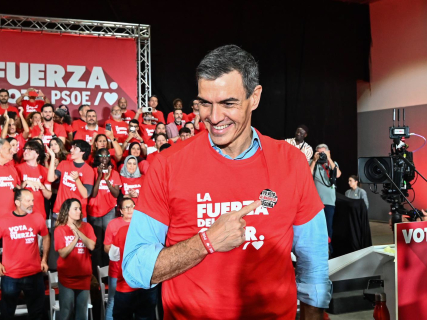









The PSOE leads the PP by 2.8 points and leaves PP and Vox four seats short of an absolute majority, according to SW Demoscopia’s daily tracking

SW Demoscopia's latest poll for La Séptima gives 136 seats to the PSOE, 125 to the PP and 47 to Vox. The Socialists rise to 32.9% and the combined total of the two right-wing parties remains at 172 seats

fotonoticia 20261123123202 1920

fotonoticia 20261123123202 1920

Add DEMÓCRATA to Google

Ask FREN

Published

Last updated

2 minutes

Most read

Poder Digital · Carrera digital

La carrera digital de los candidatos

El Poder Digital de cada candidato a la Presidencia, de 0 a 100, desde junio · cambio en las últimas 4 semanas

30405060708090100julagoseptoctnovSánchez 93,8Montero 86,3Alvise 82,2Rufián 80,8Feijóo 79,1Abascal 78,4Colau 76,5Nogueras 58,0Valido 39,0
  1. 1Sánchez93,8▼ -0,2
  2. 2Montero86,3▼ -1,7
  3. 3Alvise82,2▼ -1,8
  4. 4Rufián80,8▼ -1,2
  5. 5Feijóo79,1▲ +0,1
  6. 6Abascal78,4▼ -3,6
  7. 7Colau76,5▲ +4,5
  8. 8Nogueras58,0▼ -4,0
  9. 9Valido39,0▼ -6,0

Pendientes de que su partido anuncie el candidato: Adelante, BNG, EH Bildu, EAJ-PNV y UPN.

Ver la carrera completa

Mide presencia e influencia en redes, no intención de voto.

Six days before the general elections of 29N, SW Demoscopia polling for La Séptima keeps the PSOE in first place, with 32.9% of the votes and 136 seats. The PP obtains 30.1% and 125 seats, while Vox moves back to 15.3% and 47 representatives. Between them they would total 172 seats, four fewer than those needed for an absolute majority.

The PSOE retains first place and Vox loses weight

The socialist estimate exceeds that of the PP by 2.8 points. Regarding the measurement of November 17, the PSOE gains one percentage point, while the conservatives advance 1.2 points. Vox loses another 1.2 points and Frente Amplio moves back by five tenths. Thus, although the PSOE improves its percentage, its lead over the PP is reduced slightly with respect to the three points in the previous available update.

PP and Vox would add up to 172 seats

The projection of seats grants 125 representatives to the PP and 47 to Vox. Their total falls four below the 176 needed for an absolute majority. The PSOE would obtain 136 seats, eleven more than the PP, while Frente Amplio would gather nine and the rest of the parties, 33.

Planned distribution of seats

Party Vote Seats
PSOE 32.9% 136
PP 30.1% 125
Vox 15.3% 47
Frente Amplio and coalitions 6.8% 9
Other parties 14.9% 33
Total 100% 350

PP + Vox: 172 seats · Absolute majority: 176

The evolution of seats during November

The PP and Vox block has gone from 173 seats in the November 12 measurement to 172 in the November 17 one and the last one of the day 23. In the same period, the PSOE goes from 134 to 136 seats, while the PP advances from 113 to 125 and Vox falls from 60 to 47.

The survey is dated November 23, the last day before the legal period in which new election polls cannot be published. The projection describes an estimate of votes and seats, not an election result.

Source: SW Demoscopia for La Séptima, data released on November 23, 2026, and historical series of previous updates. Frente Amplio includes Compromís–Front Valencià, Unidad del Pueblo Canario and Ara Més–Front Ampli.

More key points, information and questions with FREN

AI-GENERATED CONTENT

What is the legal procedure for the publication and prohibition of electoral polls in Spain and which body regulates it?

In Spain, the publication of electoral polls is mainly regulated in Article 69 of the Organic Law of the General Electoral Regime (LOREG). The Central Electoral Board (JEC) oversees compliance and interprets its rules through instructions and agreements: the temporary prohibition is established by law, not a discretionary decision of the Government.

1. Requirements for publishing a poll

From the call until the holding of the elections, a specific transparency regime applies. Article 69 does not establish a general prior authorization to publish polls, but obligations for those who prepare and disseminate them. Every publication must include:

  • The name and address of the person who conducted the poll and of the person who commissioned it.
  • The sampling system, sample size, margin of error, level of representativeness, and procedure for selecting the surveyed individuals.
  • The dates of the fieldwork.
  • The full text of the questions and the number of people who did not respond to each one.

These obligations allow knowing who is behind the study and how its results were obtained (LOREG, Article 69).

2. When is their dissemination prohibited

Article 69.7 states: "During the five days prior to the voting day, the publication, dissemination, or reproduction of electoral polls by any means of communication is prohibited."

Therefore, if the elections are held on a Sunday, those five days are from Tuesday to Saturday; Monday is the last day before that interval. The restriction is not limited to publishing new polls: it also covers their dissemination or reproduction. It is important to distinguish conducting a poll from making its results public: this section prohibits the latter, not the collection of responses.

3. How the Central Electoral Board intervenes

The JEC verifies that published polls do not contain falsifications, concealments, or deliberate modifications. It also supervises the mandatory technical information and compliance with the prohibition period.

To verify this, it may request additional technical information from the person who prepared a published poll, respecting legal limits regarding data for the company's or client's own use.

If it demands a correction, the media must disseminate it within three days, indicating its origin and reason, in the same spaces or pages. When periodicity prevents this, its director must publish it at their own expense in another medium of the same area and similar reach. Resolutions are notified and published; they can be appealed before administrative courts without a mandatory prior appeal for reconsideration.

4. Additional rules for public bodies

The JEC Instruction 1/2024 requires public bodies to communicate certain studies at least 48 hours before starting fieldwork. This includes polls with questions about voting intention, evaluation of parties or political leaders, and requires communicating technical characteristics, schedule, and draft questionnaire.

Additionally, Article 69.8 obliges to provide the results of public polls on voting intention to the candidacies competing in the corresponding territory that request them, within 48 hours following the request.

5. Consequences of non-compliance

Article 153.2 provides for administrative fines ranging from . If the acts constitute a crime, Article 145 contemplates imprisonment from three months to one year, fines from twelve to twenty-four months, and professional disqualification from one to three years. These are not automatic consequences: they require the corresponding procedure; penalties are imposed by courts, not the JEC.

What powers does the Prime Minister have in calling general elections according to the Spanish Constitution?

The Spanish Constitution grants the Prime Minister a central role in calling general elections, but always within a framework of checks and formal limits. It is not an absolute or discretionary power without control, but a regulated competence linked to the regular functioning of the Cortes and the Government.

1. Who formally calls the elections?

From a legal-formal point of view, the elections are not "called" directly by the Prime Minister, but by the king through a Royal Decree, which must be countersigned (politically signed) by the Prime Minister. However, the political initiative for that call corresponds to the Prime Minister:

  • The Prime Minister is the one who proposes to the king the dissolution of the Congress or the General Courts (Congress and Senate) and the calling of elections.
  • Without that proposal from the Prime Minister, the king cannot, by himself, dissolve the Chambers or call ordinary general elections.

In practice, therefore, it is the Prime Minister who decides the timing of the early dissolution, within the limits set by the Constitution, and that decision is formalized in the Royal Decree of dissolution and call.

2. Power of early dissolution and its limits

The most relevant competence of the Prime Minister in this matter is to propose the early dissolution of the Congress, the Senate, or the General Courts and thereby bring forward the general elections. But this power is subject to several limits:

  • One-year temporal limit: a new dissolution cannot be proposed before one year has passed since the previous dissolution carried out by this same means (the so-called "optional" or discretionary dissolution by the Prime Minister).
  • Prohibition during a state of exception or siege: while a state of exception or siege is declared, the Prime Minister cannot use this early dissolution power.
  • Respect for the ordinary calendar: aside from early dissolutions, elections must be held at the natural end of the legislature, so the Prime Minister's power is to bring forward, but not to arbitrarily suppress or prolong the renewal of the Chambers.

In this context, the Prime Minister's competence is a political opportunity faculty: they can assess whether the parliamentary or political situation makes it advisable to bring forward the elections, but always within those temporal and material parameters.

3. Call due to investiture deadlock

There is a second major case of election call that also involves the Prime Minister, although here their margin of decision is practically nil: the investiture deadlock. If a period of two months passes from the first investiture vote without any candidate obtaining the confidence of the Congress, the Constitution provides:

  • The automatic dissolution of both Chambers.
  • The calling of new general elections.

In this case, the king issues the Royal Decree of dissolution and call, which must also be countersigned by the Prime Minister, but the decision no longer responds to the Prime Minister's free political judgment, but to an automatic constitutional mandate. The Prime Minister acts here more as a guarantor of procedural compliance than as the holder of an opportunity power.

4. Functions of the Prime Minister in the electoral process

Although the technical regulation of the electoral process corresponds to the organic electoral law and the independent electoral administration, the Prime Minister's position influences several areas:

  • Determination of the date within legal margins: by proposing dissolution, the Prime Minister conditions the specific date of the vote, which must fit within the minimum and maximum deadlines set by the Constitution and electoral law.
  • Political responsibility for the advance: the Prime Minister assumes responsibility before Parliament and public opinion for the decision to bring forward the elections, which can be justified in terms of governability, parliamentary deadlock, or the need to "refresh" the majority.
  • Government action until the elections: once the Chambers are dissolved, the Government continues to act ordinarily until the elections are held and the new Government is formed, although with the limits typical of an Executive transitioning to a possible caretaker Government.

5. Summary: real scope of the competence

In summary, according to the Constitution, the Prime Minister:

  • Has the political initiative to propose to the king the dissolution of the Chambers and thereby the early call of general elections, within precise temporal and material limits.
  • Cannot call elections alone nor outside the formal channels of the Royal Decree of dissolution and call.
  • Must countersign the Royal Decree by which the king dissolves the Cortes and calls elections, both in early dissolutions decided by them and in automatic dissolution due to investiture failure.
  • Is politically accountable before Parliament and citizens for the use of this faculty.

Therefore, it is a key competence in the design of the Spanish parliamentary system, granting the Prime Minister a relevant margin to order political timing, but without breaking institutional balance or election periodicity.

Could you explain step by step how the dissolution of the Cortes and the call for elections is legally processed from the moment the Prime Minister proposes it until it is published in the BOE? What are the differences between the early dissolution decided by the Prime Minister and the automatic dissolution due to investiture deadlock? What limitations does a caretaker Government have once general elections are called?

What were the official results of the last general elections prior to 29N for PSOE, PP, Vox, and Frente Amplio?

The last general elections prior to 29N were held on July 23, 2023. In the final result for the Congress, the PP obtained 137 seats; PSOE, 121; Vox, 33; and Sumar, 31. For the comparison you ask, the historical reference for Frente Amplio is Sumar: in 2023 there was no candidacy under the name Frente Amplio (Demócrata, results of 23J).

Results of the four candidacies

These are the representation figures and vote percentages, rounded to one decimal place. They refer to the Congress of Deputies, not the Senate; they are neither poll estimates nor the number of deputies each group might have later due to changes during the legislature.

  • PSOE: 121 deputies and 31.7% of the votes. It was the second candidacy by representation among the four you ask about. This is the definitive figure that should be used as a starting point to compare their seats with the 29N results (Demócrata, 23J reference).
  • PP: 137 deputies and 33.1% of the votes. It was the candidacy with the most seats among the four. Its 137 representatives should be counted separately from the UPN deputy: adding both candidacies changes the comparison base and no longer expresses only the PP result (Demócrata, PP reference).
  • Vox: 33 deputies and 12.4% of the votes. It occupied the third position among these candidacies by number of seats. Both the 33 representatives and that percentage correspond to the 2023 elections and serve as a historical reference, not as a forecast of the next electoral result (Demócrata, Vox reference).
  • Sumar, previous reference for Frente Amplio: 31 deputies and 12.3% of the votes. That representation corresponds to the Sumar candidacy presented in 2023. The published comparison with Frente Amplio uses those 31 seats but must keep the clarification about the name and composition of the previous candidacy (Demócrata, Sumar reference).

How to interpret the Frente Amplio reference

Frente Amplio did not have its own result under that name in 23J. Therefore, it would not be accurate to state that it obtained 31 deputies in those elections without adding that they were those of Sumar. Moreover, the 2023 Sumar candidacy included Podemos, so the comparison between both calls does not necessarily face an identical electoral composition (Demócrata, Sumar composition).

Which figures should be retained

For a homogeneous comparison, always use the definitive seats, the same scope — the Congress — and the same criterion for grouping candidacies. Do not mix a result of one candidacy with a sum that includes another formation, nor present the percentage rounded to one decimal place as if it had more precision.

The official publication of the results is available in the BOE of electoral results. In summary, the comparison base in seats is PSOE 121, PP 137, Vox 33, and Sumar 31; for Frente Amplio, those last 31 are a historical reference, not a result obtained under its current name (Demócrata, comparison between candidacies).

Play

Test your knowledge with FREN!

How much do you know about this topic? Answer the following 3 questions.

What percentage of votes and seats does the PSOE obtain according to the SW Demoscopia tracking published on November 23?

Question 1 of 3

How many seats short of an absolute majority would PP and Vox be if their deputies are added according to the projection?

Question 2 of 3

What is the date of the survey published by SW Demoscopia for La Séptima?

Question 3 of 3