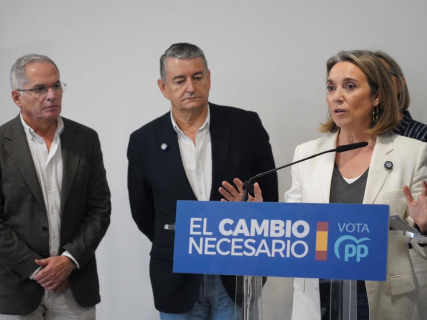










The PP’s Deputy Secretary for Institutional Renewal and candidate for Congress for La Rioja, Cuca Gamarra, together with the PP’s national Emergencies coordinator and regional MP for Cádiz, Antonio Sanz, has unveiled the PP Security Plan in La Línea de la Concepción (Cádiz), defined as a “commitment to declare war on drug trafficking.”
“Despair is over, abandonment is over, and the incapacity to move on to Feijóo’s commitment in the fight against organized crime,” Gamarra said, who has demanded that the agents of the Armed Forces and Security Forces “never feel alone and abandoned again.”
The Popular Party leader has detailed the PP Plan to Fight Organized Crime and Drug Trafficking, which includes 55 measures structured around five main areas: assuming security as the State’s “first obligation,” strengthening Justice so that it “puts itself ahead of the crime,” ensuring that the “authority of the State is exercised throughout the territory,” equipping the State’s Security Forces and Armed Forces with sufficient resources and legal coverage, and turning Spain into a country especially difficult for criminal activity and organized crime.
Gamarra has defended that “we need a tougher Penal Code, firmer, and a stronger Justice,” and has outlined the PP’s commitment to increase penalties for drug trafficking and to fight multirecidivism, as well as to push for a new law on protected witnesses and collaborators, with the aim of having “effective tools and speeding up the execution of sentences.”
She has also again called for the declaration of a risk profession for police officers, Guardia Civil members, prison officials and customs surveillance staff, along with “fair pay and increased staffing levels.” “Protecting those who protect us means good conditions,” Gamarra said, who also asked to strengthen the legal protection of the agents and to consolidate their principle of authority.
The PP’s Deputy Secretary for Institutional Renewal has stressed that “organized crime doesn’t hurt from prison; it hurts the wallet, the assets,” and has therefore urged to “strangle it” on the economic level. To do so, she has advocated for “faster and more effective forfeiture,” judicial intervention of companies, the creation of a financial intelligence unit to complement the Sepblac, and the strengthening of the ORGA and of the specialized intervention and investigation units.
Gamarra has accused the Government of Pedro Sánchez and the Minister of the Interior, Fernando Grande-Marlaska, of “an absolute abandonment by Sánchez and Marlaska of the security of Spaniards for not standing up to organized crime by protecting, defending and providing tools to those who protect us and strengthening the rule of law”. In his view, “drug trafficking and organized crime have gained ground” with the current Executive.
Along these lines, he has defended the creation of “specialized units of a permanent nature, with sufficient resources and personnel”, as well as strengthening investigation and intervention units, including rapid action groups. He has described as “urgent and a top priority” the declaration of the Campo de Gibraltar, the Andalusian coastline and the surroundings of the Guadalquivir as a zone of special singularity, and has called for “real and sufficient means” for the Guardia Civil, the Policía Nacional, Customs Surveillance and prison officials.
In the operational sphere, he has advocated renewing within a period of 24 months the maritime fleet of the Forces and Security Corps of the State and putting in place an integral maintenance plan to “ensure operational readiness” of the vessels in the fight against narcolanchas and to guarantee the safety of personnel. “We are talking about taking on drug trafficking by land, sea and air,” he pointed out.
Similarly, he has proposed a port strategy with a nationwide scope, equipping ports with scanners so that “100% of containers of Hispano-American origin” are inspected, and he has called for intensifying collaboration and international cooperation, relying on bodies such as Europol and Frontex, in order to improve the operational exchange of information against organized crime.
Lastly, in the chapter on social measures against drug trafficking, he has defended “generating a future and alternatives”, especially for young people, in areas such as the Campo de Gibraltar, through work “in a coordinated manner” by all administrations with the aim of guaranteeing the “territorial transformation” that he considers essential.