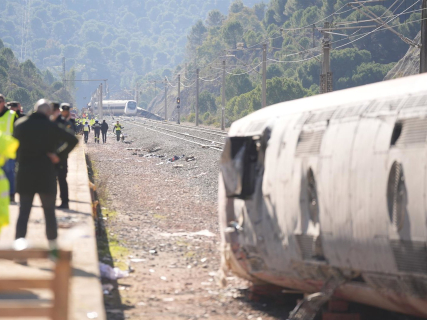

The head of the Court of First Instance and Instruction of Montoro (Córdoba), Plaza number 2, which investigates the railway accident in Adamuz, considers that it is not "sufficiently determined" that the telecommunications expert requested by the three judicial experts should intervene to clarify "why no one warned of the location of the Alvia train in the accident area at the same time it crossed with the Iryo train or once it had derailed."
According to the order issued this Tuesday and to which Europa Press has had access, after analyzing the document from the experts appointed by the court, in which they request to incorporate "a telecommunications engineer specialized in railway communications" for the preparation of the report, and also seen the report from the Public Prosecutor's Office, the judge chooses not to decide yet on that request.
Before making a statement, she requires the experts to, within a period of 9 days, "reevaluate the need for the intervention of the aforementioned professional and, if applicable, expand the justification of their request," detailing "specifically the object of the technical action requested and its impact on clarifying the causes of the railway accident that is the subject of this instruction."
The magistrate reasons that, in light of what has already been acted upon and the motivation provided, "it is not sufficiently determined that the requested intervention is projected on aspects directly related to the causes of the accident, possibly referring, in principle, to subsequent facts that exceed the object of the expertise." Furthermore, she urges them to indicate, within the same period, whether they consider the intervention of other specialists essential, specifying for each one "the specific purpose of their intervention and its connection with the object of the instruction."
In this way, the requirement is conveyed to the experts, with the proceedings awaiting their response to decide on the appropriateness of the proposed technical assistance. Against this order, an appeal for reform can be filed at the judicial office within a period of three days from the notification.
Requests from the experts and studies of the terrain
In their writing, the investigators consider it "necessary" to have "a telecommunications engineer specialized in railway communications" to "clarify the interlockings and detection systems that the track has to detect the presence of a train in each of the railway sections," as well as "the communications of this system with the command post."
After analyzing the documentation and the track renewal projects carried out shortly before the accident, the experts point out that it may be necessary to conduct specific studies of the terrain to "assess whether other external factors coincided with the possible breakage of the rail apart from the welding itself."
In this line, "thinking about a failure of the terrain," they propose "a geotechnical campaign" that allows determining "the behavior of the materials of the railway infrastructure in the adjacent area," suggesting "the study of the execution of at least two boreholes at a depth of 15 meters in the area of the infrastructure closest to the rail break" and "no less than four SPT tests in the areas adjacent to the location of the rail break."
Requirements to Adif regarding works and documentation of the track
In the same resolution, the judge notes the receipt of a document from the legal representation of Adif, dated July 17, which provides files related to the contracting of works and supplies for the renewal of the track that were not yet included in the case, in partial compliance and within the deadline of the order of July 12.
However, it specifies that the "projects related to the execution and modifications, if any, of the file for the renewal of elements of the overhead contact line of the Madrid-Sevilla High-Speed Line, from kilometers 315 to 470 have not been submitted as of the date of this document due to technical difficulties arising from the weight of the files, having informed the Section of this by the legal representation of Adif."
For this reason, it orders Adif to, through its legal representation, deliver within two days the pending documentation on a USB device, as it concerns files "not provided due to technical problems." At the same time, it sends the administrative files already incorporated to the judicial experts so that, within a period of 9 days, they indicate, in view of that documentation and their report of July 3, "whether the intervention of certain professionals or specialists is necessary for the proper issuance of their opinion, indicating in each case the purpose of their intervention and its connection with the object of the instruction."
The magistrate recalls that the case is awaiting a decision on these technical assistances once the request has been answered, "without prejudice to transferring the rest of the documentation provided by the legal representation of Adif once it has been formally submitted." Among the requests made to the public entity are the construction project for the comprehensive improvement of the infrastructure of the high-speed line Madrid-Sevilla in the section Guadalmez-Córdoba, the supply, transport, and pre-assembly file of track devices, the documentation of supply, transport, and ballast for the renewal of turnouts, the project for the renewal of turnouts (phase 2), and the execution and modified projects, if applicable, for the renewal of elements of the overhead contact line between kilometers 315 and 470.
Report from an engineer on the possible cause of the accident
The provision also includes the official letter from the Organic Unit of Judicial Police (UOPJ) of the Civil Guard, dated July 3, by which a report and graphic material on the causes and location of the accident are sent to the court, prepared by a specialist in Civil Engineering.
According to the Civil Guard, this licensed engineer writes "a report accompanied by photographs supposedly from the site of the accident in Adamuz, focusing his technical opinion on a rail fracture caused, in his view, by poor execution of the welding." The technician himself explains that he obtained the images "through a WhatsApp group of technicians and engineers who were disseminating and commenting on them, but that they were taken by the Security and Self-Protection Directorate of the railway line of Sevilla of Adif or Renfe shortly after the accident occurred."
With the aim of "delving into the origin and traceability of those photographs," the UOPJ contacted the engineer by phone on June 30 to gather more information and ask him to provide data about the origin of the images. Three days later, the professional had still not sent the requested information, so "efforts continue to complete the information received about the origin of the photographs, and thus be able to determine their interest or not in incorporating them into the proceedings."