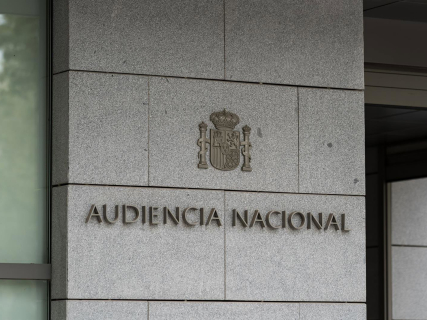

The National Court has decided not to admit Villafuel’s request for two auditors and three advisers who took part in the company’s criminal risk prevention system to appear as witnesses, identified as a possible core of the “hydrocarbons case”.
As stated in an order to which Europa Press has had access, the judges of the Criminal Chamber endorse the prior ruling of the investigating judge, Santiago Pedraz, who had already rejected the practice of these testimonial statements months earlier.
Pedraz leads the investigation into an alleged criminal plot headed by the businessmen Claudio Rivas, owner of Villafuel, and Víctor de Aldama, considered an adviser in the “Koldo case”, who would have orchestrated a fraud of 200 million euros in VAT linked to operations involving hydrocarbons.
In July, Villafuel urged the appearance of five specialists linked to its criminal compliance system, understanding that their statements could help clarify what happened. However, the judge dismissed that step in a ruling issued in August.
The company responded with an appeal in which it denounced “arbitrariness in the rejection for lack of motivation” and recalled that the investigating judge “must carry out the investigative steps that have been proposed by the parties taking part in the proceedings, provided that these are pertinent and useful for clarifying the facts”.
Villafuel’s defense also argued that the experts who designed and put into operation the criminal prevention plan would be the ones able to confirm firsthand whether the company’s internal controls were applied effectively.
Now, the magistrates of the National Court refer to the Criminal Procedure Law to conclude that the appeal “is only admissible against orders, not against rulings, against which a motion for reconsideration may be filed, against which an appeal may already be filed”.
“This is why the direct appeal filed by the defense of the appellant is inadmissible, in which it also denounces the lack of motivation in the appealed decision, which it could have obtained by filing the appropriate motion for reconsideration against the ruling appealed in the appeal,” they argue.
For the court, the evidence raised by Villafuel seeks to facilitate the eventual application of an exemption from criminal liability to the company, so that "it would rather be suitable to be carried out at the oral trial, not during the investigation phase, for which it is unnecessary and time-consuming".
"It should be recalled that, during the investigation phase, the investigative actions must be limited to those necessary to decide on the appropriate procedure for the prosecution or, on the contrary, for the dismissal of the proceedings," they add.
Therefore, "it is not, in that procedural stage, a matter of specifying each and every one of the circumstances that occurred in the commission of the investigated acts, but only those that may be relevant for that decision," the judges indicate as they close the door on these witness statements in the investigation phase.