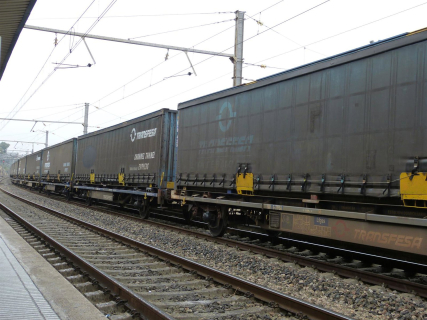

A new accident again shakes the Spanish rail system. A freight train derailed during the early hours of this Sunday, November 15, in Zarzalejo, in the Community of Madrid, leaving the driver with minor injuries and forcing the suspension of traffic on a stretch of the conventional line that connects Madrid with Ávila. The incident affects the Media Distancia and Cercanías services that use this infrastructure, so Renfe has had to establish alternative road transport for travelers.
The derailment occurred at around the 03:48 hours, when the train, belonging to the railway company Captrain, left the track as it passed through the municipal area of Zarzalejo. The driver, a man of 33 years old who was traveling alone in the cab, suffered minor injuries and had to receive medical assistance.
According to sources from Emergencias 112 of the Community of Madrid, the driver presented back pain after the accident, so the medical staff of the SUMMA 112 decided to transfer him to the Hospital Universitario Puerta de Hierro in Majadahonda for medical assessment. His condition is not serious, although he has remained under hospital observation.
The accident has forced the interruption of rail traffic between Robledo de Chavela and Zarzalejo, two municipalities located in the west of the Community of Madrid. The suspension directly affects the trains that connect the capital with Ávila and has caused disruptions to the regional services scheduled for this Sunday.
Renfe has reported the incident through its official X account, @Inforenfe, in which it warned of the suspension of traffic and of the transport alternatives available for affected travelers.
Renfe makes buses available between El Escorial and Robledo de Chavela
The derailment has forced the reorganization of the rail services that run along this corridor, used both by freight trains and by passenger connections.
As Renfe has announced, traffic remains suspended between Zarzalejo and Robledo de Chavela, which affects the Media Distancia trains that make the journey between Madrid and Ávila. To reduce the consequences of the incident, the operator has enabled an alternative bus service between El Escorial and Robledo de Chavela.
The Consorcio Regional de Transportes de Madrid has also reported that the incident affects the C-8A Cercanías line, whose services are interrupted in the section between both stations. The alternative road transport includes a stop in Zarzalejo to facilitate users’ travel.
The interruption occurs in an infrastructure that is also used by different regional services with origin or destination in other localities in Castilla y León, which may cause delays and changes to timetables beyond the direct connection with Ávila.
In fact, the information published by Adif at its stations reflects incidents in various regional services scheduled for this Sunday, including some connections to Madrid from other points along the rail corridor.
Travelers who plan to travel on this line should check the updated status of their trains through Renfe’s official channels before going to the station, especially because a definitive time for the restoration of rail traffic has not yet been announced.
The first reports point to a landslide
While work continues to restore service, the first reports suggest that the accident could be related to a landslide caused by the rains recorded over the last few days.
According to what the Cadena SER has reported, a slope would have given way while the freight train was traveling along the conventional Madrid-Hendaya line, causing the locomotive to derail.
The train would be made up of 17 wagons that were transporting electrical coils, although, according to this information, only the engine would have been directly affected by the track exit.
However, the exact causes of the derailment must be determined through the corresponding technical checks. To date, an official report has not been released that definitively establishes the cause of the accident or the specific circumstances in which it occurred.
The possible link to the rains puts the focus on ground conditions and the stability of the embankments near the railway tracks—issues that the infrastructure managers will have to examine to determine whether there was any prior problem and what actions are necessary.
Adif works to restore traffic between Madrid and Ávila
After the accident, Adif teams have moved to the area to work on the recovery of rail traffic and check the condition of the affected infrastructure.
The reopening of the section requires assessing the conditions in which the track has been left after the derailment and ensuring that passenger and freight trains can once again circulate safely.
Among the actions that may be necessary in incidents of this type are the removal of the accident-damaged rail material, the inspection of the rails and sleepers, and the checking of other infrastructure elements. For the moment, the extent of the damage and the time that the recovery tasks will require have not been specified.
The Zarzalejo accident occurs at a particularly delicate time for the Spanish rail system, marked by the recent incidents of Adamuz (Córdoba) and Urda (Toledo), which have caused a political crisis and a reshuffling in the leadership of the Ministry of Transport, Renfe and Adif.
However, for now there is no element that makes it possible to link the causes of the derailment in Zarzalejo with those of those previous accidents. The circumstances of each incident must be investigated independently.
The new incident once again highlights the consequences that an infrastructure disruption can have on rail services, even when the initial accident affects a freight train.
For now, the assessment is of a lightly injured train driver, rail traffic suspended between Zarzalejo and Robledo de Chavela, and an alternative bus service to guarantee travel for the affected passengers. Adif continues working to restore normality on the Madrid-Ávila line, while the circumstances of the derailment are investigated.