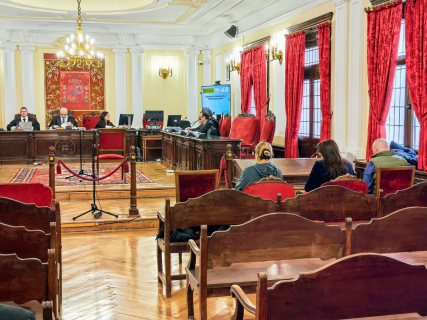

The Office of the Prosecutor is seeking prison sentences of between 18 and 20 years for three defendants, two women and a man, whom it attributes with two counts of trafficking in human beings for the purpose of sexual exploitation, in concurrence (medial) with two counts of coercive determination of prostitution, aiding illegal immigration, and membership in a criminal group in León.
In addition, the Public Prosecutor’s Office proposes that they be ordered to be prohibited from approaching the two victims, their homes, workplaces, and any space they frequent within a radius of less than 500 meters, as well as a prohibition on communicating with them by any means for 16 years.
The oral hearing began this Monday at the Provincial Court of León. According to the provisional statement of charges, a sentence of 14 years is sought for one of the defendants for trafficking in human beings, one year for aiding illegal immigration, and three years for membership in a criminal group. For the other two accused, the request is for 16 years for trafficking in human beings, one year for aiding illegal immigration, and three years for integration into a criminal group.
The accused, all of them of legal age, would have agreed to recruit women "taking advantage of their precarious economic and social situation," offering them supposed jobs as childcare and elderly caregivers, when in reality the purpose of the trip was for them to engage in prostitution in a club in the province of León.
To achieve this, they facilitated the victims’ entry into Spain, organized their travel, and gave them precise instructions so that they would pose as tourists. Each of the defendants assumed specific roles with the aim of obtaining an economic benefit derived from the sexual exploitation of the women.
Recruitment at origin and control in the clubs
According to the charges, one of the prosecuted women contacted the victims in Colombia and presented them with the false job offers. Once they accepted, she took care of preparing the trip, telling them that they had to simulate that they were coming as tourists. Upon their arrival in Spain, she put them in contact with the other defendant, who was in charge of the clubs together with her romantic partner.
Once at the premises, the person responsible for the club provided lodging to the women and explained what the activity they were actually going to carry out was, prostitution and companionship, as well as the conditions under which they had to work.
The third accused, the regent’s partner and co-director of the establishment, organized and supervised the activity of the victims, setting schedules and prices and pressuring them to increase their performance.
The women were required to have sexual relations with the clients, without being able to choose with whom, and they suffered constant pressure to keep working. "If we didn't work, there was no food," one of the affected women has reported during the trial session.
Psychological sequelae and fear of leaving the club
One of the victims developed anxious symptoms during the time she remained in the club, while the other suffered a psychological injury with post-traumatic symptoms derived from the events, which required specialized psychotherapeutic treatment.
In her statement, one of the women has said that she met the accused who offered her the job in her country of origin, when she was going through a situation of extreme vulnerability, with no job, no financial resources, and suffering gender-based violence from the father of her children. She has stated that she would not have traveled to Spain if she had known that it was to engage in prostitution and she has indicated that she did not leave the club out of fear.
Administrative irregularity and a sense of control
The second victim who testified on the first day of the trial has insisted that she never wanted to dedicate herself to prostitution. "I came to Spain hoping to work well," she said, before explaining that, when the police went to the club, those in charge "hid" some of the women who were working there as prostitutes because they were in an irregular situation. "I didn't feel free; I felt forced. I felt watched," she assured, describing how she lived the time she was prostituting herself in León.
The trial will continue at the Audiencia Provincial of León and it is expected to last, at least, until next November 27.