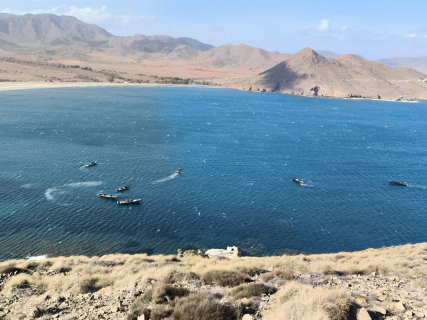

The High Court of Justice of Andalusia (TSJA) has nullified the sentence of one year and nine months in prison imposed on four 'petaca' smugglers who, in June 2024, threw 92 fuel jerrycans into the sea of the Cabo de Gata-Níjar Natural Park (Almería) while trying to flee from the security forces, by understanding that in this case there was no “specific danger in the sense of a real, imminent and identifiable threat to the environment.”
The ruling, which has been accessed by Europa Press, partially upholds the appeal filed by the defense lawyer Nabil El Meknassi and overturns the conviction for the crime of catastrophic risk, although it maintains for each of the defendants the penalty of three years in prison and a fine of 300,000 euros for a crime of smuggling, given that they transported 2,300 liters of fuel in a vessel of prohibited type that collided with a Guardia Civil patrol boat.
The Court of Appeal agrees with the defense thesis that the necessary requirements are missing to support the crime of catastrophic risk, since a specific danger to the environment has not been proven. It emphasizes that although the accused threw at least 92 plastic jerrycans with gasoline into the sea, they were “closed with the corresponding cap,” so that the contents did not reach the water.
Along these lines, the court highlights that, since they remained afloat, the jerrycans could be collected later by the Guardia Civil, without any “real” threat being perceived for the natural space, which also forms part of the Natura 2000 Network with the area known as Seco de los Olivos and the Special Protection Area for Birds of the Bay of Almería.
Likewise, the Chamber cites the doctrine of the Supreme Court to specify that the risk required by the criminal type must have potential capacity to generate damage of great magnitude. In its view, the throwing of the jerrycans did not create a “catastrophic-sized” danger, but rather, as already pointed out by the lower court sentence, a risk situation that “may not be immediate, but with the passage of time” could “alter the marine ecosystem.”
The facts go back to 9:00 a.m. on June 23, 2024, when the four convicted men were sailing in an unregistered inflatable boat of 12 meters in length, equipped with three outboard engines of 300 horsepower each, carrying at least 92 jerrycans of 25 liters, at an approximate speed of 40 knots heading toward North Africa.
The Maritime Service of the Guardia Civil deployed the patrol boat 'Río Jiloca' to the area, which located the speedboat and indicated to its occupants that they should stop by means of acoustic and light signals. Far from heeding those orders, the vessel began evasive maneuvers, with "repeated and sudden changes of course".
During the course of that pursuit, the speedboat occupied by the accused ended up colliding with the Guardia Civil patrol boat, although "it is not on record that it had the intention" to cause the collision. During the escape, the crew members were throwing into the sea the fuel canisters they were carrying.
The patrol boat kept the follow-up for an unspecified period of time, until the inflatable vessel, in one of those "sudden and abrupt turns," crossed in front of the bow of the official ship, without it having been established that it did so with the intent to ram it.
After the collision, the so-called 'go fast' was left without steering and without the ability to continue sailing. The agents of the Maritime Service then had to assist the occupants, who were subsequently arrested. Later, the security forces recovered from the sea the plastic canisters with the fuel still inside.