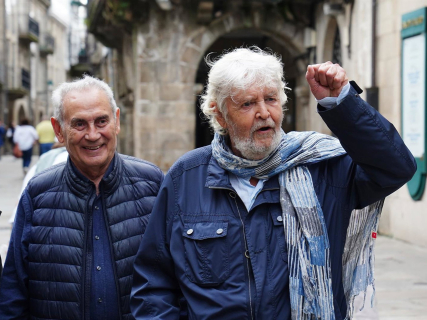

"I am fulfilled." The expression, pronounced a decade ago when saying goodbye to parliamentary life, belongs to Xosé Manuel Beiras, the intellectual who translated Albert Camus into Galician and left a decisive mark on the political evolution of the modern left in Galicia. He did this through a round trip: from nationalism to the convergence with the state-level left, to end up once again calling for votes for the BNG.
The death of Xosé Manuel Beiras Torrado --Santiago, April 7, 1936-Brión (A Coruña), October 8, 2026-- occurred this autumn in his home in A Reboraina, surrounded by his family. Beyond his figure as a politician, ideologue, intellectual, and teacher, which made him a symbol of rebellion for several generations, 'O Beiras' was also the father of two children and a partner. His euménide, as he himself called it, was the painter Aurichu Pereira, who also passed away in autumn, in 2023.
In the collective memory of Galicia remains the image of the charismatic leader, with a beard and silver hair, a gesture oscillating between serenity and, at times, fury and indignation, combining the tone of a university professor with that of a tribune in the public square.
His biography spans much of the political, cultural, and intellectual history of contemporary Galicia: from the opposition to Francoism and the recovery of political Galicianism to the consolidation of the BNG as the second force in the country, his subsequent break with the nationalist front, and the later experience of leftist convergences.
Critical of the established powers, Beiras will be remembered in the political arena for episodes that have already become symbols, such as the famous 'zapato' incident in the Parliament of Galicia in 1993. From his seat, he raised his shoe against the then president of the Xunta, Manuel Fraga, during the debate on the reform of the Chamber's regulations that raised the minimum votes required to access the distribution of seats from 3 to 5 percent.
It was also the same Beiras who, in 2002, shared a historic meal with Fraga, with whom he maintained other gestures of détente within a relationship marked by political rivalry and mutual intellectual respect. A type of bond that he would later repeat with the also popular Alberto Núñez Feijóo, although with a substantial difference: from the very beginning, he made it clear that he did not consider the one from Os Peares respectable on an intellectual level and did not spare any disqualifications --he even called him "a barroom tough guy"--.
His rebellious spirit surfaced on numerous occasions in the Pazo do Hórreo and, precisely with Feijóo, he starred in another of the most remembered moments: in the midst of a parliamentary debate, after the photographs with Marcial Dorado became public, he demanded "decency" from the then Galician president, pounding his fist on the table of the popular bench.
He who represented practically everything on the Galician left maintained, more than ten years later, his will to confront the right and power, not only as an ideological stance but as a way of being in the world and embodying a resistance against what, at times, he interpreted as collective resignation.
Intellectual, writer, and economist
Before becoming a political reference, he forged himself as an academic and thinker. In his trajectory, the leader weighs almost as much as the professor, the Marxist-inspired economist, and the essayist, and, above all, the intellectual who made Galicia his field of study and life, a legacy collected in several books that are still used in Galician classrooms.
To reach that point, he had a solid education that laid the foundation for the critical thinking that would mark all his work. He graduated in Law from the Universidade de Santiago de Compostela in 1957 and furthered his studies at the Sorbonne in Paris and in London, where he attended the London School of Economics.
This academic background, combined with family influence --his father, Manuel Beiras, was linked to the Galeguista Party during the Second Republic--, led him in the early 60s to get involved in the reconstruction of political Galicianism and to be one of the founders of the Partido Socialista Galego in secrecy.
In that same decade, he returned to Galicia to work as a professor of Structure and Economic Institutions at the Faculty of Economics of the Universidade de Santiago de Compostela (USC). Several of his students emphasized his effort to teach to think for oneself rather than to transmit notes.
In the 70s, already as secretary general of the PSG, he published the essay that many consider a turning point for the country and that, for various theorists, defined a stage: 'The Economic Backwardness of Galicia' (1972).
In the 80s, after overcoming a personal crisis that he described as a "descent into hell," he participated in the creation of the BNG and, in 1985, took office for the first time as a deputy in the Parliament of Galicia, being the only representative of the Bloc. He would remain in the Chamber until 2005, achieving in 1997 the best result of the BNG up to that point: 18 seats and the status of second political force.
Amio, return to the Parliament and tides
Over time, the relationship between Beiras and the BNG began to fracture. Strategic discrepancies and his criticisms of the weight of the UPG and the internal functioning of the nationalist front grew until they led to a rupture that reconfigured the map of the Galician left.
The point of no return came in January 2012, at the XIII National Assembly of the Bloc, held in Amio. The tensions between currents led to the departure of Beiras and the allied sectors, including the one that would later become the mayor of Santiago, Martiño Noriega, with whom he would maintain a political relationship of friendship and an almost paternal-filial bond.
Shortly after, he promoted Anova-Irmandade Nacionalista, in which Beiras became one of the central figures. The historic leader thus began a new phase, betting on formulas of convergence with other leftist forces.
The first stop was Alternativa Galega de Esquerda (AGE), a coalition created for the 2012 regional elections by Anova and Esquerda Unida, among other organizations, and in which Yolanda Díaz also participated, whom Beiras came to accuse of having betrayed him. AGE obtained 9 deputies --two more than the BNG-- and allowed Beiras to return to the Pazo do Hórreo seven years later.
From AGE it moved to the municipalist tides and to the construction, in the autonomous sphere, of En Marea, a space where Anova, Esquerda Unida, and Podemos, among other actors, converged. Under that formula, the municipal elections of 2015 placed these candidacies at the forefront of several of the main Galician cities, such as A Coruña, Santiago, and Ferrol.
In 2016, no longer with Beiras on the lists, En Marea reached 14 seats in the Galician Parliament, although internal conflicts during the legislature ended up fracturing that political space.
Reunion and support for the BNG
After that experience, Xosé Manuel Beiras reviewed his position on the confluences with parties of state scope and began a process of rapprochement to the BNG.
In the general elections of 2023, he publicly called for the nationalist vote, although without expressly mentioning the Bloque. However, in the 2024 regional elections, after Anova ruled out running in coalition with Sumar and agreed with the BNG to support Ana Pontón's candidacy, the veteran nationalist leader symbolically returned to the organization he helped to build and openly expressed his support for the leader of the Bloque.