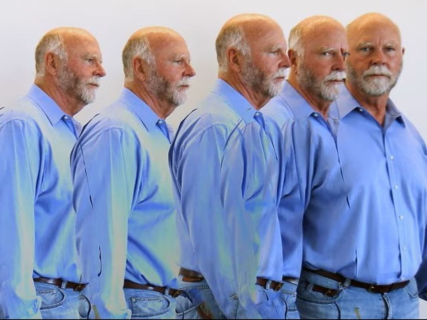
The American scientist Craig Venter passed away at the age of 79 in San Diego on April 29, 2026, as confirmed by the institute he founded, the J. Craig Venter Institute. According to available information, he died after a brief hospitalization due to the side effects of treatment for a recently diagnosed cancer. His passing has been reported by international media and confirmed by official sources linked to his scientific circle.
Venter was one of the key figures in modern biology, especially for his role in the sequencing of the human genome, one of the greatest scientific milestones of the late 20th century.
In the late nineties, Venter drove a parallel project to the Human Genome Project, the public international program funded by governments. His private initiative accelerated the process of sequencing human DNA, in a scientific race that marked a before and after in genetic research.
On June 26, 2000, both the public team and the one led by Venter jointly announced that they had managed to sequence the human genome, in an event held at the White House.
This achievement occurred after years of advances in genetic sequencing, in which Venter also participated in obtaining the first complete genome of an organism, a bacterium, in 1995.
From Public Research to Private Enterprise
Before that milestone, Venter had developed part of his career in public institutions such as the National Institutes of Health, where he participated in the identification of thousands of human genes.
In 1992 he founded his own non-profit research institute, with a model that combined private funding and shared access to scientific data. Subsequently, in 1998, he created the company Celera Genomics, with which he tackled the sequencing of the human genome using new technologies.
Celera also managed to sequence the genomes of the fruit fly and the mouse, key organisms in scientific research. The company reached a high valuation in the markets before the technological crisis of the early 2000s.
After his departure from Celera in 2002, Venter continued to develop scientific projects through new initiatives. Among them, he promoted the creation of synthetic organisms and developed research in the field of synthetic biology.
Throughout his career, he also founded several companies and research centers, consolidating a career that combined science, technology, and business activity.
His work spanned decades and contributed to the development of modern genomics, with applications in medicine, biotechnology, and the understanding of human DNA.
A profile marked by innovation and controversy
Venter's career was marked by his participation in projects that modified the pace of scientific research. His decision to compete with the public human genome project generated tensions within the scientific community.
During that process, his focus on private initiative and speed in obtaining results placed him at the center of the debate on the role of business in scientific research.
Throughout his career, he maintained his own positions on issues such as genetic data management or the relationship between science and business, in a context of changes in the biotechnology sector.