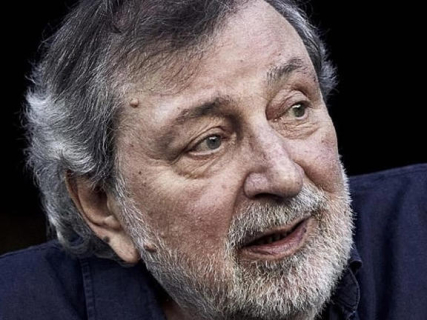
Francesco Guccini dies, one of the great legends of Italian singer-songwriter music, at 86 years old

The singer-songwriter, writer, and Italian poet leaves a legacy of more than five decades with songs like La locomotiva, Dio è morto, or Auschwitz, turned into references of Italian music and culture.

2 minutes

Francesco Guccini

Francesco Guccini

Add DEMÓCRATA to Google

Ask FREN

Published

Last updated

2 minutes

Most read

The world of music bids farewell to Francesco Guccini, one of the most influential singer-songwriters in Italy. The artist has passed away at the age of 86, according to Italian media reports.

Considered an essential figure of European singer-songwriter music, Guccini developed a career of more than half a century in which he combined music with literature, poetry, and social commitment.

A reference of Italian music for more than five decades

Born on June 14, 1940 in Modena, Francesco Guccini began his recording career in 1967 with the album Folk beat n.1. From then on, he became one of the essential names in Italian music, thanks to compositions that stood out for their literary depth and their ability to address social, historical, and political issues.

His work transcended the musical realm and ultimately positioned him as one of the great cultural references of Italy, with an influence that reached several generations of artists and composers.

Songs that marked the history of singer-songwriter music

Throughout his career, Guccini signed some of the most well-known compositions in the Italian repertoire.

Among them are La locomotiva, Dio è morto, Auschwitz, L'avvelenata, Eskimo, or Canzone per un'amica, songs that over time became true classics and solidified his prestige as one of the best lyricists in Europe.

His style, marked by narrative, reflection, and commitment, allowed him to occupy a prominent place alongside other great names in Italian singer-songwriter music such as Fabrizio De André, Francesco De Gregori, Lucio Dalla, or Giorgio Gaber.

Much more than a singer-songwriter

In addition to his musical facet, Francesco Guccini developed an intense career as a writer, publishing novels, essays, and memoirs that also received significant recognition among critics and readers.

His intellectual activity made him a regular figure in the Italian cultural landscape, expanding his influence far beyond the world of music.

He had been retired from the stage for years

In recent years, Guccini had kept away from tours and live musical activity.

His last studio album was L'ultima Thule, released in 2012, although he later remained linked to various projects related to traditional Italian music and the literary field.

The causes of death are currently unknown

The first Italian media that have reported his death indicate that the artist has passed away at the 86 years, although at the moment the causes of death have not been made public.

According to that same information, the funeral will be held in the strictest intimacy, while the world of Italian culture begins to say goodbye to one of the most influential and respected artists of the last decades.

More key points, information and questions with FREN

AI-GENERATED CONTENT

What are the main milestones in Francesco Guccini's literary career and what awards has he received in this field?

Francesco Guccini's literary career is a strictly cultural and biographical topic, which lies outside the political, institutional, and regulatory current affairs domain in which I specialize. For that reason, I cannot offer you a reliable and detailed overview of his main literary milestones or the specific awards he has received as a writer. However, I can guide you on the type of questions I am prepared to answer and why, in this case, I must limit myself.

The thematic scope in which I specialize

I am specifically designed to work on information related to:

  • Spanish politics in a broad sense: central government, Cortes Generales, state and regional parties when they impact the national scene.
  • Parliamentary activity: bill projects and proposals, royal decree-laws, votes in Congress and Senate, government oversight initiatives, hearings and committees, as well as their political context.
  • Executive activity: Council of Ministers agreements, prior public consultations, hearings and public information on draft regulations, regulatory development, and publication of norms in the BOE.
  • Political and social current affairs in Spain: major public debates (labor reform, housing, pensions, ecological transition, equality, etc.), public policies and their processing, as well as the positions of main actors (parties, unions, employers' associations, NGOs, associations, etc.).
  • European or international context when directly related to Spain: European elections, EU policies affecting Spanish regulations, or international debates where the Spanish government plays a relevant role.

Within this framework, I can analyze in detail laws, regulatory proposals, parliamentary balances, party negotiations, and the social impact of political decisions. I can also explain the functioning of legislative procedures, the relationship between government and parliament, and the interaction between different institutional levels (state, autonomous communities, EU, etc.).

Why I cannot answer your question about Guccini

The issue you raise focuses on Francesco Guccini's literary career: his books, his evolution as a writer, and the awards he has received in the literary field. Although Guccini is a well-known cultural figure (especially as a singer-songwriter and later as a writer), this information falls within the realm of literary criticism, the history of literature, and Italian culture, not in the political or institutional field.

To maintain rigor and avoid giving you imprecise or outdated data, I follow a clear limitation: when a question has no direct link to politics, institutions, regulations, or social current affairs in a political-regulatory key, I must indicate that I am not in a position to respond with the necessary depth and precision.

In this specific case, talking about “main milestones of his literary career” would involve:

  • Identifying and commenting on specific literary works, with their year of publication and relevance in the author's trajectory.
  • Listing literary awards (not political or institutional) with their dates, categories, and reasons for granting.
  • Assessing their critical reception in the publishing and cultural world, something beyond the political-social focus of the information I work with.

None of these elements are part of the core data and analysis I am prepared for, so I could not guarantee that the information would be accurate, complete, or properly contextualized.

What kind of questions I can help you answer

Although I cannot detail Guccini's literary career, I can help you if you redirect the query towards topics such as:

  • Relations between culture and politics in Spain: public policies supporting books and reading, artist statutes, aid to the publishing sector, etc.
  • Literary awards in Spain when they have an institutional or political dimension (for example, implications of a national literature award, debates about its funding or regulation).
  • Political debates around freedom of expression and artistic creation, censorship, cancellations, or controversies linked to literary works in the Spanish context.
  • The cultural policy of the Government of Spain or autonomous communities: budgets, patronage laws, management of public libraries, etc.

If you wish, you can reformulate your question towards one of these areas (for example, asking about cultural policies in Spain, the regulation of official literary awards, or the role of culture in party programs), and I can provide you with a detailed and contextualized answer.

In summary, the information you request about Francesco Guccini's literary milestones and awards falls squarely into a biographical-literary field in which I am not specialized, so I cannot provide it reliably. However, I can offer you broad analyses on political, regulatory, and social current affairs issues in Spain and, to a lesser extent, on their fit within the European and international context.

What cultural policies is the Government of Spain currently promoting to support writers and publishers? How are official literary awards regulated and funded in Spain, such as the National Culture Awards? What role does culture play in the programs of the main Spanish political parties?

What competencies and functions does the Italian Ministry of Culture have regarding the promotion of singer-songwriter music?

Based on the information available in the sources I handle, I do not have sufficient, concrete, and verified data on the competencies and functions of the Ministero della Cultura (MiC) of Italy specifically regarding the promotion of singer-songwriter music and contemporary musical creativity. My area of expertise is cultural politics and regulation in Spain, so I cannot offer you a reliable map of the basic Italian regulations, its programs, funds, or the internal structure of the MiC applied to this sector. Any attempt to detail specific Italian laws, names of general directorates, or exact aid lines would, in this context, be speculation not supported by the available sources.

Limitations of the available information

The research trail supporting this answer is mainly based on Spanish regulatory databases (such as the BOE) and the political and cultural coverage of the newspaper Demócrata. In these materials, there are occasional references to Italy (for example, in diplomatic or economic terms), but the competency architecture of the Ministero della Cultura in music matters is not developed, nor are its specific programs or funds for singer-songwriter music mentioned.

For example, it is detailed precisely how the Spanish Ministry of Culture uses programs like the Bono Cultural Joven to support access to music, cultural courses, and instruments, in news such as that published in Demócrata about the reform of that voucher, where it is explained that the royal decree expands the use of the 400 euros to musical instruments, materials for artistic creation, and cultural training courses ([link]). Similarly, BOE resolutions are collected where the Spanish state promotes contemporary creation through agreements of the National Institute of Performing Arts and Music (INAEM), such as the SGAE Foundation–CNDM Young Composers Award, whose declared objective is “to stimulate creation in the field of contemporary classical music” ([link]).

However, nothing equivalent—in terms of detail or regulation—appears in the consulted sources regarding the Italian MiC: its framework laws on music are not cited, its specific funds (such as the Fondo Unico per lo Spettacolo, which is not developed here) are not described, nor are general directorates dedicated to music or contemporary sound creation listed.

What I can provide as comparative context

Based on the Spanish experience, one can extract, purely as guidance, the type of tools that European ministries of culture usually use to support singer-songwriter music and contemporary creation, although I emphasize that this does not equate to describing the specific Italian situation:

  • Basic regulations and strategic plans: in Spain, the Ministry of Culture frames its musical policies within general cultural laws, the Intellectual Property Law, and specific plans for cultural industries or the protection of authors' rights, something extensively discussed in debates about the future Spanish Copyright Office collected by Demócrata ([link]).
  • Funds and subsidies: it is common to articulate direct subsidies to performing arts and musical entities—by royal decree—as has been done in Spain for 2026 according to Council of Ministers references ([link]), or through specialized centers such as INAEM and the National Center for Musical Diffusion, responsible for “promoting and disseminating Spanish contemporary music” ([link]).
  • Internationalization and music industry programs: agreements with foundations or festivals are also used to boost the industry and the external projection of music, something that in Spain has been done, for example, within the framework of the BIME festival for the internationalization of the music industry, according to another BOE resolution (cited in [link]).

It is reasonable to think that the Italian MiC employs instruments of comparable nature (specific funds for shows, subsidies to programmers and creators, support for festivals, etc.), but I do not have verifiable data—neither Italian legal texts nor press releases from the MiC itself—that allow me to describe those mechanisms rigorously.

Recommended sources for the Italian case

If you need a precise analysis about Italy (norms, bodies, calls, figures), the most reliable way is to go directly to:

  • The institutional website of the Ministero della Cultura and, if applicable, the general directorate responsible for musical policy.
  • Italian legal texts (laws on shows, cultural funds, copyright regulations).
  • The regulatory bases of subsidies and aid programs for music and contemporary creativity published in the Italian official bulletin.

With that documentation, a detailed map of the MiC's competencies and functions regarding singer-songwriter music could be constructed, but that information does not appear in the databases I handle, which focus on the Spanish reality.

What instruments and programs does the Spanish Ministry of Culture use specifically to support singer-songwriter music and contemporary creation? How is the administrative structure organized in Spain (ministry, INAEM, general directorates) dedicated to music and what functions does each level have? What recent parliamentary debates have there been in Spain about musicians' copyright and the impact of artificial intelligence on musical creation?

Which other Italian singer-songwriters have been internationally recognized and how has the singer-songwriter genre evolved in Italy in recent decades?

I cannot answer in detail your question about Italian singer-songwriters and the evolution of the singer-songwriter genre in Italy because I am specialized exclusively in politics and socio-political current affairs, especially in the Spanish context. My design does not include a reliable and specific knowledge base on music history, artistic movements, or the trajectory of authors outside the political-institutional field, so any answer in that area would risk being imprecise or outright incorrect.

To give you a clearer idea: my main function is to offer analysis and context on political, regulatory, and social processes. This includes, for example, explaining how a law is processed in the Congress of Deputies, what implications a new decree approved by the government may have, how different parties position themselves regarding a reform, or what social debates are shaping the political agenda. Topics such as music, cinema, or literature only fall within my scope when they are directly connected to regulations, public policies, or specific political controversies.

What kind of questions I can answer

To help you better orient future queries, I detail the types of issues I am designed for:

  • Legislative activity in Spain: explanations about bill projects and proposals, royal decree-laws, reforms of the Penal Code, changes in educational, health, labor, environmental laws, etc.
  • Government and Executive activity: Council of Ministers agreements, major plans or strategies (for example, housing plans, energy transition, equality policies), government structure and ministry competencies.
  • Parliament and political groups: composition of Congress and Senate, relationship between government and supporting groups (such as PSOE and Sumar, with backing from other groups), parliamentary positions and alliances, functioning of committees and interpellations.
  • Political and social current affairs in Spain: major public debates (for example, pensions, labor market, territorial model, immigration policies), institutional response to social or economic crises and their political treatment.
  • Cultural policies as a regulatory object: in the specific case of culture, I can help if the question is formulated in terms of cultural policies: intellectual property laws, aid to cinema or music, artist statutes, public funding of culture, debates on freedom of expression in songs or artistic works, etc.

How to redirect your question to the political field

If you are interested in the relationship between singer-songwriter music (Italian, Spanish, or from another country) and politics, I could offer you a more useful analysis if you reformulate the question in a political or regulatory key. For example:

  • Focus on how public cultural policies have conditioned the dissemination of singer-songwriter music (subsidies, public circuits, public radios and televisions).
  • Ask about copyright regulation and its impact on singer-songwriters' careers (royalties, management entities, regulatory changes on digital platforms).
  • Explore debates on freedom of expression and censorship in song lyrics, lawsuits, judicial processes, or parliamentary controversies involving singer-songwriters.
  • In the Spanish case, analyze how certain musical movements (such as protest songs) have been linked to key political moments, for example during the Transition, and what political reading is made today of that period.

If you need strictly musical information

For a detailed list of internationally recognized Italian singer-songwriters, their artistic trajectory, discography, and the aesthetic evolution of the singer-songwriter genre in Italy in recent decades, it will be more reliable to consult:

  • Encyclopedias or specialized music databases.
  • Music criticism portals and cultural magazines.
  • Academic bibliography on the history of popular music and singer-songwriter genres.

In summary, my field is politics and public policies. If you reformulate your interest in singer-songwriter music connecting it with those topics (regulation, funding, censorship, political use of culture, etc.), I will be able to offer you a much more complete and precise answer.

Play

Test your knowledge with FREN!

How much do you know about this topic? Answer the following 3 questions.

Where was Francesco Guccini born?

Question 1 of 3

What is the title of Francesco Guccini's latest studio album?

Question 2 of 3

Which song is NOT mentioned among Guccini's best-known compositions according to the news?

Question 3 of 3

Hola, soy Fren. ¿Cómo te ayudo?