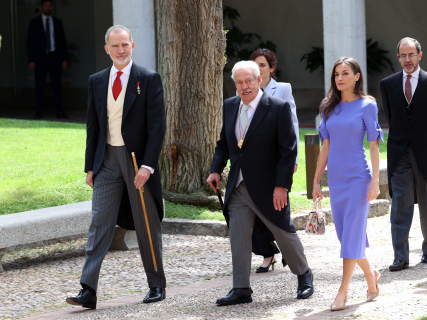
The Mexican writer Gonzalo Celorio has received this Thursday the Cervantes Prize in the Paraninfo of the University of Alcalá de Henares, where he has defended freedom as the essence of literature and has claimed the weight of the Spanish language and cultural heritage in the construction of Mexican identity.
During his speech, delivered before Kings Felipe VI and Letizia, the author remembered his father at the beginning of his speech and linked the recognition with a life dedicated to letters. "Today I arrived, Dad, exactly today, 64 years later," he stated emotionally.
Celorio focused a good part of his speech on the figure of Miguel de Cervantes and on the open and transgressive character of the novel. In his opinion, modern narrative finds in Don Quixote a permanent precedent of experimentation and breaking of norms.
"The novel is not just a literary genre, but also a libertarian one", maintained the Mexican writer, who defended a literature capable of mixing genres, memories, and personal experiences without being confined by traditional limits.
Defense of freedom and shared legacy
The author claimed freedom as one of the central concepts of Cervantes' work, understood as the sovereignty of the individual against any authority. As he explained, Cervantes' life experience —marked by prison and adversity— turned freedom into an essential value of his literary legacy.
Celorio also addressed the historical relationship between Mexico and Spain, a particularly sensitive issue in the political and cultural debate of recent years. In this regard, he defended that Mexican identity cannot be understood without the historical and linguistic link with Spain.
"Mexican nationality cannot be dissociated from Spanish history and culture that are inherent to it", he affirmed. The writer went further and highlighted the role of Castilian in the configuration of Latin American nations. "Without the Spanish language, neither Mexico nor any other Hispanic American country would have been able to configure its nationality", he pointed out.
A Work Marked by Memory and Identity
Celorio's literary career is deeply linked to personal and family memory. In novels such as Amor propio, Tres lindas cubanas or El metal y la escoria, the writer has explored stories of migration, exile, and family inheritances, mixing autobiographical elements with fiction.
The author explained that a large part of his creative process stems from research in personal archives, photographs, letters, and family diaries. As he recounted, that search allowed him to discover hidden stories and unknown episodes within his own genealogy.
For Celorio, literature should not be trapped by absolute fidelity to facts. Therefore, he defended the freedom to transform names, dates, and situations when fiction requires it. "Invention made the original story deeper," he maintained during his speech.
Institutional recognition
The Minister of Culture, Ernest Urtasun, highlighted during the event the relevance of Celorio within Hispanic letters and underlined the importance of public universities and academic autonomy. For his part, King Felipe VI praised the contribution of Mexican literature to the entirety of the Spanish language and highlighted the historical ties between both countries.
The monarch recalled that Spain and Mexico share a literary and cultural tradition that spans centuries and continues to strengthen the Spanish-speaking community. With this recognition, Gonzalo Celorio joins the list of authors distinguished with the highest award in Spanish letters, consolidating a career marked by memory, literary reflection, and dialogue between cultures.