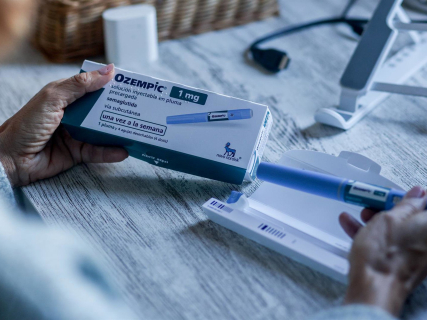

The U.S. Food and Drug Administration (FDA) has ordered strengthening safety warnings for medicines such as Ozempic and Wegovy due to their possible link to an eye disease that can cause sudden and even permanent loss of vision. The decision, announced on November 9, requires the manufacturers of the GLP-1 drug family, used mainly to treat type 2 diabetes and obesity, to include specific information about the risk of developing non-arteritic anterior ischemic optic neuropathy (NOIANA).
The measure affects some of the most widely used treatments for glucose control and weight loss. Ozempic and Wegovy, marketed by Novo Nordisk, are among the medicines included, but the warning also extends to other products, such as Mounjaro and Zepbound, by Eli Lilly. The FDA has made this decision after reviewing clinical trials, observational studies, and reports of adverse effects, although it insists that this is a rare complication and that the risk should be weighed alongside the benefits of each treatment.
The new development has special relevance for those who use these medicines in Spain, where health authorities had already identified a possible link between semaglutide and this eye disease. However, the U.S. decision expands the warning to the entire GLP-1 class of medicines, while previous European recommendations focused specifically on semaglutide.
What eye disease can Ozempic and Wegovy cause
The disease that has prompted the warning is known as non-arteritic anterior ischemic optic neuropathy (NOIANA). It occurs when blood flow to the front part of the optic nerve decreases, which is responsible for transmitting to the brain the visual information captured by the eyes.
Its main characteristic is that it can cause sudden loss of vision, generally in just one eye and without pain. In some cases, the change appears upon waking up and can manifest as a significant decrease in visual ability or the appearance of dark areas in the field of vision.
The FDA identifies several symptoms that should prompt immediate medical evaluation: sudden blurred vision, partial loss of vision, appearance of blind spots, tunnel vision, or changes in color perception. The disease can leave permanent sequelae and there is currently no treatment that guarantees recovering lost vision.
Among the factors that may increase risk are diabetes, high blood pressure, sleep apnea, smoking, anemia, and certain kidney diseases. The overlap between some of these problems and the diseases for which GLP-1 medications are prescribed makes it difficult to determine what portion of the risk is directly due to the drugs.
What the FDA has found: 15 cases in more than 134,000 patients
To make its decision, the FDA analyzed 126 clinical trials that included 134,253 participants, of whom 78,217 received GLP-1 medications and 56,036 were part of the comparison groups.
During follow-up, it identified 15 probable cases of non-arteritic anterior ischemic optic neuropathy: ten among patients treated with GLP-1 and five among those who received placebo. The calculated incidence was of 6.4 cases per 100,000 person-years of treatment, compared with 3.8 cases per 100,000 person-years in the comparison groups.
These data point to a higher frequency among those who used the medications, but they also show that the absolute risk is low. The person-year unit makes it possible to compare the occurrence of cases while taking into account both the number of participants and the time during which they were followed.
The U.S. agency also examined health data from patients with type 2 diabetes treated with different medications. In that analysis, it observed a statistically significant increase in risk compared with DPP-4 inhibitors, but it did not find a statistically significant difference when comparing GLP-1 with SGLT-2 inhibitors.
In addition, the reviewed experimental studies did not identify a biological mechanism that conclusively explains how these medications could favor the onset of the disease. Therefore, the warning responds to the body of evidence regarding a possible increase in risk and does not mean that all cases of vision loss recorded among patients were caused by the treatment.
The warning already existed in Spain for semaglutide
Although the FDA communication was issued in November 2026, the ocular risk associated with semaglutide is not an absolute novelty for European patients.
The European Medicines Agency (EMA) concluded in June 2025 that non-arteritic anterior ischemic optic neuropathy should be incorporated into the safety information of medicines containing semaglutide, including Ozempic, Wegovy and Rybelsus.
The Spanish Agency for Medicines and Health Products (AEMPS) published the 9 June 2025 a communication in which it reported this adverse reaction and classified it as very rare, with a frequency of up to one person per 10,000 patients.
According to the European assessment, the epidemiological studies suggested that adults with type 2 diabetes treated with semaglutide could present approximately twice the risk of developing this condition compared with people who did not use the medication. However, the EMA estimated that, in absolute terms, that increase equated to approximately one additional case per 10,000 people treated over a year.
The fundamental difference is that the FDA has now extended the requirement for a warning to the entire therapeutic class, including other active ingredients other than semaglutide. For that reason, the measure should not be interpreted as the detection of a completely new disease, but as an update and expansion of the available safety information.
Should Ozempic or Wegovy be stopped because of the new warning?
The FDA has not ordered the withdrawal of Ozempic, Wegovy, or the rest of the affected medicines from the market. It also does not recommend suspending them in a generalized manner. The agency states that patients should know the warning symptoms and consult a healthcare professional when they experience sudden visual changes.
In the case of a person who is following a treatment and detects sudden loss of vision, intense blurred vision, or a sudden alteration of the visual field, the recommendation is to seek urgent medical attention so that an ophthalmology specialist can determine the cause.
European authorities have established a specific indication for semaglutide: if a diagnosis of anterior ischemic optic neuropathy that is non-arteritic is confirmed, treatment must be discontinued. For the entire GLP-1 class, the FDA recommends that professionals consider stopping if this condition appears, taking into account the risks and benefits of each case.
This means that patients who do not have symptoms should not stop treatment on their own solely because of the new warning. Stopping a prescribed medication for diabetes or obesity can have consequences for disease control, so any change must be made under medical supervision.
Which medications are affected by the U.S. decision
The FDA has included in its decision different medications used to control glucose, treat obesity, and reduce certain risks associated with metabolic diseases. Among them, the following stand out Ozempic, Wegovy and Rybelsus, which contain semaglutide; Mounjaro and Zepbound, which contain tirzepatide; and other treatments such as Saxenda, Victoza and Trulicity.
The obligation to include warnings does not mean that all of them present exactly the same level of risk. The available evidence is different for each active ingredient, and the agency has adopted a common measure because it has received notifications of cases with the different medications in this family.
The update comes at a time of expansion of GLP-1 treatments, whose use has increased considerably due to their results in patients with type 2 diabetes and obesity. In this situation, health authorities consider it necessary to improve the available information both for those who already receive these treatments and for the professionals who prescribe them.
The main conclusion of the new warning is that there is a rare eye risk that should be known about and monitored, but that alone does not justify abandoning the medications in general. For Spanish patients, the recommendation remains to pay attention to any sudden loss of vision, go immediately to a specialist, and consult with their doctor before modifying treatment.