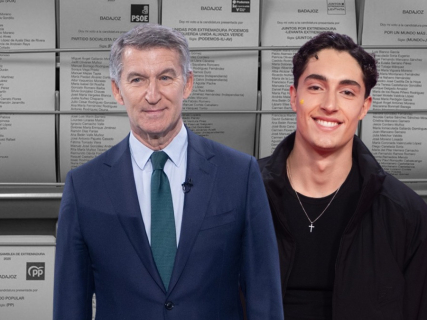
Plex joins Feijóo's campaign a few kilometers from the appointment with the ballot boxes on 29N

The candidate of the PP will record on Monday a conversation with the YouTuber, who has nearly 15 million subscribers, while Génova assures that its internal polls show an increasingly growing distance between blocs

WhatsApp Image 2026 11 20 at 13.33.06 (1)

WhatsApp Image 2026 11 20 at 13.33.06 (1)

Add DEMÓCRATA to Google

Ask FREN

Published

Last updated

2 minutes

Most read

Elecciones 29N · Encuestas

La media de las encuestas

Media a 20 de noviembre de 2026 · 19 institutos

  • PP31,0 %
  • PSOE27,8 %
  • Vox19,1 %
  • Frente Amplio6,2 %
  • ERC2,5 %
01020304050ene 2024jul 2024ene 2025jul 2025ene 2026jul 2026

Media del último estudio de cada instituto en 30 días y su evolución semanal desde el 23J. Partidos con al menos un 2 %.

Todas las encuestas

Elecciones generales del 29 de noviembre · Demócrata

The PP candidate will record on Monday a conversation with the youtuber, Daniel Alonso, popularly known for Plex, one of the most followed content creators in Spain, who adds close to 15 million subscribers, while Génova assures that its internal polling shows an ever-increasing distance between blocks

Also known for his partner, singer Aitana, the youtuber from Zamora offers the PP a showcase that traditional media does not give them: that of a young audience that hardly follows a news bulletin.

A strategy on several fronts. The appointment culminates an offensive on high-audience youth channels and podcasts. Feijóo has already granted interviews to The Wild Project, by Jordi Wild, and to El Sentido de la Birra, by Ricardo Moya, and has sent a video to Línea de Cal.

In the party’s leadership, they assume that young people do not get their information from traditional media and that on 29 November they will vote for the first time 1.6 million young people.

PP, first in the polls

The party led by Alberto Núñez Feijóo reaches the last week as the leading force in most polls. The average of 15 institutes that DEMÓCRATA prepares as of 14 November places the PP at 31.4%, the PSOE at 26.9%, and Vox at 19.1%. 40dB, GAD3 and NC Report agree on placing the popular party above 30%.

GAD3 for ABC gives the PP 31.9% and 136 seats, compared with 25.9% and 103 for the PSOE. The latest tracking by 40dB for El País and the SER places the PP at 32.4% and the PSOE at 30.4%. Sigma Dos for El Mundo estimates a PP and Vox majority of between 184 and 195 seats.

The DataRTVE model, which aggregates polls, gives both parties an average of 194 seats and an absolute majority in 93% of its simulations. The exception is SW Demoscopia’s tracking for La Séptima, which on 13 November placed the PSOE ahead with 31.6%, versus the PP’s 28.5%.

What they see in Génova. Sources from the PP confirm to DEMÓCRATA that the distance between blocks that they detect is increasingly greater and that, according to their trackings, the party does not stop rising. They recall that in 2023 the difference between the PP and the PSOE was just 1.5 points and argue that today, with the sum of blocks, it exceeds 12.

The Albiol effect and Ion Echeverría

The same sources assure that the Albiol effect can have a positive response at the polls, both in Catalonia and in the rest of Spain. The mayor of Badalona and top of the list for Barcelona responded to an Ara survey that points to a possible loss of a PP deputy in Catalonia, saying that the perception on the street is "very positive".

In the Basque Country, the party believes that Jon Echeverría could win a seat for Gipuzkoa. Echeverría denounced the throwing of stones, eggs, and firecrackers during a campaign event in Hernani, and Feijóo announced that he would travel to Gipuzkoa to support him.

More key points, information and questions with FREN

AI-GENERATED CONTENT

What are the competencies and functions of the president of the Partido Popular according to the party's statutes?

The national president of the Partido Popular is, according to its Statutes, the highest authority of the party. Their competencies focus on political and legal representation, the direction and coordination of the organization, the execution of agreements, and the proposal of certain appointments. The main reference is Article 44 of the National Statutes approved in 2025, available in the official PP text.

Main competencies and functions

  • Represent the party politically and legally. They are responsible for holding both representations. This attribution places the president at the forefront of the PP's external actions, both in its political dimension and as an organization with legal personality.
  • Preside over the main national bodies. They preside over the National Board of Directors and the National Executive Committee. In both, they have a casting vote in the event of a tie: that is, their vote resolves it. This power refers to decisions of those bodies, not a general substitution of their competencies.
  • Execute and develop agreements. They must take the necessary measures to fulfill and develop the agreements of the party Congress, the governing bodies of its territorial organization, and other bodies with superior statutory competence. Therefore, the presidency not only directs: it must also comply with decisions made by other bodies according to the Statutes.
  • Propose the management team. They can propose to the Executive Committee the appointment of the secretary general, the general coordinator, the deputy secretaries general, the coordinators, the secretaries, and the director general of Finance and Organization. The distinction is important: the article attributes the initiative to propose these appointments to the president, while the decision corresponds to the Executive Committee.
  • Propose the composition of certain committees. When appropriate, they propose to the Executive Committee the appointment of the president and members of the Electoral Committee, the Rights and Guarantees Committee, and the Membership Committee. Here too, it is a proposal power, not a unilateral appointment by the president.
  • Coordinate political action. They are responsible for coordinating the PP's political action throughout its organization. In the case of the national presidency, this responsibility extends to the state level and allows for articulating a common political action among the party's different components.
  • Authorize statements that commit the party. The Statutes require their authorization for any statement made on behalf of the Partido Popular or that may affect or politically commit it. This function reinforces their responsibility over the expression of the organization's official position.

How the scope of these powers should be understood

Article 44 combines powers inherent to the presidency, such as representing the party, presiding over bodies, or coordinating its political action, with powers that require the intervention of a collegiate body. The clearest example is appointments: the president proposes and the Executive Committee decides.

Likewise, being the highest authority does not mean they can disregard Congress agreements or indiscriminately assume the functions of all bodies. The very obligation to execute agreements shows that their leadership is exercised within a statutory structure with distributed responsibilities.

In short, the presidency gathers the political leadership and representation of the PP, leads its main national bodies, and drives the composition of its leadership. To interpret a specific decision, it is advisable always to distinguish between representing, coordinating, executing, authorizing, and proposing: the Statutes assign different effects to each of these actions.

What has been the professional and political career of Daniel Alonso, known as Plex, before becoming a YouTuber?

Daniel Alonso Agúndez, known as Plex or YoSoyPlex, does not have a documented professional or political career prior to YouTube in the consulted sources. His known trajectory begins as a student in Toro, Zamora, and continues with video creation during adolescence. Therefore, it would not be correct to present him as a former politician or professional from another sector who later became a YouTuber.

Origins and education

Biographical profiles place his origins in Toro, in a family linked to agriculture. That environment is part of his personal history but does not prove that he worked professionally in the agricultural sector before dedicating himself to the internet. The LaSexta profile identifies IES Cardenal Pardo Tavera, in Toro, as his school.

He attended high school while beginning to develop his digital activity. The consulted publications do not fully agree on whether he finished it: several indicate he left or paused studies around age 17, while others say he completed them. Therefore, what is certain is that his beginnings on YouTube coincided with his educational stage; a single version about finishing high school cannot be stated without reservations.

A GQ interview describes the family conditions of those early years: he had to maintain good grades for his mother to allow him to keep recording. That story helps understand the transition: he did not go from a consolidated profession to social networks but gradually prioritized videos while still studying.

From student to content creator

The biographies consulted place the channel opening in 2014 and the start of regular publications in 2018. These are two different moments: creating an account does not mean having a professional dedication yet. His initial activity focused on video games, especially Fortnite, before evolving towards daily videos, challenges, entertainment, and travel, as the ABC report notes.

According to the 20minutos profile, he moved from Toro to Madrid at age 17 to boost his career as a creator. That change already belongs to the development of his internet activity, not a previous work stage. No conventional jobs, university degrees, or completed vocational training are recorded in the consulted sources.

Did he have a previous political career?

There is no record of an organized political career before YouTube. The consulted sources do not document membership in parties, electoral candidacies, public offices, party responsibilities, or union affiliation. No verifiable participation in student movements, political platforms, or social movements prior to his creator activity has been found.

This does not allow stating that he never had political opinions or participated in some private activity. It means, more precisely, that there is insufficient public documentation to attribute those backgrounds to him. It would also be inaccurate to deduce a specific ideology from his family origin, studies, or entertainment content.

The appearance alongside Alberto Núñez Feijóo recorded by El Periódico corresponds to November 2026, when Plex was already a known creator. It alone does not prove membership or a previous political career.

In short, his prior path was essentially educational and familial. The first publicly identifiable professional career is digital content creation; no consolidated previous profession or organized political past is recorded.

What legal requirements must parties meet to hold campaign events specifically aimed at minors or young people during an electoral period?

In Spain, there is no general prohibition on holding political events aimed at minors: they have rights to information, ideological freedom, and participation. Parties must respect electoral rules and protections for minors, especially when collecting data or broadcasting images. It is advisable to distinguish between young adults and minors, and between attending an event, starring in it, and receiving personalized advertising.

1. Voluntary participation and consent

Articles 6 and 7 of the Legal Protection of Minors Act recognize ideological freedom, participation in youth organizations of parties, and attendance at peaceful public meetings. Therefore, minority of age should not be confused with a general incapacity to participate politically.

The law requires express consent from parents, guardians, or custodians when minors promote and convene such meetings. It does not establish the same general requirement for mere attendance. Participation must respect their freedom of conscience: attending does not equate to authorizing any subsequent use of their identity.

2. Electoral calendar and organization

Events aimed at young people are not exempt from the Organic Law of the General Electoral Regime —LOREG—:

  • Deadlines: Articles 51 and 53 regulate the campaign duration and prohibit holding campaign events or distributing propaganda once it has ended.
  • Prior advertising: from the call until the legal start of the campaign, electoral propaganda through posters, commercial media, or press, radio, and digital media insertions is prohibited, under Article 53.
  • Public meetings: Article 54 refers to legislation on the right of assembly and assigns functions to provincial electoral boards. The communication required should be distinguished from a general prior authorization.
3. Protection of image and name

Article 4 of the Legal Protection of Minors Act protects honor, privacy, and image. It considers illegitimate the use of name or image in media that harms reputation or is contrary to their interests, even with the consent of the minor or their representatives.

Additionally, Article 92 of the Data Protection Act requires consent to publish minors' data on social networks, according to its Article 7. When processing is based on consent, Spanish law allows it from 14 years old; below that, it corresponds to their legal representatives. That threshold does not automatically authorize any use of images nor replace protection of other rights.

4. Personal data and personalized messages

Collecting phone numbers, registrations, or information about political preferences is a different matter from allowing access to the event. A general authorization to collect political opinions cannot be invoked: the Constitutional Court ruling 76/2019 annulled Article 58 bis.1 of LOREG, which allowed it. Personalized advertising requires a specific examination of data protection rules; parental consent should not be treated as universal permission.

5. Educational centers and public resources

Holding a rally in educational facilities is not the same as incorporating propaganda into a teaching activity. The rules for using the center and the competence of whoever grants it must be respected, without presenting the school as a partisan organizer. Article 50 of LOREG limits acts organized or financed by public authorities and campaigns carried out by legal entities other than the electoral entities provided for.

In summary: participating, being photographed, and receiving political messages are different decisions; no authorization should be assumed from another.

Play

Test your knowledge with FREN!

How much do you know about this topic? Answer the following 3 questions.

What strategy is the PP using to attract young voters in the November 29 election campaign?

Question 1 of 3

What is the percentage of votes that the average of 15 high schools gives to the PP according to the DEMÓCRATA model as of November 14?

Question 2 of 3

What incident did Jon Echeverría report during a campaign event in Hernani?

Question 3 of 3