

With 195 votes in favor out of 344 votes cast, 33 against, and 116 abstentions, the bill (PL) on "granting Spanish nationality to Sahrawis born under Spanish administration". The initiative, from the Sumar Group, has overcome its consideration in the Plenary Session of Congress.
The initiative has moved forward with the support of all parliamentary groups with the exception of Vox, which abstained, and the Socialist, which voted against. The result is identical to that of the last legislature, when it was also debated and submitted to the consideration process. That bill, then registered by Unidas Podemos, lapsed with the early election.
Just like three years ago, the socialists have positioned themselves against the measure alleging legal issues, while in Vox they have alleged "distrust towards the proposing group".
Requirements for accreditation
The rule defended by Sumar consists of two articles, one additional provision, and five final provisions. Article 1 establishes the requirements for granting Spanish nationality by letter of naturalization to Sahrawis. Under section 1 of article 21 of the Civil Code, a series of "exceptional circumstances" are required. In this regard, the PL understands that these are met by Sahrawis born in the territory of Western Sahara before February 26, 1976, even if they do not have legal residence in our country.
To accredit such condition, a series of evidentiary means are listed that will be valued as a whole:
- Spanish National Identity Document, even if expired, with identity verification by the services of the Directorate-General of the Police.
- Certificate of registration in the Spanish census of 1974 or in the census for the Western Sahara referendum issued by the United Nations.
- Birth certificate issued by the Sahrawi authorities from the refugee camps in Tindouf and legalized by the Representation of the Polisario Front in Spain.
- Birth certificate, family book, or documents proving public employee status issued by the Spanish administration in Western Sahara
- Any other document from a Spanish administrative authority that proves birth in Western Sahara before February 26, 1976.
The nationality would also be granted according to the current text to first-degree blood relatives who have acquired Spanish nationality by letter of naturalization in accordance with the present initiative within five years, counting from the registration in the Civil Registry of the acquisition of Spanish nationality.
In the first person
On behalf of Sumar, the deputy from Sumar Tesh Sidi, born in the Sahrawi refugee camps in Tindouf, Algeria, has defended the initiative. "It will be difficult for me not to speak in the first person," she acknowledged at the beginning of a very harsh speech against her government partners, in which she urged them to "engage in an exercise of restorative memory." In her opinion, this proposal puts an end to a historical demand of the Sahrawi people: to equate their case with that of citizens from Latin America or Sephardic Jews regarding the process of acquiring Spanish nationality.
Along the same lines, the deputy from Coalición Canaria, Cristina Válido, has expressed herself, recalling when the Sahara was the 53rd province of Spain and had representatives in this Chamber: "Now they are ignored." For Jordi Salvador i Duch (Junts), this PL would serve to repair an error, "but it is not a whim, nor a symbol."
For her part, Maribel Montero, deputy of the PNV, has urged an end to the "breach of international legality" in which she considers the Spanish State is incurring since its withdrawal from the Sahara.
In their interventions, PP, EH Bildu, and ERC have asked the Socialist group and the Government not to put an initiative on this matter back in the "freezer," in allusion to, among others, the Popular Legislative Initiative for the regularization of immigrants taken into consideration by Congress months ago and which, like dozens of legislative initiatives from other groups, remains stuck in its committees with permanent extensions of the amendment period. "We hope that on this occasion the process will be finalized," stated Carmelo Barrio (PP).

The popular and the abertzales have also agreed on the need to debate aspects such as deadlines during the amendment process. "If it is a right, it cannot have limits. But this is a debate that we hope to have during the legislative process," has defended Jon Iñarritu (EH Bildu).
The PSOE, alone
Most spokespersons have directed criticism towards the PSOE for the absence of explanations after the sudden change in foreign policy that occurred in 2022 and which ended the historical Spanish stance of neutrality regarding the former colony. Since then, official positions are closer to Moroccan claims.
On behalf of the Socialist Group, Sergio Gutiérrez took the floor, who insisted that the topic the plenary was debating "emotionally binds us all," before distancing himself from the majority position of the Chamber for three reasons.
First of all, regarding the application of the letter of naturalization to acquire nationality, Gutiérrez has taken refuge in a Supreme Court ruling (2020) which holds that "those born in a territory during the stage in which it was a colony are not born in Spain, for nationality purposes".
Secondly, he has criticized that legislation is made ad hoc, "we run the risk of falling into some legal contradiction." And he has defended equating the process of the Sahara with that which followed with Equatorial Guinea: "We believe it is a good starting point."
Lastly, he acknowledged that in his group doubts are generated that private organizations can legitimize the documents that would automatically certify the letter of naturalization, and consequently, nationality.
The proposition now advances to its next parliamentary phase with the desire of the associations, and apparently, of the majority of the parliamentary groups, that it not be a victim again of the continuous extensions of the amendment period.
Procedure
The period available to interested parties to apply for nationality would be two years from the entry into force of the law, although the possibility is foreseen that, by resolution of the Ministry of Justice, it may be extended for another year.
The application must be addressed to the General Directorate of Legal Security and Public Faith, of the Ministry of Justice; and along with it, the aforementioned supporting documents and the current certificate proving the absence of a criminal record, legalized or apostilled, and where applicable, translated, corresponding to the countries in which the applicant has resided in the last five years, must be submitted. In this regard, a justification of the impossibility of obtaining it would also be accepted.
Immediately thereafter, the Directorate General of Legal Security and Public Faith will request the mandatory report from the Ministry of the Interior and the Presidency to issue the resolution within a period of 12 months.
Once the resolution is issued, the interested party will have one year to request registration in the Civil Registry and make before the Registrar the legally appropriate declarations regarding the oath or promise of fidelity to the King and obedience to the Constitution and laws. If the period expires, the procedure will lapse.
Lastly, the initiative includes a modification of article 22 of the Civil Code to include Sahrawis.
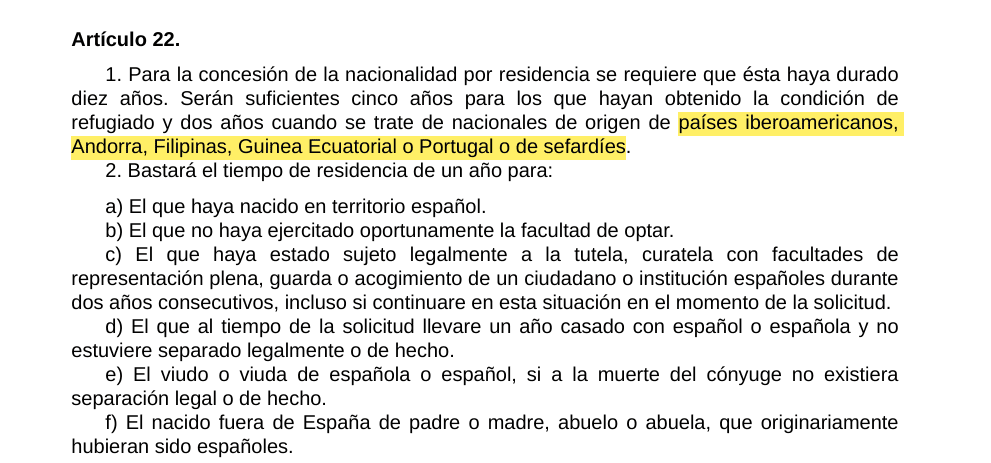
Precisely, on this last point, a PNL was unanimously approved in the Justice Commission in 2016, and it is the starting point that the PSOE would opt for.