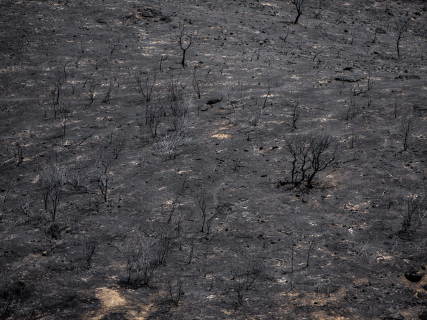
The fires have already ravaged 194,000 hectares in Spain: almost six times more than a year ago.

The Ministry for Ecological Transition counts 39 large forest fires so far in 2026, compared to the 12 recorded in the same period last year.

1 minute

incendios hectáreas quemadas

incendios hectáreas quemadas

Add DEMÓCRATA to Google

Ask FREN

Published

Last updated

1 minute

Most read

Wildfires have already ravaged 194,122 hectares in Spain since the beginning of 2026, an area 5.8 times larger than that recorded on the same dates last year, when 33,360 hectares had burned. This is evident from the provisional data provided this Wednesday by sources from the Ministry for Ecological Transition and the Demographic Challenge (MITECO) during the meeting of the Environmental Management Committee.

The balance also reflects a notable increase in large wildfires. So far this year, 39 large wildfires have been counted, those affecting more than 500 hectares, compared to the 12 recorded in the same period of 2025.

The Government urges not to let guard down

Despite the positive evolution of large wildfires, the Environmental Management Committee has insisted on the need to maintain maximum caution during the coming days.

The Ministry warns that the risk of fire remains very high in much of the north, east, and central peninsula. In addition, an extreme danger level persists in areas of the interior of the Mediterranean communities, southern Andalusia, and the more mountainous Canary Islands.

Weather forecasts also indicate a new increase in the risk of fires heading into the next weekend.

Operations continue in Aragón and Ávila

In recent days, the Ministry's resources have focused much of their activity in the Huesca Pyrenees, where several small-scale fires have been recorded, but especially complex due to their location and the combination of high temperatures with thunderstorms, one of the usual causes of this type of fire.

The teams have also intervened in various reactivations of the Burgohondo (Ávila) fire, one of the largest fires recorded this summer, where surveillance and perimeter consolidation work continues to prevent new flare-ups.

More key points, information and questions with FREN

AI-GENERATED CONTENT

What parliamentary procedures are necessary to modify the legislation on forest fire prevention in Spain?

To modify the legislation on forest fire prevention in Spain, the ordinary procedure for amending a law is essentially followed: debate and approval in the Congress and the Senate, followed by sanction and promulgation. The starting point (Government or Parliament) changes, and in urgent cases, the royal decree-law route can be used, which requires parliamentary validation. In all cases, the reform is subject to the control of the Chambers and only comes into force after its publication in the Official State Gazette (BOE).

1. Reform through a government bill

1.1. Preliminary government phase

If the initiative comes from the Government (for example, from the competent environmental ministry), a bill to amend the forest fire prevention regulations is drafted and approved by the Council of Ministers. Then, the Government sends this bill to the Congress of Deputies.

1.2. Processing in the Congress

In the Congress, the bill follows the general phases described for any law:

  • Qualification and admission for processing: The Congress Board qualifies the bill and, if no formal defects are found, admits it for processing.
  • Opening of amendment period: Once the text is admitted, a period is opened for parliamentary groups to submit amendments, both partial modifications and, if applicable, total amendments.
  • Debate on the entirety in Plenary: The Plenary may debate the “entirety” of the bill. Total amendments can be submitted to return it to the Government or propose an alternative text. If the Plenary rejects these amendments, the bill continues its course.
  • Work in committee: After passing the entirety debate, the text goes to the competent committee (in these matters, the committee assigned environmental policies). In committee, partial amendments are discussed and voted on, and a report on the bill is prepared.
  • Debate and voting in Plenary: The committee's report is submitted to the Congress Plenary, where it is debated. At this stage, amendments that remain “live” because they were not incorporated in committee may be debated. The Plenary votes on the text; if approved, it goes to the Senate.
1.3. Processing in the Senate and return to the Congress

In the Senate, the reform is also examined and voted on:

  • The Senate may approve the text without changes; in that case, the law is ready for sanction.
  • It may amend the text. Then the bill returns to the Congress, which decides whether to accept or reject the Senate amendments.
  • It may veto the bill. The Congress can override the veto by the majority provided in the Rules (absolute majority, or simple majority after a certain period).

Once the Congress sets the final text, it is sent to the Head of State for sanction.

1.4. Sanction, promulgation, and publication

The King proceeds to the sanction and promulgation of the reform law on behalf of the State, and the text is published in the Official State Gazette (BOE). From its entry into force, the new rules on forest fire prevention replace or modify the previous ones.

2. Reform through a private member's bill

If the initiative does not come from the Government but from one or more parliamentary groups or an autonomous parliament exercising legislative initiative, it is processed as a private member's bill. The parliamentary scheme is very similar to the one described:

  • The bill is presented in the Congress and is qualified and admitted for processing by the Board.
  • An amendment period is opened, a total debate is held if applicable, and it is sent to the competent committee for discussion and report.
  • The Congress Plenary debates and votes on it, and the approved text goes to the Senate, which may approve, amend, or veto it, returning it to the Congress if applicable.
  • Once the Congress and Senate procedures are completed, sanction, promulgation, and publication in the BOE occur.

The main difference is the origin of the initiative (Government versus parliamentary groups or autonomous parliaments), not so much the internal steps in the Chambers.

3. Reform by royal decree-law in case of urgency

If the Government considers there is an extraordinary and urgent need (for example, a critical fire situation), it may approve a royal decree-law that immediately modifies aspects of the forest fire prevention regulations.

This instrument has immediate effect after its publication in the BOE but must be submitted to validation by the Congress within a short period. The Congress Plenary may:

  • Validate the royal decree-law, maintaining its validity.
  • Repeal it, in which case it ceases to be in force.
  • Additionally, it may agree to its processing as a bill by the urgent procedure, allowing the text to be modified by subsequent amendments in committee and Plenary.

Although this route speeds up the response to emergencies, the stable and structural modification of forest fire prevention legislation is usually channeled through the ordinary procedures of government bill or private member's bill described above.

What practical difference is there between processing the forest fire prevention reform as a government bill or as a private member's bill from a parliamentary group? In what cases has Spain resorted to royal decree-laws to address forest fire situations, and how were they subsequently processed in the Congress? What role do autonomous communities usually have in the development or promotion of reforms on forest fire prevention at the state level?

What are the competencies of the Ministry for the Ecological Transition and the Demographic Challenge regarding forest fire management?

The Ministry for the Ecological Transition and the Demographic Challenge (MITECO) is not directly responsible for extinguishing all forest fires (a competence that falls to the autonomous communities), but it does concentrate most of the state functions of forest policy, prevention, technical coordination, information, and support with state resources. These functions derive from the Forestry Law and the basic civil protection regulations. Additionally, MITECO leads national coordination through specialized bodies and manages statistical information on forest fires. Below are its main competencies as derived from the current legal framework.

1. General framework of competence distribution

The Law 43/2003, of Forests, amended by Law 21/2015, establishes that the General State Administration (AGE) has basic competencies in forest policy and forest fires, while:

  • The autonomous communities exercise competencies in forests and forest uses and, in practice, organize ordinary prevention and extinction of fires.
  • Local entities have management functions over forests they own.

These state competencies in forestry and fires are currently exercised through MITECO, which also appears expressly as a technical and statistical reference in the Royal Decree-law 15/2022, on urgent measures regarding forest fires.

2. State functions of forest policy and fires (Forestry Law)

The Forestry Law assigns to the AGE, and therefore to MITECO in its material scope, a series of functions directly related to forest fires:

  • Definition of forest policy and strategic planning: preparation of documents such as the Spanish Forest Strategy or the Spanish Forest Plan, which condition prevention and fire management policy (art. 33.2.a of the Forestry Law, according to the excerpt shown).
  • Forest information and statistics: the law assigns the State the “collection, preparation, and systematization of forest information to maintain and update the Spanish Forest Information”, which includes data on fires (art. 33.2.b).
  • Common guidelines for prevention and extinction: it corresponds to the State the “establishment of common guidelines on training in fire extinction and prevention, standardization of material means and equipment of forest fire extinction personnel throughout Spanish territory”, as well as the deployment of state support means to autonomous communities for forest fire coverage (art. 33.2.c, according to the reproduced text).
  • Information management and international cooperation: the AGE coordinates the sending of data to community bodies and European networks on the state of forests (art. 33.3.b), a field in which international cooperation on fires fits.

The preamble of the Forestry Law also emphasizes the need for coordination among Administrations in fire prevention and fighting and the obligation to restore burned lands, which supports state programs for hydrological-forest restoration promoted by MITECO.

3. National coordination, information, and specific bodies

The Royal Decree-law 15/2022 details the state coordination device:

  • National coordination of forest fires corresponds to the Committee for the Fight against Forest Fires (CLIF), attached since 1994 to the State Commission for Natural Heritage and Biodiversity, a structure linked to MITECO's competence scope.
  • Technical and statistical information is channeled through the National Forest Fire Information Coordination Center of the Ministry for the Ecological Transition and the Demographic Challenge, which collects data on number of fires, large fires, affected area, etc.
  • CLIF prepares the “Strategic Guidelines for Forest Fire Management in Spain”, approved in the Environmental Sectorial Conference as a national coordination guiding framework, in which MITECO acts as a technical and consensus engine.

4. Civil protection and emergencies of national interest

The Law 17/2015, of the National Civil Protection System, places general responsibility for civil protection in the Ministry of the Interior but makes clear that:

  • Emergencies, including forest fires of national interest, are managed as a multilevel system in which the AGE must make available to autonomous communities and local entities the human and material resources it has for civil protection.
  • Within this framework, MITECO provides its state support means (state brigades, aerial and technical means) when agreed and coordinated with the civil protection system.

The State Civil Protection Plan for Forest Fire Emergencies, approved by Council of Ministers Agreement and published with error correction in the Resolution of January 23, 2015, fits into this scheme, articulating the intervention of state means – including those of MITECO – when the fire exceeds autonomous capacity.

5. Compensation and labor framework

The Order PCM/641/2021 sets, at the state level, the compensations for persons who suffer accidents while collaborating in forest fire extinction work. Although issued by the Presidency of the Government, it applies to those participating in devices where MITECO's means act alongside autonomous and other services.

6. Competence summary

Overall, it can be summarized that MITECO assumes, regarding forest fires: strategic forest planning; information and statistics on fires; setting common prevention and extinction guidelines and standardizing means; technical coordination at the state level through CLIF and the National Information Coordination Center; management of state support means to autonomous communities; and participation in the restoration of affected lands. All this without replacing the ordinary executive competencies of autonomous communities nor the political direction functions of emergencies that correspond to the civil protection system.

What state regulations currently govern the prevention and extinction of forest fires in Spain?

The state regulation on forest fire prevention and extinction today relies on a “basic block” of forestry and civil protection laws, complemented by specific state plans and some sectoral regulations. The forestry axis is the Law 43/2003, of Forests, amended by laws 10/2006 and 21/2015, and recently reinforced by Royal Decree-law 15/2022 on urgent measures regarding forest fires. In civil protection, the framework is marked by Law 17/2015 of the National Civil Protection System, the Basic Civil Protection Standard (Royal Decree 524/2023), and the State Civil Protection Plan for Forest Fire Emergencies. Alongside these, there are specific orders and plans (compensations, priority action plans, etc.) that complete the state regulation.

1. Basic forestry regulations

Law 43/2003, of November 21, on Forests (amended by Laws 10/2006 and 21/2015) is the basic state law in forestry and contains the core regulation of forest fires (definition of fire, prevention obligations, planning, restoration, and sanctioning regime). BOE: Forestry Law, with reforms in Law 10/2006 and Law 21/2015. The law:

  • Defines the concept of forest fire and the obligations of notification and citizen collaboration.
  • Imposes forest planning (management plans, PORF) and limits land use change in burned areas (regulation supported by the Constitutional Court in rulings such as STC 97/2013 and STC 84/2013).
  • Assigns the State common guidelines for training and extinction means and the deployment of state support means.

This framework is inserted in the broader conservation policy of Law 42/2007 on Natural Heritage, whose development includes the State Strategic Plan for Natural Heritage and Biodiversity 2030, approved by Royal Decree 1057/2022, with relevant content on natural risk management, including fires.

2. Urgent measures and system reinforcement

Royal Decree-law 15/2022, of August 1, adopting urgent measures on forest fires, updates and strengthens the Forestry Law in light of the new risk scenario (climate change, de-seasonalization of danger). BOE: RDL 15/2022. Among other aspects:

  • Obliges autonomous communities to have prevention, surveillance, and extinction plans covering their entire territory and operating year-round, with reinforced minimum content.
  • Establishes prohibitions and limitations on activities during very high or extreme risk episodes, linked to AEMET information.
  • Strengthens operational coordination (unit homologation, common protocols, aerial means, radio call signs, minimum PPE, coordination in inter-autonomous fires).
  • Consolidates State-autonomous community collaboration in hydrological-forest restoration of affected areas.

3. Civil protection and emergency planning

In civil protection, the basic law is Law 17/2015, of July 9, on the National Civil Protection System, which integrates forest fire risk within the civil protection emergency catalog and establishes the System's structure, state plans, and declaration of severely affected emergency zones. BOE: Law 17/2015.

As general regulatory development, Royal Decree 524/2023, of June 20, approving the Basic Civil Protection Standard, updates the common planning framework; it repealed, effective July 2023, the previous basic forest fire directive, although it remains applicable temporarily until replaced. BOE: Basic Civil Protection Standard.

Specifically for forest fires, the State Civil Protection Plan for Forest Fire Emergencies, approved by Council of Ministers Agreement of October 24, 2014, and published by Resolution of October 31, 2014, with error correction in 2015 Correction, remains in force. This plan sets:

  • The organization and procedures for state resources' action in major fires of national interest.
  • Support mechanisms for autonomous plans when requested or lacking sufficient capacity.

Regarding general doctrine, the National Civil Protection Strategy is published by Order PCI/488/2019, and the State General Emergency Plan for Civil Protection is approved by Resolution of December 16, 2020; both documents frame the treatment of forest fire risk alongside other risks.

4. Other relevant state provisions

Alongside the core above, there are more sectoral state regulations but directly related:

Outside the central core but related to the forestry and environmental context are, among others, the Master Plan of the National Parks Network (RD 389/2016), the regulation of the Spanish Inventory of Natural Heritage (RD 556/2011), or the already mentioned national civil protection strategy. Many other provisions cited in the extracts (university resolutions, EU decisions and regulations, specific plans, rulings, and various agreements: [link], [link], [link], [link], [link], [link], [link], [link], [link], [link], [link], [link], [link], [link], [link], [link], [link], [link], [link], [link], [link], [link], [link], [link], [link], [link], [link], [link], [link], [link], [link], [link], [link], [link], [link], [link], [link], [link], [link], [link]) have a more complementary character but complete the normative environment that feeds forest fire regulation.

What specific distribution of competencies do the State and autonomous communities have regarding forest fires according to the Forestry Law and Law 17/2015? What exact changes did Royal Decree-law 15/2022 introduce in autonomous planning for forest fire prevention and extinction? How does the State Civil Protection Plan for Forest Fire Emergencies coordinate with autonomous and local plans?

Play

Test your knowledge with FREN!

How much do you know about this topic? Answer the following 3 questions.

How much area has been devastated by forest fires in Spain since the beginning of 2026?

Question 1 of 3

How many major forest fires have been recorded so far in 2026?

Question 2 of 3

Which areas of Spain currently present an extreme risk of forest fires according to the Ministry?

Question 3 of 3

Hola, soy Fren. ¿Cómo te ayudo?