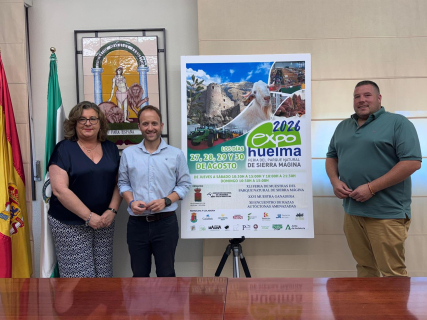

ExpoHuelma will celebrate a new edition from August 27 to 30 in Huelma (Jaén), consolidated as the main agricultural and commercial showcase of the Sierra Mágina region. The delegate of the Government of the Junta de Andalucía in Jaén, Erik Domínguez, and the mayor of the municipality, Ana María Guzmán, have announced the official poster for this event, already established as a meeting point for professionals in the business, commercial, agricultural, and livestock sectors.
On this occasion, the Junta de Andalucía participates through the Ministry of Agriculture, Fisheries, Water, and Rural Development in two of the most relevant activities of the program: the Livestock Show and the Meeting of Threatened Native Breeds.
As Domínguez has detailed, with this contribution the regional administration "once again positions itself alongside the municipalities of the province of Jaén," a collaboration that is carried out "with the aim of promoting the exchange of knowledge and experiences in this area."
Considered one of the most prominent fairs in the Sierra Mágina Natural Park, ExpoHuelma will bring together numerous exhibitors linked to agro-livestock, rural tourism, local gastronomy, and craftsmanship.
"ExpoHuelma has become an unmissable event not only to facilitate a meeting among professionals but also, hand in hand with the City Council, to continue contributing to the promotion of this wonderful territory," emphasized the Government delegate.
Domínguez has highlighted the work being done at the Livestock Show, emphasizing the importance of livestock in the region and in the province of Jaén as a whole. This space is aimed at strengthening the dissemination of native breeds, promoting their conservation, and supporting a model of sustainable rural development.
The fair will feature specimens of species such as the montesina sheep, the Andalusian white goat, or the Andalusian donkey, which evidences the event's commitment to the protection of livestock genetic heritage and the defense of extensive livestock farming.
The organization reminds that extensive livestock farming, in addition to its economic contribution, is key to the environmental balance of the territory, contributing to the prevention of forest fires, the maintenance of the landscape, the conservation of biodiversity, and to retaining population in rural areas.