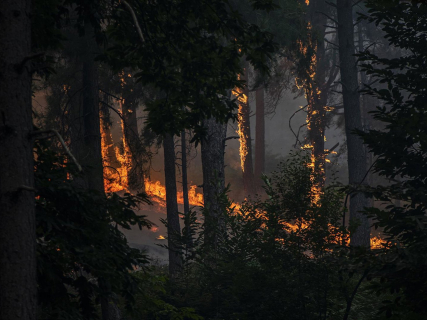

Fires have been, and are, a common phenomenon throughout history: some caused by natural factors (a lightning strike, a volcanic eruption, etc.), others by human factors. Often, humans tend to make mistakes that end up with great consequences.
On other occasions, it may not be recklessness that causes a fire, but a passion: like that of the pyromaniac. The pyromaniac is a person who suffers from an impulse control disorder characterized by the repeated provocation of fires, fascination with fire, and a feeling of tension beforehand that is relieved after igniting it.
However, it is important to differentiate it from the arsonist, as this is someone who intentionally causes a fire regardless of their motivation. (Check here for the live update on the evolution of the fires)

What is a pyromaniac like?
Pyromania is not diagnosed solely because a person has caused one or several fires. To talk about this disorder, the fire must not be pursued directly for money, revenge, concealment of evidence, political claim, or any other external purpose.
The behavior is usually related to a persistent attraction to fire, its effects, and the means used to extinguish it. There may also be a buildup of tension before the fire and a subsequent feeling of pleasure, relief, or satisfaction.
Pyromania is rare even among people convicted of causing fires. Different clinical investigations did not find this diagnosis in the majority of the analyzed arsonists, which necessitates avoiding the automatic identification between intentional fire and mental illness.
There is no single profile of the forest arsonist
An investigation conducted by specialists from the Civil Guard and the Autonomous University of Madrid analyzed clarified fires to study what characteristics appeared most frequently based on the place, method, and motivation.
The study, published in 2013, initially worked with 117 fires from 2011 and later grouped 401 recorded cases between 2009 and 2011. The authors identified five indicative profiles, although they warned that they should not be used as an exact description of each suspect.
-
The agricultural fire due to recklessness
It is usually related to burns or agricultural activities that end up getting out of control. The author usually knows the land, may be its owner, and remains at the site when the firefighting services arrive.
This profile does not correspond to a pyromaniac, because there is not necessarily an intention to provoke a forest fire.
-
The livestock or interface profile
It appears in livestock areas or near urbanized areas. The motivation may be linked to recklessness, although revenge or a prior conflict is also considered.
-
The forest mass arsonist
In this group, the fire can start next to a road or path and present several hotspots. The study related it to young authors, social or labor difficulties, and, in some cases, alcohol consumption or possible disorders.
These characteristics are statistical associations, not signals that allow accusing a person. Having labor problems, consuming alcohol, or suffering from a mental illness does not make anyone an arsonist.
-
The arsonist who acts from a track
This type of fire usually starts at night from a track or from within a vegetation mass. The author may live near the site and know the environment well.
The investigation linked it to people between 46 and 60 years old, often solitary and with difficulties in job adaptation, although it insisted that no trait appears necessarily in all cases.
-
The fire to obtain a benefit
This profile mainly affects agricultural, livestock, or hunting lands. The objective would not be the fascination with fire, but to achieve some benefit or harm certain interests.
The author usually leaves the site before the arrival of emergency services and may know the landowner.
The majority of those investigated do not respond to pyromania
The latest general data published by the Prosecutor's Office shows that, among the forest fires that led to arrests or investigations in 2024, negligence and accidents represented 50.98%, compared to 24.18% attributed to intentional actions.
During that year, 306 people were arrested or investigated, but that figure does not equate to 306 pyromaniacs: it includes recklessness, accidents, and deliberate fires with very different motivations.