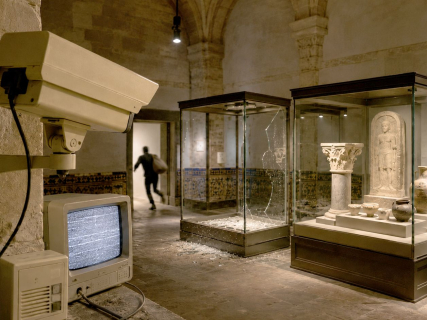

From VIBA SEGURIDAD they warn that a good part of these spaces throughout Spain and in Extremadura also continue to operate with "vintage security": surveillance infrastructures designed decades ago and poorly adapted to current risks
The recent robbery at the Provincial Archaeological Museum of Badajoz has once again focused attention on a reality that has concerned security and conservation experts for years: the rise of the so-called "silent looting," an increasingly frequent threat that combines planned robberies, small thefts, unauthorized access, and acts of vandalism difficult to detect in the short term.
In Spain, already in the 70s, specialized units for heritage protection were created within the Guardia Civil after detecting a considerable increase in robberies of cultural assets, especially churches, religious centers, and historical sites. The threat, far from disappearing, has become sophisticated. Only in 2025, the National Police dismantled a network dedicated to the looting and illegal sale of archaeological pieces with more than 3,200 historical objects seized —among them coins, fibulae, oil lamps, and Roman pieces— allegedly from archaeological sites.
"Extremadura- points out Nuño Azcona, General Director of VIBA Seguridad- is one of Spain's great heritage treasures. Merida, Caceres, and Badajoz concentrate some of the most relevant historical enclaves of our country. Therefore, they must increase their security as their great monumental and archaeological richness is unique. Criminals no longer act as they did twenty years ago. Today we talk about planned robberies, organized groups, prior monitoring of facilities, and the ability to place stolen pieces in international markets in a matter of hours. Many heritage spaces continue to operate with systems designed for past threats."
"Vintage security" and "museums with lack of resources": the new risks of historical heritage
From VIBA SEGURIDAD they warn that a good part of these spaces throughout Spain and in Extremadura also continue to operate with "vintage security": surveillance infrastructures designed decades ago and poorly adapted to current risks.
Experts also indicate the existence of "under-resourced museums": cultural spaces open to the public, but still protected by outdated cameras, unconnected systems, or surveillance models overly dependent on manual supervision.
To this is added another difficulty: the architectural limitations of many historic buildings themselves, which complicate the implementation of conventional security systems without affecting conservation or heritage aesthetics.
The rise of "invisible shielding"
"Today the challenge is not only to protect the most valuable pieces. We are also talking about preventing intrusions outside of hours, unauthorized access, accidental damage, or vandalism that can generate irreparable losses for historical heritage," they add from the company.
Faced with this, the sector is increasingly betting on the so-called "invisible shielding": solutions capable of integrating intelligent video surveillance, artificial intelligence applied to the detection of suspicious behavior, access control, anti-intrusion sensors, perimeter protection, and 24/7 remote monitoring without altering the aesthetics or conservation of historic buildings.
The combination of advanced technology, specialized surveillance, and heritage protection has already become one of the top priorities for museums, cultural institutions, and public administrations in the face of a phenomenon that evolves at the same pace as the threats.