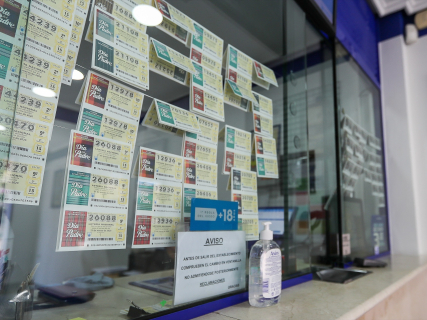
National Lottery today: result of Thursday, September 17 and winning number

Check the result of the National Lottery today, Thursday, September 17, 2026, with the first prize, second prize, endings, and refunds.

1 minute

EuropaPress 3160956 gel desinfectante interior administracion loteria manises cuarto dia

EuropaPress 3160956 gel desinfectante interior administracion loteria manises cuarto dia

Add DEMÓCRATA to Google

Ask FREN

Published

Last updated

1 minute

Most read

The National Lottery celebrates this Thursday, September 17, 2026, its weekly draw. The draw is scheduled for 20:30 hours and the first prize is endowed with 300,000 euros per series.

Once the draw is held, the numbers corresponding to the first and second prizes will be known, in addition to the endings and refunds that result in winning.

Result of the National Lottery today:

First prize: pending the draw

Second prize: pending the draw

Endings: pending the draw

Refunds: pending the draw

Result of the National Lottery today, Thursday, September 17

The winning numbers will be incorporated into this information after the draw is held and the official result is published.

The distribution includes the first and second prizes, in addition to approximations, hundreds, endings, and refunds as applicable.

How much is won with the first prize

The first prize of this draw is endowed with 300,000 euros per series.

What time is the National Lottery today

The draw is scheduled for 20:30 hours this Thursday, September 17.

How to check the number of the National Lottery

To check a ticket, you must compare the played number with the prizes published after the draw and review the corresponding endings and refunds.

More key points, information and questions with FREN

AI-GENERATED CONTENT

What are the legal requirements for organizing and holding a National Lottery draw in Spain?

A National Lottery draw is not just another “private” draw: it is a state-owned game whose organization and holding is exclusively reserved to the State, through the State Society for Lotteries and State Bets (SELAE). That is, an individual, a company, or even another public administration cannot organize a “National Lottery draw” on their own; they can only participate in those already organized by the State.

1. Reservation of activity and State competence

The basic framework is set by Law 13/2011, on gambling regulation, which:

  • Defines state-level gambling (including lotteries) and subjects its operation to enabling titles (licenses and authorizations).
  • Establishes an exclusive reservation of state-level lottery activity in favor of SELAE and ONCE, subject to strict public control, given the economic relevance and risks of fraud and money laundering.
  • Configures a very severe sanctioning regime for organizing games and lotteries without an enabling title, including closure of activities and high financial penalties.

On this basis, the organization of the National Lottery corresponds to the General State Administration, through SELAE, under the supervision of the ministry responsible for Finance.

2. Specific regulatory framework of the National Lottery

The National Lottery is governed by a set of rules before and after Law 13/2011, among which stand out:

  • The General Lottery Instruction (Decree of March 23, 1956) and its development regulations.
  • Decree 1643/1962, of July 5, on procedures for the National Lottery draw (technical aspects of the draw).
  • Royal Decree 773/1989, of June 23, which regulates formal aspects of draws managed by the National Organization of Lotteries and State Bets (now SELAE), especially when held in Spain or abroad.
  • The Order of October 17, 2001, which adapts the amounts of the major prizes of the National Lottery to the euro and regulates various management and marketing aspects.
  • Royal Decree 191627/2004 (RD 208/2004), which updates rules on the holding of draws and grants SELAE the power to set draw days, modalities, and operational parameters within the legal framework.
3. Requirements to organize and hold each draw

Within this framework, the main requirements that SELAE must meet for each National Lottery draw are:

  • Prior approval of the draw program: the “program” (date, type of draw, series and fractions of tickets, price, amount and distribution of prizes, possible charitable purposes, etc.) must be approved by SELAE’s competent bodies, in accordance with lottery regulations and, when appropriate, with authorization or knowledge of the supervising ministry.
  • Public and controlled holding: according to Royal Decree 773/1989 and its amendment by RD 208/2004, the draw acts:
    • Are of public nature.
    • Are carried out with the human and technical means that SELAE determines, after internal verification.
    • A control table must be established with at least a president (the Director General of Lotteries and State Bets, or their delegate) and a public notary or auditor, who record that everything complies with the regulations and the draw program.
  • Integrity and security of the draw: Law 13/2011 requires guaranteeing:
    • The integrity of the game (absence of manipulation of drums, balls, computer systems, etc.).
    • The technical control of equipment and systems, and traceability of operations.
    • Prevention of fraud and money laundering, given the bearer nature of tickets and stubs.
  • Publicity of the rules: the essential conditions of the draw (program, prize amounts, participation method, prize expiration, etc.) must be clear and accessible to the public, usually through:
    • Publication in the Official State Gazette (BOE) when it concerns general provisions (e.g., regime changes, special extraordinary draws with specific purposes).
    • Dissemination through SELAE’s official channels and the network of sales points for each specific draw.
  • Economic and tax regime: the regulations set:
    • The minimum percentages of revenue allocated to prizes (with specific rules for the National Lottery compared to other games).
    • The tax regime of prizes (tax on certain lottery and betting prizes, introduced and modified by subsequent budget and tax measures laws).
4. Consumer protection, responsible gambling, and sanctions

Law 13/2011 obliges SELAE to:

  • Prevent participation of minors and legally prohibited persons.
  • Offer sufficient information about prize probabilities and participation conditions.
  • Apply responsible gambling measures and prevention of addictive behaviors.

Organizing a National Lottery draw outside SELAE would constitute unauthorized gambling, fitting into the very serious infringements of Law 13/2011, with sanctions that may include high fines and closure of activities.

In short, there is no “open procedure” for third parties to organize a National Lottery draw: the law reserves this power to the State, which must comply with a strict set of authorization, control, publicity, security, and participant protection requirements.

What regulations govern the prizes and distribution of the National Lottery?

The regulation of the National Lottery and, in particular, its prizes and the distribution of revenue, is not contained in a single rule, but in a set of laws, royal decrees, ministerial orders, and resolutions. It can be distinguished between the general framework of state-level gambling, the specific regulations on revenue and prize distribution, and the provisions that specify prize amounts and management.

1. General framework of state-level gambling

The basic legal regime of state-owned games – which includes the National Lottery – is found in:

  • Law 13/2011, of May 27, on gambling regulation (BOE). It is the sectoral reference law for state-level gambling activities, especially those carried out by electronic means, but also for lotteries reserved to the State Society for Lotteries and State Bets (SELAE). It establishes principles for participant protection, licensing regime, administrative supervision, infringements and sanctions, as well as the reservation of certain lotteries to specific operators.
  • Law 23/2022, of November 2, which amends Law 13/2011 (BOE). It strengthens aspects such as safer gambling and protection against addictive behaviors, updating several provisions of Law 13/2011.
  • Royal Decree 1613/2011, of November 14, which develops Law 13/2011 regarding technical requirements for gambling activities (BOE), and Royal Decree 1614/2011, of November 14, on gambling licenses, authorizations, and registers (BOE). Although not exclusively focused on the National Lottery, they set the technical and authorization framework under which SELAE operates.
2. Distribution of revenue and prizes in state games

The classic rule that regulates the distribution of revenue and prizes in state games, with explicit mention of the uniqueness of the National Lottery, is:

  • Royal Decree 419/1991, of March 27, which regulates the distribution of revenue and prizes in State Sports Bets and other games managed by the National Organization of Lotteries and State Bets (BOE). It establishes the minimum percentages of revenue that must be allocated to prizes for state-level games, as well as the distribution among categories and other revenue destinations.
  • Royal Decree 208/2004, of February 6, which regulates certain aspects related to state-owned games (BOE). It modifies, among others, article 2 of Royal Decree 419/1991 and sets that, except as established for the National Lottery – which is governed by its specific rules – other state-level games managed by SELAE will allocate a minimum percentage of revenue to prizes (generally at least 55%, and 50% in certain Lottery Primitiva modalities). This places the National Lottery as a game with its own rules for the prize payout percentage.
  • Royal Decree 98/2003, of January 24, and Royal Decree 258/1998, of February 20, which partially amend Royal Decree 419/1991 (BOE and BOE). They adjust specific aspects of that revenue distribution, especially in sports bets and other games.
3. Specific regulations of the National Lottery and its prizes

The National Lottery has, for decades, its own regulatory framework of a regulatory nature:

  • The General Lottery Instruction, approved by Decree of March 23, 1956, is the traditional basic rule on the organization of National Lottery draws and other games. It is repeatedly cited by subsequent regulations as a reference framework (for example, in Royal Decree 208/2004 and the Order of October 17, 2001).
  • Order of October 17, 2001, which adapts the amount of major prizes of the National Lottery to the euro and regulates certain aspects related to state games (BOE). It defines, after the euro’s introduction, what is understood by “major prizes” of the National Lottery (from 30,000 euros per ticket) and reorganizes management and marketing issues (call and allocation of lottery administrations, integration into the basic network, bond regime of active game sales points, etc.). It is a key piece for the practical treatment of the highest prizes.
4. Taxation and special levy on prizes

The taxation of prizes – which affects the “effective distribution” received by the winner – is articulated through the special levy on prizes of certain lotteries and bets and withholding obligations. Although the basis of the levy is in general tax regulations, from an operational point of view the following stand out:

  • Order HAP/70/2013, of January 30, which approves forms 230 and 136 for withholdings and payments on account of the special levy on prizes of certain lotteries and bets (BOE).
  • Order HAP/2368/2013, of December 13, which approves form 270, the annual summary of withholdings and payments on account of that special levy (BOE).

These orders do not set the levy percentage (which is determined in tax laws), but regulate how SELAE and other entities must apply withholdings on prizes.

In summary, the percentages of revenue and prize structure of the National Lottery are supported by the block formed by the General Lottery Instruction, Royal Decree 419/1991 and its development and amendment (Royal Decree 208/2004, Royal Decree 258/1998, Royal Decree 98/2003), while the general organization of the game and its supervision are mainly governed by Law 13/2011 (amended by Law 23/2022) and its development royal decrees. The taxation of prizes is articulated through the special levy and the cited withholding model orders.

How many National Lottery draws are held annually and what changes has its format undergone in recent years?

The National Lottery of Spain currently holds around a hundred draws per year. The official calendar maintains two stable weekly appointments — Thursday afternoons and Saturday at noon — to which several special and extraordinary draws are added throughout the year, placing the total annual number approximately between 100 and 120 draws.

This estimate can be inferred from how SELAE numbers the draws. For example, the ordinary draw on Thursday, August 13, 2026, appears in the official calendar as the “draw number 65 of the National Lottery of 2026”, when there are still more than four months left in the year. Added to this are several Saturday extraordinary draws — such as those in August or September — so the total volume of calls clearly exceeds one hundred annually.

Basic current format

The basic mechanics remain very stable:

  • Each tenth participates with a five-digit number.
  • The classic structure includes first prize, second prize, extractions of several digits, approximations, hundreds, endings, and refunds.
  • Ordinary Thursday and Saturday draws mainly differ in the price of the tenth and the amount of the prizes.

From the latest calls described by Demócrata and various institutions:

  • Ordinary Thursday draws: an illustrative case is that of August 13, 2026, with a first prize of €300,000 per series (€30,000 per tenth) and a second prize of €60,000 per series (€6,000 per tenth). The tenth costs €3 and SELAE usually issues six series of 100,000 tickets, with a total issuance of 18 million euros.
  • Ordinary Saturday draws: on “normal” Saturdays, the announced first prize is €600,000 per series (€60,000 per tenth) and the second prize reaches €120,000 per series (€12,000 per tenth). The usual price of the tenth in these ordinary Saturday draws is €6.

Changes and trends in recent years

Although the essential rules of the game have barely changed — two major prizes, staggered minor prizes, and refunds — adjustments and format reinforcements are observed on several fronts:

1. More marked differentiation between Thursdays, Saturdays, and extraordinary draws

The coexistence of ordinary draws and high-value extraordinary draws has intensified:

  • Thursdays are consolidated as a draw with a lower price (€3 per tenth) and medium prizes (€300,000 per series for the first prize), designed for more frequent participation.
  • Saturdays alternate ordinary draws (€6 per tenth, €600,000 per series for the first prize) with extraordinary draws of higher price and endowment. For example, the September Extraordinary Draw of 2026 sets a price of €15 per tenth, with a first prize of €1.5 million per series and an expanded prize structure, clearly differentiated from the ordinary Saturday before or after.
  • Something similar occurs with other extraordinary draws such as those in August or the Red Cross, which increase both the total issuance and the number of high-value prizes.
2. Strengthening of thematic and commemorative draws

Another clear evolution is the prominence of commemorative tenths associated with social causes or institutional anniversaries, without changing the draw mechanics but rather its positioning:

  • Tenths dedicated to the 50th anniversary of Tussam, presented by the City Council of Seville for a Thursday draw distributing 12.6 million in prizes.
  • A draw on April 25 dedicated to the 40th anniversary of the Carlos III Health Institute, framed within the General Health Law, according to ISCIII itself.
  • Tenths dedicated to the Spanish Federation of Rare Diseases (FEDER) or the 40th anniversary of the Spanish Diabetes Federation, where the prize structure is maintained (300,000 € and 60,000 € per series, respectively for first and second prize) but the solidarity or visibility character is emphasized.
  • Saturday draws in which the tenth pays tribute to local anniversaries, such as the 1200th anniversary of the city of Murcia, with 42 million euros in prizes and a first prize of 1 million euros per series.

These examples show a trend to “thematize” the calendar, using the same prize framework but linking the draw to cultural, scientific, or social milestones.

3. Stability of the prize structure

Despite these adjustments in price, issuance, and specialization according to the type of draw, recent news insist that the National Lottery “maintains its traditional prize structure”, with a very recognizable scheme for the player: major prizes on the full five-digit numbers and a network of secondary prizes by approximations and endings. That is, the changes in recent years have gone more through the path of commercial design of the calendar and amounts than through a deep redesign of the game mechanics.

Play

Test your knowledge with FREN!

How much do you know about this topic? Answer the following 3 questions.

What is the prize amount for the first prize in the National Lottery draw on September 17, 2026?

Question 1 of 3

What must be done to check if a National Lottery ticket has won a prize?

Question 2 of 3

What prizes, besides the first and second, are awarded in the National Lottery?

Question 3 of 3

Hola, soy Fren. ¿Cómo te ayudo?