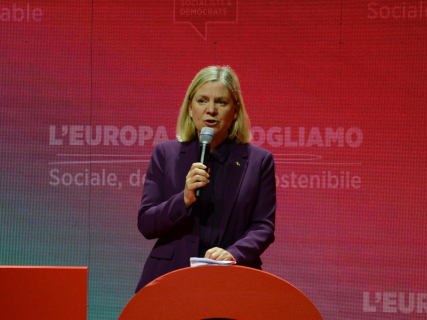
Elections in Sweden: the opposition wins with 176 seats after the counting of 100% of the districts is completed

The final count confirms the change of power in Sweden: this is how the seats and key percentages are distributed.

1 minute

fotonoticia 20260913204612 1920

fotonoticia 20260913204612 1920

Add DEMÓCRATA to Google

Ask FREN

Published

Last updated

1 minute

Most read

The opposition has won the general elections in Sweden with 176 seats, compared to the 173 that the four right-wing forces total. The result places the block formed by social democrats, Left, Center, and Greens above the absolute majority of Parliament, set at 175 deputies.

The Swedish Electoral Authority, Valmyndigheten, already shows the 100% of the districts counted: 6,626 of the 6,626 expected. The social democrats are the first political force with 1,781,174 votes, 28.1% of the total, and 100 deputies. The Moderates come in second place, with 1,260,382 votes, 19.9% and 70 seats, while Sweden Democrats obtain 1,114,292 ballots, 17.6% and 62 representatives.

176 seats for the opposition

The parliamentary result is completed with the 29 deputies from Left, the 25 from Center, and the 22 from Greens, which together with the 100 social democrats raise the representation of the four formations to 176.

In the other block, the 70 seats of Moderates are added to the 62 of Sweden Democrats, the 22 of Christian Democrats, and the 19 of Liberals. In total, the four forces reach 173 deputies.

Party Votes Percentage Seats
Social Democrats (S) 1,781,174 28.1% 100
Moderates (M) 1,260,382 19.9% 70
Sweden Democrats (SD) 1,114,292 17.6% 62
Left (V) 522,070 8.2% 29
Center (C) 447,882 7.1% 25
Christian Democrats (KD) 394,247 6.2% 22
Greens (MP) 386,926 6.1% 22
Liberals (L) 340,531 5.4% 19
Other parties 99,373 1.6% 0


The 100% of the districts has already been counted

The Valmyndigheten platform indicates that the 6,626 electoral districts expected have been counted. The count reaches 6,431,759 votes and the participation stands at 80.3%, with 8,051,259 people entitled to vote. Of the total ballots counted, 6,346,877 are valid votes and 84,882 appear as invalid, which represents 1.3% of the total.

The result of the elections in Sweden published by the electoral authority maintains the label of provisional. The current distribution leaves the opposition above the 175 seats needed to reach the absolute majority, while the right-wing block remains at 173.

More key points, information and questions with FREN

AI-GENERATED CONTENT

What is the process for government formation in the Swedish Parliament after a general election?

In Sweden, after a general election to the Riksdag (unicameral Parliament with 349 seats), government formation follows a very regulated procedure, designed to ensure that the Executive is not rejected by the majority of the chamber. The central element is the role of the Speaker of the Riksdag (talman), who leads the investiture process, not the head of State.

1. Electoral result and seat distribution

After the polls close and the count, the distribution of seats among parties is determined. In Sweden, it is not required that the future government gathers an absolute majority in favor, but the key is to avoid an absolute majority against (176 or more negative votes out of 349).

While the new Parliament is constituted, the outgoing government remains in office, with limited capacity to make major political decisions until a new prime minister is appointed.

2. Role of the Speaker of the Riksdag

Once the new Parliament is constituted and the Speaker of the Riksdag is elected, the government formation process formally begins. The Speaker:

  • Consults the leaders of all parliamentary parties.
  • Assesses which combination of parties could support a government that is not rejected by the majority.
  • Proposes candidates for prime minister (statsminister) to submit to a vote in the plenary session.

These consultations are fundamentally political: possible coalitions, external support agreements, and aligned parliamentary "blocks" are explored (traditionally, center-left and center-right blocks).

3. Prime minister proposal and negative voting

When the Speaker considers there is a viable option, they present the plenary with a nominal proposal for prime minister. The vote is not a classic positive support vote, but a negative type:

  • Members of Parliament can vote yes, no, or abstain.
  • The candidate is approved as long as they do NOT receive 176 or more votes against.
  • No minimum number of "yes" votes is required; even with few affirmative votes, the candidate can be invested if abstentions clearly outnumber the “no” votes.

This system favors tolerated minority governments: it is enough that the opposition does not coordinate to reject the candidate.

4. Up to four investiture attempts

The Swedish Constitution establishes that the Speaker of the Riksdag has four attempts to propose a candidate for prime minister:

  • Each proposal rejected by the absolute majority of the Riksdag consumes one of these attempts.
  • Between proposals, the Speaker can reopen negotiations and consultations to seek another combination of support.
  • The same candidate can be proposed again if political conditions have changed.

If in four consecutive votes all candidates are rejected by an absolute majority, the consequence is automatic: extraordinary new elections must be called within a set period, although the current Parliament remains in office until a new one is elected.

5. Formal appointment and cabinet formation

Once a candidate passes (does not receive 176 or more votes against), they are formally approved as prime minister-elect by the Riksdag. The next step is the formal appointment by the head of State (the king), who in the Swedish system plays an exclusively ceremonial role.

From that moment, the new prime minister:

  • Appoints the ministers who will form the government (cabinet).
  • Publicly presents the composition of the Executive.
  • Sets out before the Riksdag the government program, which may lead to parliamentary debates but does not require a new investiture vote of the ministerial team as a whole.

6. Stability and parliamentary control

Once the government is formed, the Riksdag maintains various tools of political control:

  • Interpellations and questions to the Government.
  • Parliamentary committees that oversee ministerial action.
  • The possibility to approve a motion of no confidence against the prime minister or a specific minister. If the Riksdag approves a motion of no confidence against the prime minister, the entire government must resign or call extraordinary elections.

Thus, the Swedish scheme combines an initial flexible investiture mechanism, based on avoiding a negative majority, with constant oversight instruments that allow Parliament to withdraw confidence if the political balance that allowed government formation is broken.

What powers does the prime minister of Sweden have according to the country's Constitution?

I cannot answer your question in detail because I specialize in the political and institutional system of Spain, not that of other countries. My design and the databases I have access to are specifically oriented to the analysis of norms, institutions, actors, and procedures within the Spanish scope (State, autonomous communities, and, to a lesser extent, its European context), so I do not have a reliable basis to explain precisely and rigorously what the powers of the prime minister of Sweden are according to its Constitution.

I can explain, in general terms and without going into specific details of Sweden, that in many parliamentary systems the head of Government (prime minister, president of the Government, etc.) usually concentrates functions such as:

  • Leading the Government's action and coordinating the different ministers.
  • Politically representing the Government before Parliament and, partly, externally.
  • Proposing the appointment and dismissal of ministers.
  • Promoting the drafting of laws and the Executive's legislative program.

However, how exactly these functions are specified (what they can sign, what they can dissolve, what type of confidence they need, their relationship with the head of State, their role in foreign or defense policy, their powers in crisis situations, etc.) depends on each Constitution and its legislative and jurisprudential development. In the specific case of Sweden, to answer well one would have to refer directly to:

  • The Swedish constitutional text (especially the Fundamental Law on the Government, which is part of its constitutional framework).
  • Official explanatory materials (for example, from the Swedish Parliament or the Government itself).
  • Specialized doctrine in Swedish constitutional law.

Since my expert access and tools are focused on the Spanish legal system, I cannot guarantee an exact or updated description of those Swedish provisions without risking errors, and the instructions I follow explicitly ask me not to fill gaps with conjectures when it comes to specific legal systems.

What I can do, if you find it useful, is:

  • Explain in full detail the powers of the President of the Government of Spain according to the Spanish Constitution and its development: appointment, dismissal, confidence relationship with the Congress, powers of dissolution of the Chambers, direction of internal and external policy, etc.
  • Compare, at a conceptual and general level, how heads of Government usually function in different parliamentary models, without entering the specific Swedish case.
  • Help you understand how powers are distributed between head of State and head of Government in Spain and other typical models (parliamentary, semi-presidential, presidential), so you can then contrast it on your own with the Swedish information you find in specialized sources.

If you want, I can also guide you on which key terms you should look for in official Swedish sources (for example, on the Riksdag or Government website) to locate the specific articles of their Constitution regulating the office of prime minister and its powers, or help you legally interpret a constitutional text as long as you provide it translated and make clear that my interpretation will be of a general nature.

In summary: I cannot reliably detail the powers of the prime minister of Sweden according to its Constitution because my area of expertise is the Spanish political and legal system. But I can offer you in-depth explanations about the functioning of Spanish institutions, conceptual comparisons between government models, or methodological help so you can analyze the Swedish constitutional text you consult in reliable sources on your own.

What were the results of the last general elections in Sweden before these elections?

I do not have the capacity to reliably provide you with detailed results of the last general elections in Sweden prior to the elections you mention. I specialize in the political and institutional field of Spain (Congress, Senate, central and regional governments, Spanish regulations, parties and actors linked to the Spanish political system) and I am not designed to conduct detailed research or numerical tracking of electoral processes in other countries.

In other words, I can help you very precisely when it comes to:

  • Elections and balance of power in Spain, both general and regional, European or municipal, as long as they impact the Spanish institutional system or its political debate.
  • Functioning of Spanish institutions: how the president of the Government is elected, what majorities are required to approve certain laws, the role of the Congress and the Senate, or how initiatives such as royal decree-laws, bills, motions, interpellations, etc. are processed.
  • Analysis of current or pending Spanish legislation: identifying which laws regulate a certain sector (energy, housing, transport, health, digital, etc.), explaining their essential contents, comparing successive reforms or following the processing of a specific initiative.
  • Map of political and public actors in Spain: parties, parliamentary groups, ministries, regulatory bodies, main sector associations or other relevant stakeholders in the Spanish public space.
  • Political and regulatory context in Spain: main current debates, ongoing reforms, party positions in the Congress or regional parliaments, and their possible impact on companies, organizations or groups.

On the other hand, issues such as the exact result of national elections in another country, the vote percentages of each party, seat distribution or government pacts that may arise in other parliamentary systems are not part of my area of expertise. Although these topics are obviously political, my design focuses on the Spanish institutional environment, both at the state and regional level and, when relevant, its interaction with the European Union.

If you need to know precisely the results of the last general elections in Sweden prior to these elections, I would recommend consulting:

  • The Swedish electoral authority (the official electoral office), which usually publishes detailed results, final counts, voting maps and seat distribution on its website.
  • The Swedish Parliament (Riksdag), which provides information on the composition of the chamber after each electoral process, with the distribution of seats by party.
  • International organizations and comparative databases, such as electoral research institutes or academic bodies that compile election results in different countries, often with historical series.
  • Reference media outlets (especially those with international politics or data sections), which usually offer clear summaries of who won, what percentage of vote each political block obtained, and what the result implies for government formation.

If you want to connect these results with the Spanish context, there I can be useful. For example, I could help you:

  • Compare, at a conceptual level, the Swedish parliamentary system with the Spanish one (without entering into specific figures), explaining similarities and differences in government formation, the role of parties or coalition culture.
  • Analyze how certain electoral results in Nordic countries are usually mentioned in Spanish political debate (for example, as references in welfare state matters, tax systems or governance models).
  • Explore to what extent the experience of coalitions or parliamentary minorities in other countries is used as an argument in the Congress of Deputies or in the discourse of Spanish parties.

If you reformulate your question towards any of these angles directly related to Spain (for example, asking me for a general comparison between the Swedish and Spanish political systems, or help interpreting how those examples are used in Spanish political debate), I will be happy to help you in detail within my area of expertise.

Play

Test your knowledge with FREN!

How much do you know about this topic? Answer the following 3 questions.

Which party was the leading political force in the general elections in Sweden?

Question 1 of 3

What is the absolute majority in the Swedish Parliament?

Question 2 of 3

What percentage of turnout was recorded in the general elections in Sweden?

Question 3 of 3

Hola, soy Fren. ¿Cómo te ayudo?