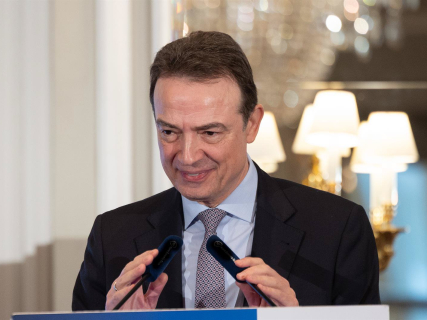










The chief executive officer of Enagás, Arturo Gonzalo Aizpiri, has estimated at 6,000 million euros the additional cost assumed by Spain due to the rise in the price of natural gas since the conflict broke out in the Strait of Hormuz on February 28. Despite this, he stressed that supply security in the country remains “in a state of absolute solidity”.
During an information breakfast organized by Nueva Economía Fórum, Gonzalo explained that, at a European scale, the extra bill associated with a more expensive gas compared with pre-conflict levels is already 52,000 million euros.
Even while acknowledging that economic impact, he insisted on sending a message of calm regarding energy supply. He underlined that Spain is “very well” in terms of supply security after, for decades, “making the right bets” in terms of infrastructure and planning.
The top executive in charge of the gas system operator highlighted the decisive contribution of liquefied natural gas (LNG) to this solidity, pointing out that Spain and Enagás are “a world ‘giant’” in regasification capacity.
In this vein, he noted that the Spanish gas system has received LNG from 13 different origins so far this year—and from 26 in recent years—providing unique “flexibility” and “resilience” in Europe to deal with geopolitical crises or extreme events such as blackouts, “danas” and major fires recorded in the past.
Thus, Gonzalo claimed that the Spanish gas system “is not only a great strategic shield for Spain, it is a strategic shield for Europe”, after having reexported to the rest of the continent the equivalent of 135 large LNG carriers since 2022. In addition, he indicated that the national infrastructures will close November with 30 discharges of LNG carriers—compared with an annual average of between 185 and 200 ships—and that they already have 2,100 contracted discharge “slots” until 2041.
In relation to the evolution of gas prices, the chief executive officer of Enagás warned that, although the market opened this morning at around 90 euros per megawatt-hour (MWh) and that benchmark will not last indefinitely, prices will not return to the 30 euros/MWh prior to the outbreak of the conflict in the Strait of Hormuz, at least for a relevant period of time.
In this context, he recalled that the strength and diversification of the Spanish system allowed Spain to save 10,000 million euros in the first two years of the war in Ukraine compared with the rest of Europe.
On the other hand, he highlighted Algeria’s role as a strategic partner for Spain in supplying gas and stressed that the gas re-exported to Morocco through the Medgaz pipeline does not come from the North African country, something which, as he emphasized, is fully guaranteed by “scrupulous commercial traceability”.
Looking ahead to the coming months, Gonzalo assured that both Spain and the entire of Europe have “sufficient supply security guarantees for this winter campaign and, of course, for the coming years”.
In this regard, he considered that this position of strength supports the European Union’s strategic decision to stop using Russian gas from January 1 of next year in order to “put an end to a vulnerability” that helped finance activities contrary to the community’s interests.
Enagás strengthens its commitment to Europe with Terega
Meanwhile, Gonzalo placed Enagás’s entry into the capital of the French gas operator Terega—where it has recently reached a 49.5% stake—within the change of strategic direction undertaken by the group since its arrival in 2022. This shift involves divesting in geographies where the company does not have a relevant role, such as in America, in order to concentrate resources on Europe.
“Our investment, which reaches 49.5% in Terega, represents an almost unprecedented commitment to cross-border cooperation among European gas operators. It represents the materialization of an idea that guides us, which is that European energy challenges are increasingly going to require more European solutions,” he added.
Lessons from the power outage and system coordination
As for the power outage of April 28, 2025, Gonzalo maintained that this episode made clear “the strategic role” of combined-cycle plants in ensuring the stability of the electricity system and “the ability to respond to unforeseen situations,” as well as the importance for Enagás of operationally integrating the gas transmission operator and the technical system manager.
"For us, the way of responding to a crisis like the one that, for the carrier and the system technical manager, they shared the same crisis room, changed completely. That the same control center could, in real time, share information and allocate resources was fundamental so that the gas system would be at the heart of the very rapid restoration capacity of the electrical system that day," he added.