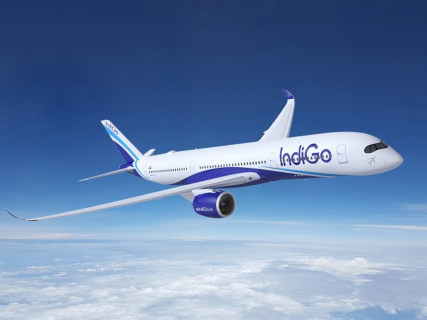

IndiGo closed the first quarter of its fiscal year 2027, which ended in June, with a net loss of 2.380 billion rupees (€21.6 million), after leaving behind the profit of 21.763 billion rupees (€198 million) obtained in the same period of the previous fiscal year, impacted by the sharp rise in fuel prices due to the military conflict in the Middle East and by high exchange rates.
As detailed in its financial report, aviation fuel costs skyrocketed almost double (+85.7%) in the first three months, reaching 108.329 billion rupees (€987 million), which accounted for nearly half of the total operating expenses of the Indian airline.
Its CEO, Rahul Bhatia, has highlighted that the first quarter was characterized by a volatile operating environment, in which high fuel costs and limitations related to the network in the Middle East affected profitability.
Despite this, the revenue of the InterGlobe subsidiary increased by 18.9% year-on-year, reaching 256.141 billion rupees (€2.288 billion) at the start of the new fiscal year, driven by the increase in unit revenue per passenger.
During this period, the number of passengers transported stood at 31.3 million, just 0.3% above the comparable quarter, while the load factor fell by 1.3 percentage points, to 83.3%.
As of June 30, IndiGo's fleet totaled 432 aircraft, including 26 A320ceo, 174 A320neo, 176 A321neo, 3 A321XLR, 44 ATR, 3 A321 freighters, and 6 B787 (on a crewed lease).
For the second quarter, the airline expects capacity to remain virtually at the same levels as a year ago, due to the persistent operational uncertainty affecting travel between India and West Asia.
Since December, the airline has been going through a severe crisis when a new regulation regarding pilots' maximum working hours caused thousands of flights to be canceled for days.
The company was accused of "significant failures" and this crisis resulted in a fine for the firm, which controls two-thirds of India's air market, and a reprimand for its CEO, Pieter Elbers, who a few months ago announced his resignation for "personal reasons."
This context is faced by the current director general of the International Air Transport Association (IATA), Willie Walsh, who will become CEO of the Indian company starting in August, in a change already announced previously.