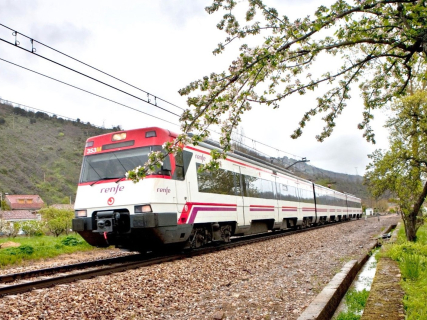
Renfe will maintain 73% of the AVE trains tomorrow due to the strike during the peak travel operation.

Renfe faces the August exit operation with a strike and minimum services of 73% in high speed and up to 1.2 million seats offered.

1 minute

fotonoticia 20260730180125 1920

fotonoticia 20260730180125 1920

Add DEMÓCRATA to Google

Ask FREN

Published

Last updated

1 minute

Most read

Renfe will face the first major operation out of August with minimum services of 73% on high-speed trains this Friday, due to the strike called by the Railway Union to denounce the problems in the air conditioning systems of the fleet.

The Ministry of Transport and Sustainable Mobility has also set minimum services of 65% for Medium Distance trains, while in Commuter trains 75% of services will be guaranteed during peak hours and 50% during the rest of the day.

These levels of minimum services do not imply that the rest of the trains are automatically canceled, but rather that, depending on the degree of adherence to the strike, they may ultimately not operate.

In the two previous strike days promoted by this union during the last month, participation was limited to 1.8% and 2.1%. In this third call, the Railway Union again denounces "the dangerous situation" that, in their opinion, is experienced on board the trains due to "deficiencies in the air conditioning systems."

The call for the strike is directed at all intervention and driving groups of Renfe Viajeros throughout the national territory.

Coinciding with this operation out, Renfe has scheduled an offer of almost 1.2 million seats between Thursday and Sunday, both in High Speed and Long Distance services (AVE, Avlo, Alvia, Euromed, Intercity, and International AVE) as well as in Medium Distance trains (Avant and Regionals).

More key points, information and questions with FREN

AI-GENERATED CONTENT

What are the parliamentary procedures required to modify minimum services in the event of a railway strike in Spain?

Modifying minimum services in the event of a railway strike in Spain only requires parliamentary procedures when the legal framework enabling the Government to set them is to be changed; in contrast, purely regulatory regulation (royal decrees and resolutions that specify those services) can be modified solely by the Executive. Currently, the basis lies in article 10.2 of Royal Decree-Law 17/1977 (right to strike) and in sectoral royal decrees and resolutions that guarantee essential railway transport services, such as Royal Decree 1476/1988, Royal Decree 359/1984, or the Resolution of December 11, 2007. To reform the distribution of powers or the legal criteria on minimum services, a law must be approved, either through a government bill or a parliamentary bill, following the legislative procedure in the Congress and Senate.

1. Current regulatory framework: legal and regulatory rank

The system is based on:

  • Legal rank norm: article 10.2 of Royal Decree-Law 17/1977, which empowers the governmental authority to adopt measures to ensure essential services in case of strike. Any change to that empowerment or its limits requires a law (or a new royal decree-law that must then be ratified or processed as a bill).
  • Sectoral regulatory norms that specify essential services and mechanisms for setting minimums. For the then Ministry of Public Works and Urbanism, Royal Decree 1476/1988 determines guarantees for providing essential services during a strike. In the railway sector, Royal Decree 359/1984 guarantees the operation of the public railway service of FEVE and assigns the competent Minister the restrictive determination of essential services and strictly necessary personnel.
  • The Resolution of December 11, 2007 assumes powers for determining minimum railway services in case of labor conflict or absenteeism, showing that, in practice, the concrete setting of minimums is done by administrative resolutions supported by structural royal decrees.

These regulatory norms are approved by the Government or administrative bodies (Ministry, State Secretariats), without direct Parliament intervention. Therefore, if only the percentages or specific criteria of minimum services are to be changed, it suffices to modify the corresponding royal decree or resolution, without parliamentary procedures.

2. Modifying the legal regime: government bill

If the reform intends to alter the basic legal regime (for example, who sets the minimum services or what limits the Government has in setting them), the norm with the rank of law must be modified. The ordinary channel of the Executive is the bill:

  • The Council of Ministers approves a bill that reforms the regulation of the right to strike or essential services in railway transport.
  • It is sent to the Congress, where it is published and a period for total amendments (return) and to the articles is opened.
  • If the total debate is passed, the text goes to a working group and committee, which prepare a report with amendments.
  • The Plenary of the Congress debates and votes on the entire bill (articles and, if applicable, titles and provisions).
  • Once approved, it is sent to the Senate, which can:
    • Approve it without changes.
    • Make amendments.
    • Interpose a veto (absolute majority).
  • The Congress decides on amendments and, if applicable, lifts the veto by absolute or simple majority (after two months).
  • The law is sent to the King for sanction and promulgation and comes into force after its publication in the BOE.

This procedure is the same regardless of whether the law specifically affects railways, the entire transport sector, or the general regime of the right to strike.

3. Modifying the legal regime: parliamentary bill

The initiative can also come from deputies, parliamentary groups, the Senate, or autonomous assemblies through a parliamentary bill. Its features are:

  • It is presented directly in the Congress or Senate.
  • In the Congress, it must pass a consideration debate. If rejected, it lapses; if approved, it follows a procedure practically identical to a government bill.
  • If it originates in the Senate, after approval it goes to the Congress, where it is processed with amendments, working group, committee, and Plenary.

The essential difference is the origin of the initiative, not the subsequent parliamentary procedures.

4. Use of royal decree-law and its parliamentary control

In situations of extraordinary and urgent need, the Government could modify the legal regulation through a royal decree-law (for example, introducing a new general criterion for minimum services in transport strikes). In this case:

  • The royal decree-law comes into force upon publication in the BOE.
  • The Congress must ratify or repeal it within a maximum of 30 days.
  • The Congress itself can agree to process it as a bill, then opening a full amendment procedure.

This mechanism adds intense parliamentary control, although ex post, over urgent reforms affecting minimum services.

5. Initiatives without the force of law

Finally, parliamentary groups can present non-legislative motions to urge the Government to change royal decrees or resolutions setting railway minimum services. These initiatives are debated and voted on but do not directly modify the regulation; their role is political impetus, not normative.

If I wanted the Government to no longer be able to unilaterally set minimum services on the railway, what specific legal changes would need to be proposed? What role have court rulings played so far in limiting or qualifying minimum services in railway strikes? What leeway do autonomous communities with railway powers have to set or modulate minimum services in their own labor conflicts?

What are the legal competences of the Ministry of Transport and Sustainable Mobility in setting minimum services in strikes in the railway sector?

The Ministry of Transport and Sustainable Mobility exercises its competences over minimum railway services as part of the Government's power to guarantee essential services in case of strike (article 28.2 of the Constitution and article 10.2 of Royal Decree-Law 17/1977). The specific empowerment in the railway sector is carried out through the Ministry's organic norms (such as Royal Decree 1476/2004) and resolutions of assumption of competences, particularly the Resolution of December 11, 2007, which concentrates this power in the Secretary of State for Infrastructure and Planning. These decisions must strictly respect the Constitutional Court's doctrine on the right to strike, which requires that minimum services be set by a genuine governmental authority, in a reasoned, proportionate manner and after prior union consultation. Furthermore, the competence is nuanced by the State-autonomous communities distribution derived from Law 38/2015 of the railway sector and constitutional rulings on railways and essential services.

General framework: Constitution and strike regulations

The starting point is article 28.2 of the Constitution, which recognizes the right to strike and allows it to be limited to guarantee the maintenance of essential community services. This clause is developed in article 10.2 of Royal Decree-Law 17/1977 on labor relations, which assigns the “governmental authority” the power to agree on necessary measures to ensure the operation of public services or those of recognized and urgent necessity, including setting minimum services.

The Constitutional Court, in the April 8, 1981 ruling on this Royal Decree-Law (summarized in the BOE reference as STC 8-4-1981), and in later rulings such as STC 296/2006 and STC 58/2013, has established three key requirements:

  • Minimum services must be set by a governmental authority (Government, minister, autonomous councilor, Secretary of State by assumption), not by the company itself.
  • They must be proportionate and strictly necessary to preserve the essential service.
  • They must be reasoned and, generally, preceded by consultation with the affected trade unions.

Railway sector fit and state competence

Law 38/2015, of September 29, on the railway sector, configures the railway on the General Interest Railway Network as a basic State competence, structuring the Ministry of Transport's position over RENFE, ADIF, and other operators (Law 38/2015 on the railway sector). The Constitutional Court, in STC 245/2012, confirms this core State competence, although it admits that autonomous communities may assume regional services through transfer (for example, the transfer Royal Decree to the Generalitat of Catalonia RD 1598/2010).

In practice, this translates to:

  • For services on the general interest network (long distance, high speed, much of commuter rail), the competence to set minimum services lies with State bodies (Government or Ministry of Transport).
  • For transferred or autonomous community-owned services (certain commuter rails or regional networks), the competent governmental authority is the autonomous one, applying the same constitutional doctrine.

Internal competences of the Ministry of Transport

Organically, Royal Decree 1476/2004 (not fully reproduced in sources but cited in the Resolution of December 11, 2007) assigned the General Secretariat of Infrastructure the function of “determining the mandatory minimum services to ensure the provision of essential railway transport services in cases of labor conflict or company absenteeism.”

However, repeated rulings by the Superior Court of Justice of Madrid annulled resolutions of that General Secretariat for not being a “governmental authority” in the sense of article 10.2 of Royal Decree-Law 17/1977. To correct this, the Resolution of December 11, 2007 expressly assumed those competences to the Secretary of State for Infrastructure and Planning, a political body dependent on the minister:

  • Article 3.1.g) of Royal Decree 1476/2004, which originally assigned the function to the General Secretariat, is invoked.
  • Article 14 of the then-current Law 30/1992 on assumption is used, justifying the legal need for minimum setting to be done by an authority with government power.
  • Since then, minimum railway service resolutions in strikes of RENFE, ADIF, or other State operators are signed at the Secretary of State level (or the minister himself), in the name of the Ministry of Transport.

Form and limits of ministerial action

With this arrangement, the Ministry's legal competences are specified as:

  • Proposal and drafting of royal decrees of the Government to guarantee public railway services in conflict situations (such as the Royal Decree on Basque Railways, RD 592/1981), when deciding to set a general framework for an operator or territory.
  • Issuing specific minimum service resolutions for each strike or absenteeism episode in the State railway scope, signed by the Secretary of State or minister after hearing the affected unions.
  • Coordinating with other departments (Interior, Labor, Presidency) when the measure requires Council of Ministers intervention or impacts security and public order.

In any case, the Ministry's setting of minimum services is conditioned by constitutional jurisprudence: it cannot empty the right to strike; it must be limited to what is strictly necessary to ensure basic train circulation, the safety of people and infrastructure, and other constitutionally protected goods. Any excess may be annulled by the contentious-administrative jurisdiction for violating article 28.2 of the Constitution.

What legal requirements must a union meet to call a strike in the Spanish railway sector?

In Spain, a union wishing to call a strike in the railway sector must adhere to the general regime of the right to strike (still regulated, subsidiarily, by Royal Decree-Law 17/1977 and nuanced by constitutional jurisprudence) and also comply with the specific requirements of essential public railway transport services. In practice, this implies formally agreeing on the strike, giving written notice to the employer and labor authority within the deadline, appointing a strike committee, and respecting the minimum services set by the competent governmental authority. In railways, the notice period is longer (10 calendar days) and there is a reinforced obligation of publicity towards users, as well as specific Ministry of Transport intervention to set minimum services.

1. Basic legal framework of the right to strike

The right to strike is recognized in article 28.2 of the Constitution and is exercised, until a specific organic law is approved, according to the provisions of Royal Decree-Law 17/1977, of March 4, on labor relations, as interpreted and partially refined by Constitutional Court Ruling 11/1981, of April 8, and others.

From the current text of the Royal Decree-Law, several key rules emerge:

  • Recognition of the right: strike is enshrined as a right of workers in labor relations and renunciation agreements are declared null.
  • Need for express agreement: “the declaration of strike, whatever its scope, requires, in any case, the adoption of express agreement (…) in each workplace.”
  • Intervention of representatives: workers through their representatives or directly by vote may agree on the strike declaration. Some numerical requirements of the original text were declared unconstitutional by STC 11/1981, which has relaxed these formal demands.

2. Formal calling requirements the union must respect

Although the Royal Decree-Law is formulated in terms of “workers” and “representatives,” in practice unions promote and articulate these decisions. To call a valid strike, the union must ensure at least the following formal requirements derived from the norm:

  • Adoption of strike agreement: there must be a formal strike declaration agreement, adopted by workers' representatives or by vote of the affected workforce. A record of this agreement is made.
  • Communication to employer and labor authority: the declaration agreement “must be communicated to the affected employer(s) and the labor authority by the workers' representatives.”
  • Written form and minimum content of notice: the communication must be in writing and include:
    • The objectives of the strike.
    • The efforts made to resolve differences beforehand.
    • The start date of the strike.
    • The composition of the strike committee.
  • Appointment of strike committee: only workers from the affected workplace can be chosen as committee members, and the composition “may not exceed twelve people.” The committee intervenes in union, administrative, or judicial actions to resolve the conflict.

3. Deadlines and special features for railways (public service)

The Royal Decree-Law establishes a specific regime when the strike affects companies providing public services. In these cases:

  • The minimum notice to the employer and labor authority must be at least ten calendar days before the strike starts (versus five days in the general regime).
  • Representatives must give the strike the necessary publicity before it starts so it is known by service users.

Railway transport (Renfe, Adif, and other railway companies) is considered an essential public service, so these deadlines and reinforced publicity obligations apply to strikes in the sector.

4. Minimum services in railway transport

Article 10 of Royal Decree-Law 17/1977 empowers the “governmental authority” to agree on necessary measures to ensure the operation of essential community services during a strike, which in practice means setting mandatory minimum services.

A key piece in the railway field is the Resolution of December 11, 2007, from the State Secretariat of Infrastructure and Planning, which assumes competence to determine minimum services “to ensure the provision of essential railway transport services in cases of labor conflict or company absenteeism.” This resolution responds to rulings by the Superior Court of Justice of Madrid that annulled previous minimum service settings for being issued by an incompetent body.

Consequently, when a union calls a strike at Renfe, Adif, or another railway company subject to this regime, it must consider that:

  • The state governmental authority (State Secretariat competent in infrastructure/transport) may issue a resolution setting minimum services.
  • Workers and the union itself are obliged to respect the minimum services established in that resolution, without prejudice to possible later challenge before the contentious-administrative jurisdiction.

5. Labor effects during the strike

Finally, the Royal Decree-Law specifies that exercising the right to strike does not terminate the employment relationship, but the employment contract is suspended and the worker “will not be entitled to salary” during the strike, remaining in a special Social Security status, without obligation to contribute and without entitlement to certain benefits.

For the calling union in the railway sector, scrupulously fulfilling the requirements of agreement, reinforced notice, strike committee appointment, and compliance with minimum services is key for the strike to be considered lawful and enjoy corresponding constitutional protection.

What exactly did Constitutional Court Ruling 11/1981 say about the formal requirements for calling a strike? How are minimum services practically set in a Renfe or Adif strike and can they be challenged in courts? What legal differences exist between a strike at Renfe and a strike at private railway companies providing auxiliary services?

Play

Test your knowledge with FREN!

How much do you know about this topic? Answer the following 3 questions.

What is the main reason for the strike called by the Railway Union at Renfe?

Question 1 of 3

What percentage of Medium Distance trains does the Ministry of Transport guarantee during the strike?

Question 2 of 3

Which railway operators are not affected by the Renfe strike according to the news?

Question 3 of 3

Hola, soy Fren. ¿Cómo te ayudo?