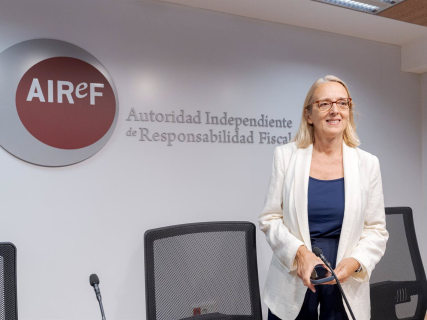










The Council of Ministers gave the go-ahead this Tuesday to the new 2027-2031 cycle of review of public spending, known as "Spending Reviews", which will be developed by the Independent Authority for Fiscal Responsibility (AIReF).
This new spending analysis program will cover the system of care for people in situations of dependency, vocational training and the impact of the network of centers of excellence, environmental and ecological transition policies, transport subsidies and mobility aid, as well as the evaluation of public instruments that support access to housing and the expansion of supply.
According to the Executive, these matters have been chosen for their economic, social and budgetary importance, and for the margin that exists to increase the effectiveness and efficiency of related public policies.
The validation of this agreement in the most recent Council of Ministers prior to the elections of November 29 seeks to ensure continuity in the public spending review processes as a tool to improve the efficiency, effectiveness and quality of public policies.
In addition, the launch of this new evaluation cycle forms part of the commitments acquired by Spain in the Medium-Term Fiscal and Structural Plan 2025-2028 (PFEMP), approved within the new European framework for economic governance.
This medium-term plan includes spending reviews as one of the main measures to raise the quality and efficiency of public spending and promote the sustainability of public accounts.
Within this framework, Spain commits not only to maintain the instrument of "Spending Reviews" once the 2022-2026 cycle has ended, but also to intensify its effect through the implementation of reforms derived from the evaluations and the quantification and monitoring of the savings generated.
Specifically, the commitments assumed with the European institutions include the approval of a new cycle of spending reviews before 2026 ends.
The Council Recommendation itself states that the continuity of spending reviews and the application of the reforms that derive from them form part of the set of commitments whose implementation is necessary to maintain the extension of the adjustment period until 2031.
Specifically, the PFEMP includes approval of a new cycle of "Spending Reviews" before 2026 ends, as well as the continuation of measures aimed at strengthening the quality of public spending and the use of evidence in budget decision-making.