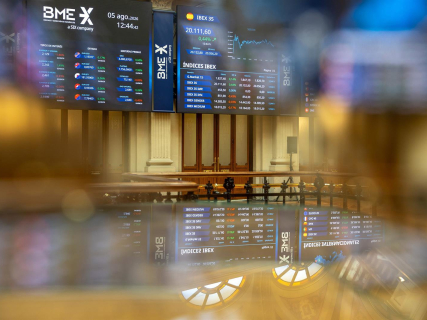

The Ibex 35 has closed this Thursday’s session with a gain close to 0.6%, despite the sharp battering suffered by the big tech companies and the semiconductor companies at the opening of Wall Street, pressured by fears that a Democratic victory will curb the expansion of data centers and by uncertainty about the impact of Artificial Intelligence (AI).
In this scenario, the main Spanish index added 0.59%, to 19,486 points, after having risen by around 1.8% during the day, extending in a specific way the 'rally' experienced on Wednesday following the elections in the United States.
At the same time, the session has been conditioned by the new batch of corporate results for the third quarter of 2026 and by the tension in the Middle East, which keeps the crude oil price anchored in the vicinity of 97 dollars.
The Islamic Revolutionary Guard Corps of Iran has said this Thursday that two large-capacity tankers and a tugboat caught fire after colliding with naval mines while they were trying to cross the Strait of Hormuz in an "illegal" manner, while also asserting that it intercepted and diverted two US attack drones.
In addition, the President of Parliament and Iran’s chief negotiator, Mohamad Baqer Qalibaf, has ironized this Thursday about the interpretation of the Vice President of the United States, JD Vance, who attributes the collapse of the Republican Party in the midterm elections to the war with Tehran, and has urged him to take these conclusions to the current occupant of the White House, Donald Trump.
In this context, Brent, the benchmark in Europe, rose at the close of trading in the Old Continent’s stock markets by 2.3%, to 96.78 dollars, while West Texas Intermediate (WTI), the benchmark in the US, stood at 90 “green bills,” with a rise of 2.4%. These rebounds come after that on Wednesday both contracts sank to as much as 8%.
"The market seems to be perceiving a lower probability of an immediate escalation of the conflict, although, from our perspective, there is no conclusive evidence to support it. That said, this kind of volatile movement should not be surprising in a broad-market scenario that is in a state of turmoil," explained Norbert Rücker, Director of Economic Research and Next Generation at Julius Baer.
ROVI and BBVA pull the Ibex 35
On the business front, Rovi has communicated, before the opening, that it obtained a net profit of 162.8 million euros in the first nine months of the fiscal year, 67% more than in the same period of 2025.
It has also been reported that the Spanish cooperative group Dcoop and Acesur have prevailed in the bidding for Deoleo over the proposal presented by the Sevillian olive oil group Migasa and the Italian Coricelli, in an operation valued at 520 million euros.
Meanwhile, the steel group ArcelorMittal has said that it recorded an attributed net profit of 867 million dollars (about 800 million euros) in the first nine months of 2026, which represents a decline of 70.8% compared with earnings of 2.975 billion dollars (around 2.744 billion euros) in the same period of the previous year.
Within the Spanish select index, the biggest gains corresponded to Rovi (+8.31%), BBVA (+2.05%), Bankinter (+1.78%), Inditex (+1.69%) and Repsol (+1.55%). On the other side, Indra led the declines with -3.94%, followed by Merlín (-3.67%), ACS (+3.03%), Acerinox (-2.09%) and Sacyr (-2.08%).
The rest of the major European markets ended with losses, except for the CAC 40 in Paris, which added 0.34%. In contrast, the FTSE 100 in London and the DAX in Frankfurt fell by 0.43%, while the MIB in Milan retreated by 1.03%.
In the United States, the Nasdaq 100 was recording a cut close to 5% at 18.00, while the S&P 500 and the Dow Jones stood 3% and 2.4% lower, respectively.
In fixed income, the yield on the Spanish 10-year bond was at 3.824%, compared with 3.826% at Wednesday’s close, with the risk premium versus the German “bund” at 56.86 basis points.
In the currency market, the euro remained virtually flat versus the dollar (+0.02%), changing to 1.2229 “green bills” per unit of the single currency.
As for gold, the main safe-haven asset during periods of turbulence, it maintained its upward trend (+1.5%) at the close of European stock exchanges, up to 4.100 dollars. For its part, bitcoin has reacted negatively to the correction of the Nasdaq and the S&P 500 in the United States, plunging almost 5%, to 76.600 “green bills”.