

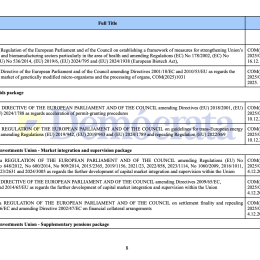
Brussels will present this Wednesday the details of its work programme for 2027, along with an indicative calendar for the approval of the main legislative and policy initiatives it intends to drive during the coming year. A kind of Annual Regulatory Plan at Community level that makes it possible to anticipate the priorities of Ursula von der Leyen’s Executive and map out the regulatory horizon of the European Union for the next year.
The drafts Demócrata has had access to point to a renewed push for the review of the rules that govern the digital environment, with the dual objective of facilitating the technological development of European companies and safeguarding an “ethical use” of new technologies. Community officials familiar with the details of the document explain that areas such as access to imported raw materials or technological progress “have stopped being the foundations of a prosperous EU economy as they used to be.”
A transformation, in the view of the Community Executive, that makes it necessary to review the instruments with which Europe intends to compete in an international scenario increasingly shaped by technological dependence, the fragmentation of supply chains, and the race to develop new industrial capabilities. Economic and technological independence thus becomes one of the axes running through much of the initiatives planned for 2027.
New regulation for Copyright
It will be during the second quarter of 2027 when the Commission presents a new legislative package under the name “Digital Transformation, Simplification and Copyright.” According to the sources consulted by Demócrata, the purpose of this initiative will be to simplify the digital regulatory framework and adapt it to the new challenges posed by the protection of intellectual property in technological development.
Among the measures contemplated is a review of the objectives of the Digital Decade, the Community programme that sets the targets for the technological transformation of the European Union for 2030. The Executive intends to update its priorities to align them with the most recent technological advances and prevent the Community objectives from becoming outdated in the face of the speed at which the sector evolves.
"With the speed of technological progress, we must ensure that our companies can thrive in a future-ready environment", explain community sources familiar with the work being carried out in the Berlaymont building.

Featured story
Spain will ask the EU to review copyright in the face of the advance of generative AI
4 minutes
In parallel with this simplification exercise, community services are working on the design of new safeguards that will allow the potential of artificial intelligence to be harnessed in the cultural and creative sectors. The intention is to protect human creativity, cultural and linguistic diversity, and at the same time promote ethical use of AI. This is one of the demands that the Spanish Government has brought to the Community institutions.
In fact, the Ministry of Culture submitted an explicit request to undertake "a thorough assessment of the legislative framework on copyright". An initiative that was backed by Portugal, Slovenia, Estonia, Germany, Slovakia, and Greece. The six countries accompanied Spain in defending a review that will make it possible to adapt intellectual property safeguards to new uses of protected content by artificial intelligence systems.
The work programme also includes the explicit commitment to adapt digital policy to protect minors from risks and harm online. Protecting the youngest users is thus maintained among Brussels' regulatory priorities, which aims to move toward a safer digital environment without losing sight of the development of technological services.
An industrial strategy to accelerate artificial intelligence
Another pillar of the new digital roadmap will be the approval of a European industrial strategy for artificial intelligence. The Commission will present specific guidelines to accelerate the deployment of this technology in five sectors considered strategic: health, transport, agri-food, advanced manufacturing, and defense.
The objective is to shift the development of AI from the field of research and innovation to its effective application in the European productive fabric. To do so, the draft opens the door to measures aimed at strengthening the Union's sovereign capabilities at different links in the technological chain, from the production of microchips to the availability of computing capacity.
The initiative is framed by the community purpose of reducing dependence on external providers and providing European companies with the necessary infrastructure to compete in the development and deployment of artificial intelligence models. Technological autonomy is thus linked both to industrial capacity and to access to the digital resources that make it possible to train and run these systems.

Across the documents that outline the new battery of measures, the Commission also identifies as a priority challenge the attacks carried out by autonomous artificial intelligence agents, capable of infiltrating networks and compromising computer systems. The growing sophistication of these threats, according to the community approach, makes it necessary to strengthen prevention and incident response mechanisms for cybersecurity.
In this context, the Executive intends to use the European Shield of Democracy to improve coordination between Member States in the face of information manipulation and other threats to the democratic space. Community sources also do not rule out "exploring regulatory routes against online hate crimes".
To this battery of measures will be added the creation of an European Instrument for Strategic Facilitators, designed to finance shared assets in the fields of cyberdefense and space. Its development will be structured in cooperation with the European Defence Agency and the Member States, with the purpose of strengthening common capabilities and avoiding the fragmentation of national investments.
Brussels extends simplification to the financial sector and housing
"Europe will only be stronger if we work together at different levels and beyond borders. The moment to make our independence real is now," the text accompanying the work programme argues.
Regulatory simplification will not be limited to the technological area. The Commission also intends to carry this approach over to the financial sector through a Omnibus package on bank financing, with which it seeks to review and simplify the provisions that affect this area.

Housing will be another of the sectors included in the 2027 agenda. The Community Executive prepares a specific simplification package focused on reducing the bureaucratic procedures that condition construction and facilitating both the rollout of new projects and the rehabilitation of the existing real estate stock.
The initiative aims to help raise the available housing supply by reducing administrative burdens and eliminating obstacles that hinder the development of new developments. It is a matter of bringing into the real estate market one of the lines of action that runs through the entire program: reviewing Community procedures to promote economic activity and speed up the execution of projects.
Review of visas: the new migration policy
The drafts also include an explicit reference to the European Security Council, announced by the Commission president, Ursula von der Leyen, during her State of the Union address. The proposal responds to the desire to review the mechanisms for political and strategic coordination of the Twenty-Seven in an international scenario marked by the deterioration of European security.
"We must understand that the doctrines and decision-making mechanisms on foreign policy and security that were created in Europe during times of peace no longer meet our current needs," explained the European Commissioner for Defence, Andrius Kubilius, in an interview with Demócrata.

Featured story
Andrius Kubilius: "If Europe loses confidence in Starlink, the company will suffer the consequences"
10 minutes
The initiative is thus added to an agenda that seeks to strengthen the Union’s capacity to act in matters of security and defense, alongside the development of new industrial and technological capabilities. Cooperation between the member states and the review of the Community decision-making instruments appear as central elements of this approach.
On migration matters, the Commission foresees an update of visa rules during the first quarter of 2027. The reform will seek to "facilitate legitimate travel, labor mobility, and the arrival of qualified talent in the European Union," as Community sources explain.

The objective is to adapt the visa regime to the mobility needs of the European economy, facilitating legitimate travel and the inclusion of qualified professional profiles. A review that adds to efforts to improve the competitiveness of the internal market and respond to the needs of certain productive sectors.
Rome to define the community’s future
One of the most novel announcements in the work programme is the launch of the so-called "Conference on Europe", within the framework of the 70th anniversary of the signing of the Treaty of Rome. As the documents detail, the initiative aims to "bring together the brightest minds across the entire European Union to build an inspiring vision of a common Europe oriented to new generations".
The project seeks to open a space for reflection on the continent’s future and bring together different profiles to address the challenges facing the community project. A political and institutional dimension that accompanies the rest of the legislative initiatives and that connects with the message of strategic autonomy that the Commission wants to place at the center of its next exercise.
The message running through the document is that European autonomy can no longer be limited to reducing external dependencies. It requires adapting the rules, developing own capabilities, and mobilizing resources so that the Union can compete in a transforming technological and geopolitical environment.