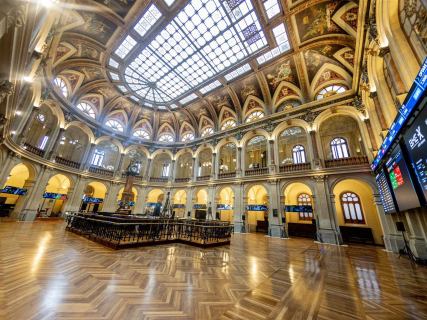

The Ibex 35 of the Madrid Stock Exchange started the session this Tuesday with a rise of 0.45%, standing at 20,189 points, after chaining a previous day's advance close to 0.7% that left it at the doors of 20,100 units.
During the day, investors will keep their focus on the situation in the Middle East, following the announcement by the United States Government of new sanctions against "multiple entities, individuals, and vessels," which it accuses of "facilitating the destabilizing activities" of the Iranian Government, hours after communicating the start of the commercial offensive against the Islamic Republic.
"The United States has taken strong actions against multiple entities, individuals, and vessels that facilitate the destabilizing activities of the Iranian regime," states the official note from the State Department signed by its spokesperson Thomas Pigott.
The sanctions target, among others, "a large group of transporters and agents that move Iranian oil, as well as petroleum and petrochemical products, through the United Arab Emirates, China, Singapore, and Europe to finance the Quds Force of the Islamic Revolutionary Guard and other elements of the regime," according to the statement.
The text concludes with "a call to the international community to join" Washington "in the task of holding these actors accountable," and comes shortly after the start of the Trump Administration's commercial offensive against Iran, in which the U.S. Treasury Secretary, Scott Bessent, has warned of sanctions against all countries that maintain trade relations with Tehran, including China, with the aim of completely isolating the Iranian economy.
In parallel, the U.S. Secretary of Defense, Pete Hegseth, has stated that the Trump Administration does not exclude "in any way" resuming attacks against Iran after the start of the so-called economic war, despite the Treasury Secretary himself having pointed out days earlier that "there will probably not be a large-scale kinetic restart."
"We do not rule out the use of kinetic attacks at any point in the Strait of Hormuz or in the vicinity of Iran," Hegseth has stated. "If we need to use them, we will use them. If Iran is reckless enough to overstep or provoke the U.S. military, we will do what is necessary," he added.
In the same appearance, the head of Defense has emphasized that he is "in full coordination" with Scott Bessent "regarding the economic pressure and all the pressure that can be exerted." "We know that Iran cannot withstand it. Ultimately, its economy is in a downward spiral," he has pointed out.
In addition, he has assured that the United States maintains control over the Strait of Hormuz through an "impregnable" naval blockade through which "oil flows" while "Iran cannot transport anything."
From Tehran, the impact of the economic offensive launched by Washington against the Islamic Republic —described by the United States as the "largest financial offensive ever orchestrated"— has been minimized, recalling that the North American country "has been trying for a long time to cut the economic arteries" of Iran.
"They have made many attempts during this period, they have tried to test the majority of the Iranian people and the country's officials, and they have failed on every occasion, and apparently they want to fail again," declared Iranian Economy Minister, Alí Madanizadé, in an interview granted to the state radio and television, IRIB.
In this geopolitical context, the price of Brent crude, a reference in Europe, fell by 0.9% at the start of trading in European markets, to $91.3, while West Texas Intermediate (WTI), a reference in the United States (USA), dropped by 0.8%, to $84.2 per barrel.
On the macroeconomic front, investors will have several references this Tuesday, including the German GDP data for the second quarter, the IFO business confidence index, and the figures for new home sales in the United States.
However, the key event of the week will be the meeting of central bankers in Jackson Hole, which will begin on Thursday and in which the President of the Federal Reserve (Fed), Kevin Warsh, will speak on Friday, in his first participation in this forum, in a scenario marked by the volatility associated with the rise in yields of U.S. debt.
Markets are also keenly awaiting the quarterly accounts of semiconductor manufacturer Nvidia, which will be published tomorrow at the close of European markets.
In the national sphere, the National Institute of Statistics (INE) has released at 9:00 AM the industrial prices for July, which recorded an increase of 9.2% year-on-year, 2.2 points above the June figure, driven by the rise in energy costs.
Largest rises and falls of the Ibex at the opening
In the first minutes of trading on the Madrid Stock Exchange, within the Ibex 35, IAG (+1.39%), Acerinox (+1.28%), ACS (+0.96%), Inditex (+0.79%), and Banco Sabadell, which advanced by 0.78%, stood out on the upside.
On the opposite side, the main initial declines were for Logista (-1.11%), which is trading ex-dividend, ArcelorMittal (-0.51%), Telefónica (-0.25%), and Repsol, which fell by 0.22%.
In the rest of the markets on the Old Continent, the main European stock exchanges aligned with Madrid and also opened positively. Milan added 0.6%, Paris appreciated by 0.4%, Frankfurt advanced by 0.3%, and London gained 0.1%.
In the foreign exchange market, the euro ceded ground against the dollar, down to an exchange rate of 1.1658 "greenbacks," while in the fixed income market, the yield on the Spanish ten-year bond relaxed to 3.698%.