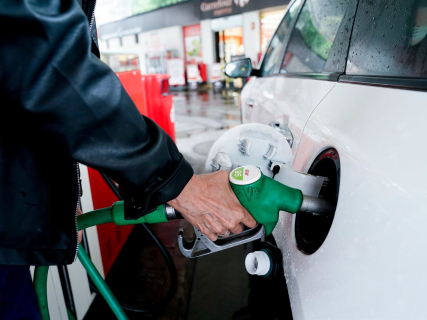









The price of gasoline today, Wednesday 25 November: gasoline 95 drops to 1,526 euros and diesel, to 1,759

Both fuels fall by 1.1 cents compared with Tuesday and accumulate declines over the last seven days

fotonoticia 20261119101015 1920

fotonoticia 20261119101015 1920

Add DEMÓCRATA to Google

Ask FREN

Published

Last updated

1 minute

Most read

Poder Digital · Carrera digital

La carrera digital de los candidatos

El Poder Digital de cada candidato a la Presidencia, de 0 a 100, desde junio · cambio en las últimas 4 semanas

30405060708090100julagoseptoctnovSánchez 93,3Montero 86,0Alvise 81,6Rufián 79,2Feijóo 78,8Abascal 77,5Colau 76,3Nogueras 57,6Valido 38,5
  1. 1Sánchez93,3▼ -1,7
  2. 2Montero86,0▼ -2,0
  3. 3Alvise81,6▼ -1,4
  4. 4Rufián79,2▼ -1,8
  5. 5Feijóo78,8▲ +0,8
  6. 6Abascal77,5▼ -3,5
  7. 7Colau76,3▲ +4,3
  8. 8Nogueras57,6▼ -4,5
  9. 9Valido38,5▼ -6,5

Pendientes de que su partido anuncie el candidato: Adelante, BNG, EH Bildu, EAJ-PNV y UPN.

Ver la carrera completa

Mide presencia e influencia en redes, no intención de voto.

The price of gasoline today, Wednesday, November 25, stands at an average of 1,526 euros per liter for 95 gasoline and 1,759 euros for Gasóleo A in Spain. Both fuels drop 1.1 cents compared with Tuesday, according to the prices reported by service stations to the Ministry for Ecological Transition (MITECO). The data correspond to the update consulted at 00:52 hours.

With these rates, filling a 50-liter tank costs 76.30 euros with 95 gasoline and 87.95 euros with Gasóleo A. 98 gasoline reaches 1,719 euros per liter and premium diesel is at 1,854 euros.

Price of gasoline and diesel today, Wednesday, November 25

These are the national average prices of the main fuels in this Wednesday’s update:

Fuel Price per liter A 50-liter tank
Gasoline 95 E5 1,526 € 76.30 €
Gasoline 98 E5 1,719 € 85.95 €
Gasóleo A 1,759 € 87.95 €
Premium diesel 1,854 € 92.70 €

How the price of fuels has evolved over the last week

95 gasoline has gone from 1,585 euros per liter last Wednesday, November 18, to 1,526 euros this day, November 25. The weekly drop is 5.9 cents per liter, which amounts to 2.95 euros less for a 50-liter tank.

Gasóleo A also shows a drop in that period: it has gone from 1,812 to 1,759 euros per liter. The reduction is 5.3 cents, equivalent to 2.65 euros in a refueling of 50 liters.

How much does it cost to refuel 98 gasoline and premium diesel

The difference between 95 gasoline and 98 gasoline means an additional 9.65 euros for a 50-liter tank. In the case of diesel, choosing premium Gasóleo instead of A increases the cost by 4.75 euros for the same quantity.

The prices published by the MITECO are those reported by service stations and are used to calculate national averages. The price of gasoline today can vary between establishments and change with updates to the rates during the day.

More key points, information and questions with FREN

AI-GENERATED CONTENT

What procedures must the Ministry for the Ecological Transition follow to modify the regulation of fuel prices in Spain?

The Ministry for the Ecological Transition and the Demographic Challenge (MITECO) must first identify what it wants to change: market rules, price information, taxes, or the price freedom regime itself. It cannot unilaterally modify by ministerial order what a law establishes. Then it must process the proposal, gather participation and reports, and submit it to the competent body for approval.

1. Choose the regulation and verify competence

For gasoline and diesel, the starting point is article 38 of the Hydrocarbons Sector Law: "The prices of petroleum-derived products shall be free." Therefore, generally replacing that freedom with administered prices requires a law-level regulation, except for a specific legal authorization applicable to the intervention.

  • Ministerial order: to develop aspects within the Ministry's competencies and within the corresponding authorization.
  • Royal decree: for regulatory development corresponding to the Government, without contradicting the law.
  • Law: if the legal regime is modified; the Ministry prepares a draft bill that the Government may submit to the Parliament.
  • Royal decree-law: as an exceptional route in extraordinary and urgent need, respecting constitutional limits.

Tax modifications require coordination with the Treasury and the appropriate legal instrument. Automotive fuels should not be confused with gas supplies subject to specific regimes.

2. Prepare the text and justify the intervention

The promoting body within the Ministry must draft the proposal and prepare the Regulatory Impact Analysis Report. It must explain the problem, objectives, alternatives, and why the intervention is necessary and proportionate. It should also assess economic, budgetary effects, impacts on consumers, competition, and companies, including small businesses, as well as administrative burdens.

The main reference for drafting draft bills and state regulations is article 26 of the Government Law.

3. Open public participation

Two moments must be distinguished:

  • Prior public consultation: before drafting the text, to gather opinions on the problem, the need to act, and alternatives.
  • Hearing and public information: on the drafted project, when it affects rights and legitimate interests, to receive statements from citizens, operators, and associations.

The hearing has a minimum ordinary period of fifteen working days, reducible to seven when appropriate and justified. Exceptions to these procedures must be supported by legal assumptions and motivated; invoking political convenience is not enough.

4. Gather reports and review European limits

The report of the Technical General Secretariat and other reports required by the project's content must be obtained. Coordination with other departments will be necessary when it affects their competencies. The intervention of the CNMC is especially relevant to examine competition, margins, and market functioning; it does not replace normative approval.

An opinion from the Council of State must also be requested when mandatory. If there are selective aids or compensations, European State aid rules and their possible notification must be checked. Excise tax reductions must respect the applicable European minimums.

5. Approve, publish, and apply

The order is approved by the competent holder; the royal decree, by the Council of Ministers. A draft law requires parliamentary approval. The royal decree-law subsequently requires parliamentary validation or repeal within thirty days. Finally, the provision must be published in the BOE and specify its entry into force and, when appropriate, adaptation periods and controls.

What are the legal competencies of the Ministry for the Ecological Transition regarding the setting and control of hydrocarbon prices?

The Ministry for the Ecological Transition and the Demographic Challenge (MITECO) can regulate certain prices and components of hydrocarbon supply, require information, and control sectoral obligations, but it does not ordinarily set the price of gasoline and diesel. Its powers depend on the product and must be distinguished from those of the Council of Ministers and the National Commission on Markets and Competition (CNMC).

1. Gasoline and diesel: price freedom

The general rule is in article 38 of the Law 34/1998, on the hydrocarbon sector: the prices of petroleum-derived products are free. Therefore, the Ministry's energy competence does not allow it alone to impose a general maximum price at gas stations nor determine their commercial margins.

The Ministry can propose regulatory changes and intervention measures with legal coverage. However, supervising prices, requesting information, or promoting aid does not equate to being able to freely replace the market price with an administrative one. This competence should also not be confused with tax modification, which requires its own instruments and competent bodies.

2. Natural gas and LPG: express powers

The same law assigns specific powers over regulated supplies:

  • Natural gas last resort tariff (TUR). Article 93.5 establishes that the Ministry holder, with prior agreement of the Government Delegated Commission for Economic Affairs, "shall issue the necessary provisions for establishing the natural gas last resort tariff or a system for its automatic determination and updating." It is a maximum price for legally enabled consumers, not for all gas contracts.
  • Liquefied petroleum gases (LPG) by pipeline. Article 94 allows establishing consumer sale tariffs and transfer prices to distributors, through specific values or automatic formulas, also with prior agreement of that commission. This authorization should not automatically extend to any LPG presentation.
  • Charges and underground storage. According to article 92, the Ministry approves gas system charges and access fees to underground storage, with prior agreement of the mentioned commission. In contrast, the CNMC approves tolls and fees for transport, distribution, and liquefied natural gas plants.

The practical application of the competence over the TUR is reflected in the September 2026 resolution of the Directorate General for Energy Policy and Mines.

3. Information, monitoring, and sanctions

MITECO conducts economic monitoring of the sector and obtains price information. For the gas system, article 92.3 expressly obliges regulated companies to provide the Ministry and CNMC with the data necessary to determine tolls, fees, and charges.

It can also act against sectoral non-compliance within its attributions. For example, the Order TED/1194/2025 applies article 42.3 to disqualify a wholesale operator. This power does not turn a price increase, by itself, into an infringement.

Investigation of anti-competitive agreements or abuses mainly corresponds to the CNMC. The institutional coordination of March 2026 strengthens information exchange without confusing respective competencies.

4. Extraordinary intervention

The Ministry can promote Government actions: in April 2026 it promoted the request for recommendations to the CNMC on margins, within Royal Decree-law 7/2026. The official communication of the agreement assigns the Council of Ministers the adoption of subsequent measures. The conclusion is clear: there are specific ministerial powers, but not a general and unlimited power to set prices.

What legal requirements must a service station meet to report its prices to MITECO?

A service station must report its prices to MITECO every Monday and whenever they change, through the enabled procedure and respecting advance deadlines. The central regulation is Order ITC/2308/2007, of July 25, especially its articles 3 to 6 and annex I.1. The obligation also includes information about the installation, quantities, and discounts, as applicable.

1. Identify who is obliged

Article 3 distinguishes three situations: wholesale operators regarding installations in their network; holders of exploitation rights of installations assigned by an operator and holders with exclusive supply contracts; and holders of independent installations. Therefore, it should not be assumed that the property owner always reports: exploitation and contractual relationship with the operator must be considered.

2. Respect periodicity and advance notice

For a station supplying vehicles, article 6.1 requires:

  • Weekly submission: every Monday, even if prices have not changed; if it is a holiday, the next working day.
  • Submission upon modification: every time a price changes, in addition to the weekly communication.
  • Advance notice: communicate new prices at most three days before and at least one hour before their effective application.

For example, a change scheduled for 12:00 must have been communicated, at the latest, by 11:00. Informing after starting to charge it does not meet this deadline.

3. Correctly declare prices

Article 5 refers to the format of annex I.1. The installation and marketed products must be identified, their retail prices communicated, and when they apply indicated. Amounts include corresponding taxes and must be expressed in the required unit for each product, for example, euros per liter or per kilogram.

It is advisable to distinguish the general price from discounts linked to cards or particular conditions: they are not necessarily the same amount. MITECO offers its frequently asked questions and submission instructions to complete the information.

4. Use the enabled channel

The ordinary route is the MITECO electronic procedure. There are individual submissions via form and grouped submissions via files with the ministerial format. Access uses credentials or certificates accepted by the system; when another person acts, they must have the corresponding authorization.

The order provides for an automatic receipt with date and time of submission. Keeping it is a recommended measure to prove that information was submitted within the deadline, especially with frequent changes.

5. Check the alternative and additional obligations

Article 6.1 contemplates an alternative for distributors to whom it applies: declare that their prices coincide with the maximum or recommended by the operator. That declaration must be renewed quarterly. If they apply different prices, they must communicate them according to the ordinary regime.

Additionally, article 6 contemplates monthly information according to annex I.1.2, within twenty calendar days following the corresponding month, and annual information according to annex I.1.3, within the first forty calendar days of the year, referring to the previous one. These submissions do not replace price communication.

Non-compliance may lead to inspection and sanctioning actions, as the CNMC has reminded regarding these obligations. In practice, the station must control who reports, what is declared, when each price takes effect, and what receipt proves the submission.

Play

Test your knowledge with FREN!

How much do you know about this topic? Answer the following 3 questions.

What is the national average price of 95 gasoline on Wednesday, November 25?

Question 1 of 3

How much has the price of 95 gasoline dropped in the last week?

Question 2 of 3

What is the cost difference for a 50-liter tank between 95 gasoline and 98 gasoline?

Question 3 of 3