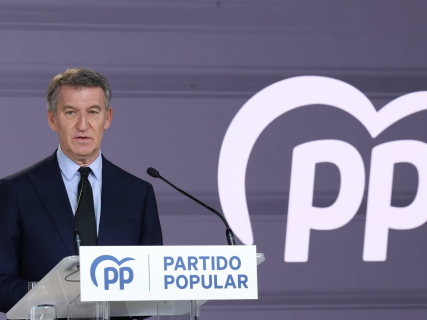









Betting houses position Feijóo as the next president: this is how the 29-N elections are quoted

The bettors do not believe in the comeback: all the betting houses consulted place the PP leader as the next occupant of the Moncloa

fotonoticia 20261124135925 1920

fotonoticia 20261124135925 1920

Add DEMÓCRATA to Google

Ask FREN

Published

Last updated

3 minutes

Most read

Poder Digital · Carrera digital

La carrera digital de los candidatos

El Poder Digital de cada candidato a la Presidencia, de 0 a 100, desde junio · cambio en las últimas 4 semanas

30405060708090100julagoseptoctnovSánchez 93,3Montero 86,0Alvise 81,6Rufián 79,2Feijóo 78,8Abascal 77,5Colau 76,3Nogueras 57,6Valido 38,5
  1. 1Sánchez93,3▼ -1,7
  2. 2Montero86,0▼ -2,0
  3. 3Alvise81,6▼ -1,4
  4. 4Rufián79,2▼ -1,8
  5. 5Feijóo78,8▲ +0,8
  6. 6Abascal77,5▼ -3,5
  7. 7Colau76,3▲ +4,3
  8. 8Nogueras57,6▼ -4,5
  9. 9Valido38,5▼ -6,5

Pendientes de que su partido anuncie el candidato: Adelante, BNG, EH Bildu, EAJ-PNV y UPN.

Ver la carrera completa

Mide presencia e influencia en redes, no intención de voto.

The betting houses and prediction markets consulted place Alberto Núñez Feijóo as the main favorite to become the next president of the Government after the general elections of November 29. 

The odds also make it possible to compare other scenarios: which party will win more seats, which one will lead the percentage of the vote, or what Government formula may come out of the ballot boxes. 

The comparison brings together the odds of Bwin, Betfair Exchange and Sportingbet, the contracts of Polymarket, and the references from Oddschecker. The latter is a comparator that compiles prices from different operators; Betfair Exchange allows users to trade bets, and Polymarket works as a prediction market.

Bwin: Feijóo at 1.12 and the PP, favorite to win on seats

Bwin offers an odds of 1.12 that Feijóo will be the next president of the Government, compared with 5.50 for Pedro Sánchez and 67.00 for Santiago Abascal. In the market for winner by number of seats, the PP is quoted at 1.25, the PSOE at 3.75, and Vox at 67.00. The platform also maintains a market on the composition of the next Executive: PP and Vox are quoted at 1.17; a coalition led by the PSOE, at 5.00; a single-party PP majority, at 13.00, and any other formula, at 67.00.

The house also sets individual lines of deputies. For the PP, it sets the threshold at 132.5 seats, with odds of 2.00 to surpass that figure and 1.73 to stay below. In the case of the PSOE, the line is at 117.5 deputies, with odds of 1.80 for the higher end and 1.91 for the lower end. Vox has the threshold at 65.5 seats, with 1.91 to surpass the figure and 1.83 to not reach it.

Betfair Exchange: Feijóo is quoted at 1.21 and Sánchez at 3.55

On Betfair Exchange, the best available price to back Feijóo as next president is 1.21, while that of Pedro Sánchez stands at 3.55. Santiago Abascal appears at 25.00 on the same market screen. These are exchange prices between users, not fixed odds offered by a traditional house, and they can vary depending on the orders available.

Sportingbet: the PP also appears ahead in bets for seats

Sportingbet offers odds of 1.12 for Feijóo as next president of the Government. Sánchez is listed at 5.50 and Abascal at 67.00. For the winner-by-number-of-deputies market, the platform sets odds of 1.25 for the PP, 3.75 for the PSOE, and 67.00 for Vox.

The seat lines put the PP at 132.5 deputies, the PSOE at 117.5, and Vox at 65.5. The odds to surpass or not those thresholds are, respectively, 2.00 and 1.73 for the PP; 1.80 and 1.91 for the PSOE; and 1.91 and 1.83 for Vox.

Polymarket: 89% for Feijóo and 76% for the PP’s victory

The US prediction market gives Feijóo 89% and Sánchez 11% in the contract on who will be the next president of the Government. The traded volume of that market is around five million dollars. In the contract on the party that will obtain the most seats, the PP records 76% and the PSOE 26%.

These percentages should not be added up as if they were parts of a closed allocation: Polymarket negotiates independent contracts for each party. The platform also places at 87% the affirmative quote of the market on a majority of PP and Vox, with an approximate volume of 150,000 dollars.

Oddschecker: Feijóo, at 1/7, and the PP, at 1/4, to win on seats

Oddschecker records odds of 1/7 for Feijóo as the next president of the Government, compared with 9/2 for Sánchez and 66/1 for Abascal. In the market for winner by number of seats, their best references are 1/4 for the PP, 7/2 for the PSOE, and 66/1 for Vox. These are the best odds compiled among the operators included in its comparison, not the portal’s own bets.

The comparator also includes the market for the party with the highest percentage of the vote: the PP appears at 1/4, the PSOE at 11/4, and Vox at 40/1. For the formula of the next Government, PP and Vox appear at 1/5, while any other alternative trades at 10/3.

Comparison of electoral odds

Platform Next president More seats
Feijóo Sánchez PP PSOE
Bwin 1.12 5.50 1.25 3.75
Betfair Exchange 1.21 3.55 — —
Sportingbet 1.12 5.50 1.25 3.75
Polymarket 89% 11% 76%* 26%*
Oddschecker 1/7 9/2 1/4 7/2

* On Polymarket, the PP and PSOE quotes in the seats market correspond to independent contracts. Therefore, they can add up to more than 100% and do not represent a closed percentage allocation. The odds of Bwin, Betfair Exchange, and Sportingbet are decimal; Oddschecker uses fractional odds and acts as a comparator. Polymarket expresses its quotes in percentages. In Betfair Exchange, the best available price is shown to back each result. 

More key points, information and questions with FREN

AI-GENERATED CONTENT

What is the status of the call and organization of the general elections on November 29?

As of November 25, 2026, the general elections on Sunday, November 29 are formally called and the process is in its final stage: the campaign remains open and the deadlines for remote voting are ending. The call is not pending approval; it came into effect on October 6. The practical priority is to distinguish the procedures already closed from the actions that can still be carried out before Sunday.

Call and schedule

The Royal Decree 806/2026, of October 5, published the following day, dissolved the Congress and Senate elected in July 2023 and called for the renewal of both Chambers. 350 deputies and 209 senators will be elected. In Congress, Madrid goes from 37 to 38 seats and Cádiz from nine to eight; the other constituencies maintain their representation, according to the information from Congress.

  • Candidacies: the schedule set their submission between October 21 and 26, the proclamation on November 2, and their publication on the 3rd. Those ordinary deadlines have already passed.
  • Campaign: started on November 13 and ends on Friday the 27th at 24:00 hours.
  • Reflection and voting: Saturday the 28th will be the reflection day; on Sunday the 29th, polling stations will be open from 9:00 to 20:00 hours.

These dates are recorded in the Demócrata calendar.

Census and administrative preparation

The INE estimates the census at 38,728,356 voters: 35,958,711 residing in Spain and 2,769,645 abroad. Among residents in Spain, 1,615,127 can participate for the first time in a general election for having reached the age of majority. The consultation and claims period was from October 12 to 19; the sending of census cards began on November 2.

The organization already has specific actions from the Central Electoral Board: Instruction 2/2026 regulated free propaganda spaces; on November 5 its national distribution and the resolution on the RTVE information plan were published. Interior has also enabled information about polling stations, voting modalities, and accessibility on its process portal.

Deadlines that still matter
  • Voting by mail from Spain: the application closed on November 19. Although the initial deposit deadline ended on the 25th, the Central Electoral Board extended it until Thursday, November 26, at the latest by 14:00, respecting the schedule of each office, according to the latest information from Demócrata. Those accepted for this modality cannot vote in person.
  • Permanent residents abroad: postal sending to the consulate ended on November 24, but in-person deposit at enabled centers continues until November 26, according to the Interior guide.
  • Residents in Spain temporarily abroad: the specific guide sets November 25 as the last day to send certified votes, after having previously requested it through the consular procedure.
After the polls

After voting, the counting, general scrutiny, and proclamation of elected officials will follow. The constitution of the new Congress and Senate is set for December 23 at 10:00 hours. In summary, the call is in force and the organization is underway: the closure of remote voting, the end of the campaign, and election day remain.

What are the main powers of the Prime Minister according to the Spanish Constitution?

The Prime Minister directs the action of the Executive and coordinates its members, according to article 98.2 of the Spanish Constitution. This is their central competence, but it does not mean they concentrate all the Government's powers: ministers retain their attributions and certain decisions correspond to the Council of Ministers. Additionally, the Constitution assigns them specific functions in the formation of the Executive, relations with the Cortes, and the functioning of the State.

1. Direct and coordinate the Government

Article 98.2 establishes that the Prime Minister "directs the action of the Government and coordinates the functions of the other members thereof, without prejudice to the competence and direct responsibility of these in their management." Therefore, they set the general orientation of the Executive and ensure coordination among its members, respecting each minister's responsibilities.

It is important to distinguish this function from the powers of the Government as a whole: article 97 entrusts the Government with the direction of domestic and foreign policy, civil and military administration, and State defense, in addition to the executive function and regulatory power.

2. Propose the appointment and dismissal of ministers

According to article 100, the other members of the Government are appointed and dismissed by the king, at the proposal of the Prime Minister. This allows the Prime Minister to determine the political composition of their team and promote changes, although the formal appointment and dismissal correspond to the monarch.

3. Submit a vote of confidence

Article 112 allows the Prime Minister, after deliberation by the Council of Ministers, to submit a vote of confidence before Congress on their program or a general policy statement. That is, they can ask deputies to expressly confirm their support. Confidence is obtained by a simple majority; if Congress denies it, the Government must resign, according to article 114.1.

4. Propose the dissolution of the Chambers

According to article 115, the Prime Minister can propose the dissolution of the Congress, the Senate, or the Cortes Generales, after deliberation by the Council of Ministers and under their exclusive responsibility. The dissolution is decreed by the king and must set the election date. There are limits: it cannot be proposed while a motion of censure is pending and, except for the exception in article 99.5, one year must have passed since the previous dissolution.

5. Propose a consultative referendum

Article 92 assigns the Prime Minister the proposal to hold a consultative referendum on political decisions of special importance. They cannot call it alone: prior authorization from Congress is needed and the call corresponds to the king. Its consultative nature distinguishes it from other constitutionally provided referendums.

6. Intervene in relations with the Crown

Article 64 assigns the Prime Minister the countersigning of acts of the king, although competent ministers may also countersign them. Countersigning means accompanying the act with a signature that implies assuming responsibility. There are exceptions: certain acts related to the presidential appointment and dissolution under article 99 are countersigned by the president of Congress. Additionally, according to article 62.g, the Prime Minister may request that the king preside over the Council of Ministers to be informed of State affairs.

7. Appeal to the Constitutional Court

Article 162.1.a legitimizes the Prime Minister to file appeals of unconstitutionality against laws and regulations with the force of law. This power allows requesting the Constitutional Court to examine their compatibility with the Constitution.

In summary, the Presidency combines political leadership, team configuration, and institutional relations, always within constitutional controls and without replacing the collective powers of the Government.

What has been Alberto Núñez Feijóo's political trajectory and party before becoming a candidate for Prime Minister?

Alberto Núñez Feijóo belongs to the People's Party (PP), a formation in which he has developed his party career and whose national presidency he assumed in April 2022. Before running as a candidate for Prime Minister in the 2023 general elections, he had been a civil servant, senior health official, head of Correos, and president of the Xunta de Galicia for thirteen years.

His beginnings: from civil servant to senior official

Born in Os Peares, Ourense, in 1961, he graduated in Law and entered the Galician autonomous administration by competitive examination. His first professional stage was linked to administrative management before assuming political leadership responsibilities. In 1991 he was appointed technical secretary general of the Ministry of Agriculture of the Xunta and later moved to the Health area, where he also held responsibilities in the Galician Health Service, the Sergas. These were his first positions of responsibility in the Galician Government (Politico profile).

The state stage: Health and Correos

In 1996, with José María Aznar's arrival to government, he moved to the state administration. He was Secretary General of Health Assistance at the Ministry of Health and Consumption and president of the National Health Institute, known as Insalud, between 1996 and 2000. This body managed state health care in territories that had not yet received those competencies (Politico profile).

He then moved to Correos: between 2000 and 2001 he was CEO of the public business entity Correos y Telégrafos, and between 2001 and 2003 he presided over the state company. Therefore, before leading a territorial party, he had held management positions both in Galicia and in state institutions (biographical chronology).

His party and return to Galicia

His affiliation to the PP dates to 2002, after having held public offices in governments of that formation. There is no record in the consulted sources of prior membership in another party. The People's Party of Galicia, or PPdeG, is the Galician organization of the PP, not a different formation (RTVE profile).

In 2003 he returned to the Xunta as Minister of Territorial Policy, Public Works, and Transport in Manuel Fraga's government. In 2004 he became first vice president. In 2006 he succeeded Fraga as head of the PPdeG and led the opposition to the Galician government formed by PSdeG and BNG until the 2009 elections (trajectory in Expansión).

Thirteen years at the head of the Xunta

In 2009 he won the regional elections and became President of the Xunta. He remained in office until 2022, after achieving four consecutive absolute majorities: in 2009, 2012, 2016, and 2020. This was the longest period of his career leading a government and the main executive experience with which he later made the leap to national politics (RTVE profile).

From regional president to national candidate

After the internal PP crisis that ended Pablo Casado's leadership, Feijóo was elected national president of the party on April 2, 2022. He then left the Presidency of the Xunta and became a senator by designation of the Galician Parliament. In 2023 he led the PP candidacy for the general elections on July 23: thus, he reached his first national candidacy after three decades of administrative, executive, and party responsibilities (profile and trajectory).

Play

Test your knowledge with FREN!

How much do you know about this topic? Answer the following 3 questions.

Which platform gives Alberto Núñez Feijóo an 89% chance of being the next Prime Minister?

Question 1 of 3

What is Bwin's odds for the PP to get more seats than the other parties?

Question 2 of 3

According to Oddschecker, what odds are offered for Feijóo to be the next Prime Minister?

Question 3 of 3