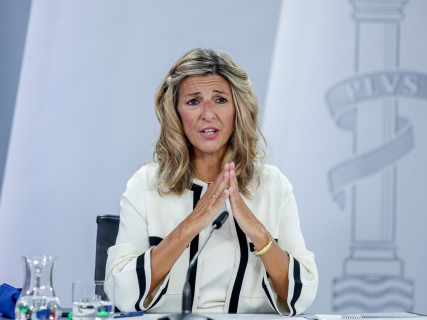

The General Union of Workers (UGT) has expressed its support for Yolanda Díaz's candidacy to lead the International Labour Organization (ILO), considering that her political trajectory incorporates in her agenda "all the important issues" related to employment and that it represents "a guarantee of leadership, commitment, and capacity for consensus."
In a statement, the union organization emphasizes that, during the years she has served as the first vice president of the Government and Minister of Labour, Yolanda Díaz has demonstrated that her way of addressing labor reality and social dialogue contains "the keys to the concrete search for solutions" to the problems of the working class and the business fabric, "reinforcing collective bargaining as a key element to achieve social justice and sustainable economic growth."
UGT highlights that this management and negotiation experience makes Díaz a suitable candidate to assume the general direction of the tripartite United Nations agency, given her familiarity with social concertation processes and her ability to articulate broad agreements.
Furthermore, the union focuses on the current international context, "marked by the weakening of multilateralism, the increase in inequalities, and the persistent deficits in labor rights," and recalls that the ILO plays an "essential role as the only tripartite global organization."
The union center points out that the ILO faces "significant challenges" that affect both its power to act and its normative mission, making it necessary to strengthen dialogue among governments, unions, and employers, safeguard fundamental rights at work, and articulate joint responses to global challenges such as technological transformation, ecological transition, or the fight against inequalities.
UGT argues that Yolanda Díaz's candidacy can help consolidate the ILO's role as a global reference in the defense of decent work, social justice, and international cooperation, preserving its independence, its tripartite structure, and its capacity to respond, from consensus and the protection of the general interest, to current challenges and those that may arise in the future.