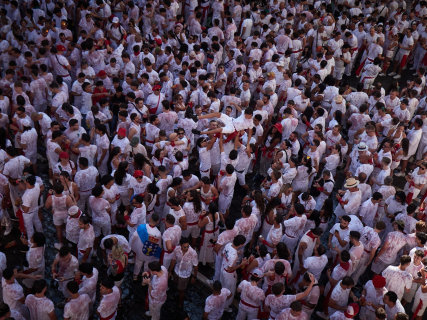
San Fermín 2026 today: La Palmosilla returns after four goring injuries

Today's San Fermín bull run, Sunday, July 12, begins at 8:00 AM with bulls from La Palmosilla. The livestock farm from Cádiz returns to Pamplona after starring in 2025 in the run with the most goring injuries of the entire festival.

3 minutes

EuropaPress 7648606 momentos previos chupinazo san fermin 2026 plaza ayuntamiento julio 2026

EuropaPress 7648606 momentos previos chupinazo san fermin 2026 plaza ayuntamiento julio 2026

Add DEMÓCRATA to Google

Ask FREN

Published

Last updated

3 minutes

Most read

Today's San Fermín bull run will feature La Palmosilla. Six bulls from the Tarifa ranch will run through the streets of Pamplona this Sunday in the sixth bull run of the 2026 festival.

The race began at 8:00 AM from the corrals at the Santo Domingo slope and will end at the bullring after crossing the Plaza Consistorial, Mercaderes, Estafeta, and Telefónica.  

What time is today's San Fermín bull run

The sixth bull run began at 8:00 AM on Sunday, July 12.

Before the start, runners will chant the song to San Fermín three times in front of the niche located on the Santo Domingo slope. The firing of a rocket will mark the opening of the corrals and the start of the race.  

Here are the main details:

* Date: Sunday, July 12, 2026.
* Time: 8:00 AM.
* Ranch: La Palmosilla.
* Bull run number: sixth of San Fermín 2026.
* Start: Santo Domingo slope.
* Finish: Pamplona bullring.

Where to watch the sixth San Fermín bull run

The bull run can be watched live on La 1 de TVE, Canal 24 Horas, and RTVE Play.

Radio Nacional will also broadcast the race. RTVE Play offers a multi-camera option this year that allows viewers to follow different points of the route.  

The special broadcast begins before eight with the atmosphere in the streets, the runners' chants, and an analysis of the bulls that will participate in the bull run.

La Palmosilla returns after four goring injuries

La Palmosilla arrives with one of the toughest precedents from recent San Fermín festivals.

Its bulls left four people injured by goring in 2025, the highest number of gorings in that edition. Such a figure had not been reached in a single race since 2016, when Cebada Gago caused seven gorings.  

The ranch's previous track record had been very different. Its first three participations in Pamplona ended without goring injuries. In 2024, it resulted in one goring, and a year later, the total rose to four.  

A ranch known for its speed

La Palmosilla bulls usually complete the course at high speed.

The average of their five previous participations is two minutes and 43 seconds, although this record is influenced by the 2024 race, which exceeded four minutes. Excluding it, the average of the other four bull runs is reduced to two minutes and 23 seconds.  

Speed can allow for long runs in front of the bulls, but it also reduces reaction time. The risk increases especially if a bull separates from the steers or finds the course saturated with participants.

The bulls from La Palmosilla for this Sunday

The lot transferred to Pamplona is composed of eight bulls weighing between 555 and 590 kilos, although only six will run in the bull run and will be fought in the afternoon.  

These are the eight animals brought:

* Camarado, black brindle, 590 kilos.
* Mágico, black mulatto, 590 kilos.
* Jubiloso, light chestnut, 580 kilos.
* Mirloblanco, streaked black mulatto, 580 kilos.
* Cortijero, streaked black mulatto, 575 kilos.
* Sombrerito, chestnut, 575 kilos.
* Zorzal, red, 565 kilos.
* Cantarillo, chestnut, 555 kilos.  

The six selected for the run will subsequently be taken to the corrals of the bullring, where they will remain until the afternoon bullfight.

Who is fighting this afternoon in Pamplona

The sixth bullfight of the Feria del Toro will begin at 6:30 PM.

The bulls from La Palmosilla will be fought by Fortes, Fernando Adrián, and Samuel Navalón, according to the official program of the Pamplona City Council.  

Sunday's event also coincides with Diversity Day within the official San Fermín program.

Which ranch is running tomorrow in San Fermín

The seventh bull run will take place on Monday, July 13th with bulls from Miura, one of the most recognizable brands of the festival.

Manuel Escribano, Pepe Moral, and Jesús Enrique Colombo make up the poster for Monday's bullfight. The last bull run will arrive on Tuesday the 14th with bulls from Jandilla.  

More key points, information and questions with FREN

AI-GENERATED CONTENT

What is the status of the regulation of the San Fermín bull runs at the regional and state levels?

The San Fermín bull runs do not have a specific “state bull run law”: they fall under the basic state regulations on bullfighting events, safety, and animal health, with detailed development corresponding to Navarra and the Pamplona City Council. At the state level, the core is Law 10/1991 and its Bullfighting Events Regulation, which set the general framework and protection of public order. In Navarra, the reference is Foral Law 2/1989 on public shows and its specific regulatory development for bullfighting events and bull runs, reinforced by several very technical foral orders on routes, fencing, cattle, and animal health. The current state is one of consolidated regulation, with the latest major update in Navarra through Foral Law 5/2025.

Basic state framework

The State establishes a general framework of administrative powers and citizen security in bullfighting matters through Law 10/1991, on administrative powers in bullfighting events. This law classifies bullfighting events and explicitly includes bull runs and other traditional bullfighting festivals in public streets, emphasizing that although details correspond to autonomous communities, the State must guarantee public order and citizen security.

The law is developed through Royal Decree 145/1996, Bullfighting Events Regulation, amended by Royal Decree 1034/2001 and Royal Decree 2283/1998, among others. This regulation defines the different types of bullfighting events, sets authorization or communication requirements, safety conditions, presidency, authority functions, and sanctioning regime. Although it mainly focuses on bullfights in arenas, it serves as a framework for festivities in public transit places, including bull runs.

Complementary rules, such as the Order of January 25, 1993, on Bullfighting Registries or the Order of May 7, 1992, on post-mortem recognition of fighting cattle, regulate professional and veterinary aspects.

On the health front, the breeding and movement of fighting cattle are regulated at the state level by Royal Decree 186/2011, relating to the sanitary classification of fighting cattle farms, and by a set of rules on animal health and livestock movements: RD 479/2004 on livestock farms, RD 51/2004, RD 1698/2003, as well as various orders and royal decrees on bluetongue and other health aspects (Order APA/1901/2006, Order APA/2371/2007, Order APA/2601/2007, Order APA/2776/2005), which indirectly affect festivities where fighting cattle are moved.

Additionally, constitutional jurisprudence has reinforced the cultural dimension of bullfighting (and by extension the entire “fiesta”) through rulings such as STC 177/2016 and STC 134/2018, although these rulings focused on bullfights and not on specific bull runs.

Navarrese specificity: Foral Law and regulations

Navarra has exclusive competence in shows, within the framework of Organic Law 13/1982, of Reintegration and Improvement. On this basis, the community approved Foral Law 2/1989, regulating Public Shows and Recreational Activities (also accessible at [link]), later amended by Foral Law 26/2001 and recently by Foral Law 5/2025 (also at [link]).

Foral Law 2/1989 establishes the general regime for shows and recreational activities, sets the need for licenses and authorizations for high-risk shows, and defines rights and obligations of companies, artists, and the public. Among other aspects, it prohibits the participation of minors under 16 in bullfighting or high-risk shows, allowing only their presence as spectators, which directly affects bull runs.

In development of this law, the Government of Navarra approved Foral Decree 249/1992, Bullfighting Events Regulation (cited in other norms, although its full text is not found in sources). This regulation supports Foral Order 374/2012, which regulates in great detail the characteristics and technical conditions of spaces enabled for bull runs, cattle releases, recortadores contests, and Basque-Landes bullfights. This order sets fencing requirements (minimum wooden sections, distance between posts, height and spacing of planks), evacuation exits, absence of obstacles hindering cattle passage, and rules on “fun elements” that may be installed, clearly differentiating passing bull runs from releases in enclosed spaces.

In parallel, Foral Order 233/2014 regulates the identification of fighting cattle and sanitary conditions of animals and facilities used in bullfighting events in Navarra. It complements the state Royal Decree 186/2011 and the Navarra bullfighting events regulation itself, defining what is understood by shows without death, corrals for festivities, and organizer obligations as the livestock farm holder during the event.

Administrative control is reinforced with instruments such as Foral Order 98/2017, which approves the First Inspection and Control Plan on gaming and public shows 2017-2020, and broader agreements on public health like the Navarra Government Agreement of June 19, 2020 on the post-COVID “new normal,” which also temporarily affected the celebration of shows and bull runs.

Practical application to the San Fermín bull runs

In practice, the San Fermín bull runs are governed by this combination of rules:

  • State: Law 10/1991, Bullfighting Events Regulation, and livestock health regulations (including RD 186/2011), which set the minimum framework for public order, safety, and cattle health.
  • Navarra: Foral Law 2/1989 and its amendments (FL 26/2001, FL 5/2025), Bullfighting Events Regulation (FD 249/1992), Foral Order 374/2012 (fencing, routes, fun elements), and Foral Order 233/2014 (identification and cattle health), plus municipal ordinances of Pamplona, which are not found in consulted sources.

No further information is available in consulted sources about specific state legislative projects for bull runs. Recent regulatory evolution is concentrated in Navarra with Foral Law 5/2025, which updates the general framework for shows, while the technical detail of bull runs remains in current foral orders.

What exact changes does Foral Law 5/2025 introduce in the regulation of public shows that may affect the San Fermín bull runs? What specific safety requirements (fencing, emergency exits, capacity) are demanded on the Pamplona bull run route according to Navarrese regulations? What leeway does the Pamplona City Council have to tighten or relax the conditions for holding the bull runs within this regional and state framework?

What are the competences of the Pamplona City Council in organizing the Sanfermines?

The Pamplona City Council has central competence in organizing the Sanfermines: it designs and finances the official program of events, approves each year the San Fermín Proclamation, and coordinates security, municipal devices, and use of public space. Some key pieces (bull run, Feria del Toro) are managed in collaboration with the Casa de Misericordia and other entities, but under a framework regulated by ordinances and agreements. Additionally, it assumes institutional leadership of symbolic acts (Chupinazo, procession, Pobre de Mí) and sets the rules of coexistence, civility, and compliance with ordinances during the festivities. From these bases, both the festive aspect and civil protection and citizen security are articulated.

Municipal competence and normative framework

Legally, the festivities are governed by three pillars:

  • San Fermín Proclamation: an annual provision that sets schedules, behavior rules, and conditions for public space use during the festivities. The City Council itself presents it as the order that “organizes” San Fermín and it is officially published before July 6, as can be seen in the 2026 Proclamation.
  • General ordinances: also applied during festivities (noise, cleaning, terraces, alcohol consumption, etc.). The Plenary has urged strengthening civility campaigns and “compliance with municipal ordinances” linked to coexistence in Sanfermines, according to the institutional declaration of July 2, 2026, recorded by the City Council itself in this note.
  • Bull Run Ordinance: specifically regulates this event. An example is the prohibition of recording on the route: the Municipal Police reminds that article 11 prohibits “using any image or sound recording device” without authorization and sanctions these behaviors as serious infractions, with fines between 601 and 6,000 euros, according to municipal information in this news.

The City Council’s material competences during the festivities rest on this normative basis.

Organization of the program and festive space

The City Council designs and finances the official San Fermín program. For 2026 it has approved 516 events (concerts, verbenas, children’s activities, livestock fair, procession, etc.), with a budget of about 1.76 million euros, as detailed in the note “Childhood and neighborhoods gain prominence…” available at [link]. That document highlights two political lines: bringing the festival to neighborhoods and strengthening the children’s and youth offer.

Besides its own programming, the City Council enables festive spaces managed in collaboration with social entities (Nafarroa Oinez, Regional Houses, Herri Sanferminak, Diversity Collectives…), as noted in “The City Council enables five festive spaces…” ([link]). The municipal competence here is twofold: authorizing and ordering the use of public space and selecting, through calls or agreements, the groups that program part of the offer.

The City Council itself specifies which acts “with corporate presence” it organizes directly (Chupinazo, Vespers, Procession, Octave, Pobre de Mí, etc.), as recorded for 2025 in this official list and in the specific institutional events agenda ([link]).

Security, civil protection, and coexistence

Regarding security, the City Council leads the General Plan for the festivities and the Local Civil Protection Board. The note “The first Local Civil Protection Board addresses the details of the General Plan…” ([link]) explains that this plan sets police and health devices, traffic restrictions, cleaning, and objectives of “oversight, surveillance, and protection” of the events and daily life. From the Security and Coexistence area, a command center and daily Board meetings are coordinated between July 8 and 14.

The Board includes municipal areas of Security, Urban Conservation and Health, Social Action, Equality and Culture, along with the Government of Navarra, Government Delegation, Commonwealth, Casa de Misericordia, Firefighters, Municipal Police, Foral Police, National Police, and Civil Guard. That is, the municipal competence is local coordination and integration of all involved services.

The emphasis on coexistence is reflected in the institutional declaration on Sanfermines approved in Plenary (July 2, 2026), which commits the City Council to festivities “where coexistence, enjoyment in freedom, and mutual respect prevail” and to preventing gender-based violence, as shown in [link]. Days earlier, the Presidency Commission had approved a recognition declaration for public service personnel who make the Sanfermines possible, highlighting institutional support and commitment to “guarantee the necessary human and material resources” (see [link]).

Data offered by Mayor Asiron on “very high participation” and a decrease in complaints during the 2026 Sanfermines, collected by the newspaper Demócrata in this report, illustrate how municipal management of security and mobility (945,000 public transport trips) is a very visible competence exercised during the festivities.

Bull run, Feria del Toro, and agreements

In the bullfighting field, the Casa de Misericordia de Pamplona organizes the Feria del Toro and selects the herds that run the bull run, as detailed by Demócrata in this piece. The City Council, as the holder of local authority, assumes other functions: presiding over (and delegating) the bullfights and setting administrative and safety conditions in the Bullring and the route. The municipal note on the delegation of presidencies of the 2026 Feria del Toro bullfights ([link]) accounts for this prerogative of the mayor.

The media and tourist dimension is also managed through agreements. RTVE explains the agreement with the City Council and EITB for the broadcast and preservation of the audiovisual archive of the bull runs in this article; the council has framed this alliance and other projects in the “Pamplona San Fermín SF 365 Tourism Sustainability Plan,” mentioned in general municipal references ([link]).

All these actions show that the City Council exercises comprehensive competence: it regulates, programs, and finances the festivities; coordinates security and public services; and, through proclamations, ordinances, and agreements, sets the rules of the game for other actors (social entities, Casa de Misericordia, media, etc.), without prejudice to foral and state competences in public order or bullfighting events.

For a general view of the festival and the institutional role of the City Council, the encyclopedic entry on the Sanfermines in Wikipedia and the municipal historical summary at this page can be consulted. Demócrata also offers political and social coverage of the festivities and their institutional environment in news such as the 2026 chupinazo profile ([link]), the presence of national leaders in the bull runs ([link]), or controversies about municipal management of the festivities in terms of freedom of expression and democratic memory ([link], [link], [link]).

What specific role does the Casa de Misericordia have vis-à-vis the City Council in managing the bull run and the Feria del Toro? How is the San Fermín Proclamation prepared and negotiated each year within the City Council and with other institutions? What recent political changes in the Pamplona City Council have influenced the Sanfermines model (program, festive spaces, institutional messages)?

What requirements must the herds meet to participate in the San Fermín bull runs?

The available sources allow only a partial picture: there is no public and detailed list of “administrative requirements” for herds, but it is clear that participation in the San Fermín bull runs is conditioned by three levels: the closed selection made by the Casa de Misericordia of Pamplona (MECA) according to breeding, health, and bullfighting criteria; the strict animal health framework of Navarra; and the municipal regulation of the bull run and bullfighting festivities. The full text of the foral bullfighting regulation or a specific accessible ordinance on requirements such as age, weight, or horn characteristics of the bulls is not available in the consulted sources. In practice, the key is that only certain top-level herds, with health guarantees and proven track records, are invited by MECA and accepted by the City Council in the Feria del Toro.

Selection of herds by the Casa de Misericordia

The newspaper Demócrata reports that the Casa de Misericordia, organizer of the Feria del Toro, “selects each year the participating herds attending to breeding, health, and bullfighting criteria” and that “the same cattle that run in the morning bull run are fought in the corresponding afternoon bullfight” in Pamplona, according to this information about the 2026 San Fermín herds.

In 2026, for example, herds such as Fuente Ymbro, Cebada Gago, Victoriano del Río, Álvaro Núñez, José Escolar, La Palmosilla, Miura, or Jandilla have been contracted, all reference brands in the bullfighting circuit, reinforcing the idea that access is very restricted to top fighting cattle herds with prior history in major fairs.

Additionally, notes from the Pamplona City Council show that the municipal Corporation visits the Corrales del Gas to “personally meet the herds that have already arrived to participate in the 2026 San Fermín Feria del Toro,” citing Victoriano del Río Cortés, Fuente Ymbro, Heirs of José Cebada Gago, and Álvaro Núñez, with the later incorporation of El Capea/Carmen Lorenzo, José Escolar Gil, La Palmosilla, Miura, and Jandilla, according to the municipal note accessible at this official reference.

In summary, from a practical point of view, a herd wishing to be in Pamplona needs to:

  • Be a consolidated fighting cattle herd, with suitable size and behavior for first-category bullfights.
  • Be expressly selected by the Casa de Misericordia, in a closed invitation process based on bullfighting trajectory and health guarantees.
  • Fit the Feria del Toro programming, since the same bulls from the bull run are fought in the afternoon.

Health framework and foral regulation in Navarra

Alongside the bullfighting selection, Navarra applies very strict animal health regulations that condition any movement of fighting cattle. The foral Government has even proposed vaccinating all bovine livestock due to nodular dermatitis outbreaks in France, as reported by Demócrata in the appearances of Minister Aierdi, in this information and this complementary note.

Moreover, in sanitary risk contexts, the foral Executive has suspended “all fairs, contests, and livestock markets” until a certain date, precisely to avoid the spread of diseases such as contagious nodular dermatitis, according to the news about the suspension of livestock events in Navarra available at this article.

Although these measures are cited regarding bovine livestock in general and not specifically bull runs, they allow inferring that herds participating in San Fermín are subject to:

  • Mandatory veterinary controls before entering the Pamplona corrals.
  • Compliance with all vaccination, transport, cleaning, and vehicle disinfection requirements and health documentation set by Navarra for bovine movements.

However, the consulted sources do not reproduce the full text of the bullfighting events regulation nor the specific bull run ordinance with technical detail of requirements for herds (exact minimum age of bulls, maximum weights, or horn characteristics).

Role of the City Council and bull run regulation

The Pamplona City Council regulates the bull run as a public show and coordinates bullfighting aspects with MECA. MECA’s centrality is clear in the agreement with RTVE and EITB on bull run broadcasting, where the Casa de Misericordia, as holder of the bullring, participates in the agreement and receives part of the 650,000 euros annually linked to those broadcasts, according to the official note available at this broadcasting agreement.

Regarding the bull run, the municipal “Bull Run Table” approves yearly adjustments to improve safety, such as the recent prohibition for runners to remain stopped in the arena, recorded in this note. The same safety logic presumably applies to requirements demanded of the cattle and herds, although accessible documents focus on rules for human runners.

Limitations of available information

The full text of the Navarrese bullfighting regulation or a “bull run ordinance” with technical detail of requirements for herds (age, weight, exact documentation, or economic responsibility regime) has not been located in consulted sources. What is clear is that:

  • The selection is discretionary and carried out by MECA based on breeding, health, and bullfighting criteria.
  • Herds must strictly comply with Navarre’s animal health regulations.
  • The Pamplona City Council integrates that selection into the general bull run and Feria del Toro device.

To know the exact legal requirements a specific herd must meet, it would be necessary to consult the autonomous bullfighting events regulations and the internal Feria del Toro documentation handled by the Casa de Misericordia and the City Council.

Which specific herds run each day in the 2026 San Fermín bull runs and what reputation do they have regarding speed or danger? What rules and prohibitions govern human runners in the Pamplona bull run according to the City Council? How do health alerts such as nodular dermatitis or avian flu affect the holding of animal festivities in Navarra?

Play

Test your knowledge with FREN!

How much do you know about this topic? Answer the following 3 questions.

What time did the sixth running of the bulls of San Fermín 2026 start?

Question 1 of 3

How many bulls from La Palmosilla participate in the run on Sunday, July 12, 2026?

Question 2 of 3

Which ranch will run in the seventh running of the bulls of San Fermín, on Monday, July 13?

Question 3 of 3

Hola, soy Fren. ¿Cómo te ayudo?