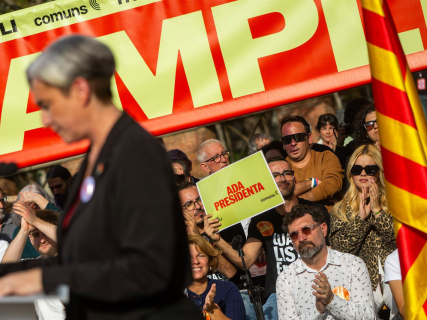

In a limiting situation, Frente Amplio demanded a historic mobilization to fight for a comeback that would manage to stop the advance of Partido Popular and Vox. The response was up to the task, with participation of 79%, just a few tenths of what was recorded in 1982, the highest in all of history. But the result barely changed the board.
The coalition of left-wing parties led by Ada Colau sank to 13 seats, the worst result for the alternative left in fifteen years. Three years ago, in June 2023, Sumar won 31 seats.
The space, which managed to surpass 20% of the votes riding on Podemos in 2015, with 69 seats—plus two more from Izquierda Unida—and even came to dream of surpassing the PSOE, records something more than 6% of the votes.
A result that buries the records collected in a decade of change starting from 15M and returns the space to 2011, when Izquierda Unida reached eleven seats in 2011.
More than half, in Madrid and Barcelona
The distribution of seats reveals one of the drags that explain the weak result of Frente Amplio. The coalition concentrates more than half of its seats in the two largest constituencies, Madrid (5) and Barcelona (3).
Added to that are the three obtained in the Community of Valencia, in a coalition with Compromís (two in Valencia and another in Alicante, which is held by a Podemos candidate), in Zaragoza with la Chunta and in Balearic Islands with Ara Mès.
In the rest of the country, all the votes achieved by the coalition go without representation.
The diagnosis anticipated by Frente Amplio at the start of the campaign—that the numbers would not work out for the left-wing bloc without a strong result in the mid-sized and small provinces—came true.
Swallowed by the push of Vox and the territorial left
Ada Colau’s side had insisted throughout the campaign on the importance of surpassing the 10% barrier in order to fight with Vox for the seats that PP and PSOE left behind, and even for those that the two major parties could take back.
They lost the battle outright to Vox, which is the only one of the major parties that comes out ahead—eroding the two-party system, which loses seats—with 51 seats and more than 15% of the votes.
In addition to the flight of voters to the PSOE, the result of Frente Amplio is also explained by the energetic push of nationalist and territorial lefts, strengthened after the elections.
Esquerra Republicana goes from seven to eleven deputies, EH Bildu from five to seven, BNG from one to two, and Adelante Andalucía makes its way into Congress with four representatives. All of them achieve a better result than Frente Amplio, which stays at 13 from the 31 it achieved with Sumar in 2023.