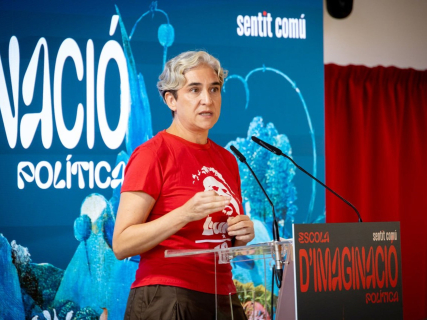









Más Madrid proposes Ada Colau as the candidate of the Broad Front for the Presidency of the Government

The training suggests that the former mayor of Barcelona also heads the list for the Catalan capital in a candidacy of a choral nature and with a confederal structure.

fotonoticia 20261003143927 1920

fotonoticia 20261003143927 1920

Add DEMÓCRATA to Google

Ask FREN

Published

Last updated

1 minute

Most read

Poder Digital · Carrera digital

La carrera digital de los candidatos

El Poder Digital de cada candidato a la Presidencia, de 0 a 100, desde junio · cambio en las últimas 4 semanas

30405060708090100julagoseptoctnovSánchez 93,8Montero 86,3Alvise 82,2Rufián 80,8Feijóo 79,1Abascal 78,4Colau 76,5Nogueras 58,0Valido 39,0
  1. 1Sánchez93,8▼ -0,2
  2. 2Montero86,3▼ -1,7
  3. 3Alvise82,2▼ -1,8
  4. 4Rufián80,8▼ -1,2
  5. 5Feijóo79,1▲ +0,1
  6. 6Abascal78,4▼ -3,6
  7. 7Colau76,5▲ +4,5
  8. 8Nogueras58,0▼ -4,0
  9. 9Valido39,0▼ -6,0

Pendientes de que su partido anuncie el candidato: Adelante, BNG, EH Bildu, EAJ-PNV y UPN.

Ver la carrera completa

Mide presencia e influencia en redes, no intención de voto.

More Madrid proposed this Wednesday that Ada Colau be the candidate of the Broad Front for the Presidency of the Government and lead the list of the platform for Barcelona in the upcoming general elections on November 29.

The Madrid formation has argued that the proposal responds to the principles of territoriality, generosity, and confederal functioning on which, it indicates, the different forces that make up the Broad Front have been working for months.

More key points, information and questions with FREN

AI-GENERATED CONTENT

What is the parliamentary status of the possible Frente Amplio candidacy and what are the next steps for its formalization?

As of today (October 7, 2026), the so-called Frente Amplio is not yet a registered candidacy nor a formal coalition before the Electoral Board, but rather a political project in an advanced negotiation phase driven by Movimiento Sumar, Izquierda Unida, Más Madrid, and the Comuns. Therefore, it does not yet have its own “parliamentary status” in the sense of a registered initiative or group: what exists is a recomposition of the coalition to the left of the PSOE preparing its candidacy for the general elections on November 29.

1. Current situation of the Frente Amplio project

According to information from Demócrata, the four formations currently supporting Sumar in the Government have agreed on:

  • Name and project: the new electoral brand will be “Frente Amplio”, presented as an alternative left-wing space aiming to group Sumar, IU, Más Madrid, and Comuns and potentially other territorial allies.
  • Launch date: on October 17 a large public event will be held where the Frente Amplio project will be formally presented and the person who will lead the candidacy for the general elections will be announced (Demócrata news).
  • Leadership: leadership is open. Various reports place the Minister of Health and leader of Más Madrid, Mónica García, as the favorite, and she herself has declared she is “willing to do whatever is necessary to stop the far right,” although conditioning any step on a consensus among the parties. Other names are also mentioned (such as the Minister of Culture, Ernest Urtasun), but no final decision has been made.
  • Scope of the coalition: the basic alliance groups Movimiento Sumar, IU, Más Madrid, and Comuns. The project aims to expand to other forces that currently cooperate parliamentarily with Sumar: Compromís, Chunta Aragonesista, Més per Mallorca, or Verdes Equo are cited, among others. Some, like Compromís, have expressed preferences for more autonomous formulas with a strong territorial focus; others are waiting to see how the new space is configured before deciding.
  • Relationship with Podemos: Frente Amplio is born without Podemos being an organic part of the promoting core. Since 2023, political and strategic distances persist. Podemos proposes open primaries for the entire left, while the Sumar space prioritizes negotiation among organizations; the possible incorporation of Podemos remains an unknown.

Meanwhile, ministers and leaders of these forces are holding almost continuous summits to adapt the new coalition’s calendar to the scenario created by the early election call for November 29 and the recent fall in Congress of the housing royal decrees, which has acted as a political trigger and as the central axis of Frente Amplio’s discourse.

2. Necessary formal procedures and legal margins

Legally, Frente Amplio must follow the general rules of the Organic Law of the General Electoral Regime (LOREG) for electoral coalitions at the state level:

  • The parties that decide to run together under the Frente Amplio brand must sign a coalition agreement defining the name, distribution of responsibilities, allocation of candidacies by constituencies, and integration of electoral accounts.
  • This agreement must be communicated and registered before the competent Electoral Board within the deadline set in the November 29 election calendar. Specialized press cited by Demócrata estimates that, in practice, the coalition should be registered at the latest on the eve of its public presentation on October 17, to avoid a race against time.
  • Once the coalition is registered, each party will integrate its candidacies into the common lists by constituency. In parallel, bank accounts, the accounting integration agreement, and the necessary documentation for subsequent auditing by the Court of Auditors will be communicated to the electoral administration.

In summary: as of today, the registration of “Frente Amplio” as an electoral coalition is not yet recorded. We are in the immediately prior phase of political negotiation and drafting of the coalition agreement, which must be translated into a formal registration before the Electoral Board in the coming weeks.

3. Expected next steps until formalization

Based on information available in the press and particularly in Demócrata, the most likely steps are:

  • Closing the internal Sumar–IU–Más Madrid–Comuns pact: final definition of the minimum program, internal operating rules, and distribution of positions on lists and campaign bodies.
  • Decision on the lead candidate: likely before or at the event on October 17. Mónica García is the name with the most options in the betting pools and has already verbalized her availability, but the decision will depend on consensus among the organizations.
  • Negotiation with territorial forces: bilateral and multilateral meetings with Compromís, Chunta Aragonesista, Més per Mallorca, Verdes Equo, and other regional actors to decide whether they fully integrate into Frente Amplio, articulate specific confluences by territory, or run with their own coordinated brands.
  • Possible inclusion (or not) of Podemos: if some formula of shared primaries or political negotiation allowing a single alternative left candidacy succeeds; otherwise, Frente Amplio and Podemos may compete with separate projects.
  • Registration of the coalition and presentation of candidacies: once the political agreement is closed, the formal communication of the Frente Amplio coalition will be submitted to the Electoral Board and, within legal deadlines, the complete lists by provinces will be registered.

In conclusion, Frente Amplio is in the final stretch of its political formation, with a date already set for its public presentation and leadership designation, but still without formal translation into the electoral register. The success of its formalization will depend on how quickly the internal agreement is closed, the degree of incorporation of territorial allies, and whether or not they achieve a shared solution with Podemos before the Electoral Board’s deadlines for November 29.

What are the powers and attributions of the Presidency of the Government of Spain according to current legislation?

The Presidency of the Government of Spain is the political leadership center of the Executive. Its powers are mainly defined in the Spanish Constitution, in Law 50/1997, of the Government, and are complemented by sectoral regulations (such as Law 2/2014, on the Action and Foreign Service of the State) and by royal decrees structuring the Presidency of the Government itself. Together, they configure a leadership position over the Government and a hinge with the rest of the State powers.

1. Basic constitutional functions

The Constitution configures the Government as the body that directs internal and external policy, the civil and military Administration, and the defense of the State, and establishes that the President of the Government is its highest political authority. From this position, the Constitution attributes to him, among others, the following essential functions:

  • Direction of Government action: the President sets the political program, marks the general lines of governmental action, and is politically accountable before the Congress.
  • Relationship of confidence with the General Courts: he is invested by the Congress, can raise before this Chamber the question of confidence on his program or a declaration of general policy, and is subject to ordinary parliamentary control (questions, interpellations, debates).
  • Influence on the dissolution of the Chambers and electoral call: after deliberation of the Council of Ministers and under his exclusive responsibility, he can propose to the King the dissolution of the Congress, the Senate, or the General Courts, setting the election date in the decree.
  • Participation in the call of consultative referendums: the referendum on political decisions of special significance is convened by the King at the proposal of the President of the Government, with prior authorization from the Congress.
  • Role in Government responsibility: if the Congress denies him confidence or approves a motion of censure with an alternative candidate, the President and his Government must resign, opening a new investiture process.
2. Legal attributions according to the Law of the Government

Law 50/1997 develops in detail the functions of the President. Alongside the general direction of the Executive and coordination of its members, the law expressly attributes him competencies such as:

  • Representation of the Government: he holds the representation of the Government as a whole.
  • Determination of the program and political guidelines: he establishes the Government’s political program and the guidelines of internal and external policy, ensuring their compliance.
  • Proposal of dissolution of the Chambers: he is the one who proposes to the King the dissolution of the Congress, the Senate, or the General Courts, after deliberation of the Council of Ministers.
  • Raising the question of confidence: he decides to submit to the Congress’s confidence his program or a declaration of general policy, also after deliberation of the Council of Ministers.
  • Proposal of consultative referendum: he proposes to the King the call of consultative referendums authorized by the Congress.
  • Relations with the Crown: he endorses, when appropriate, the acts of the King and submits laws and other norms with the rank of law to him for sanction.
  • Appointment and dismissal of the Government: he proposes to the King the appointment and removal of vice presidencies and ministers and can reorganize ministries and Secretariats of State.
  • Organization of the Executive itself: he creates, modifies, and suppresses ministerial departments and Secretariats of State and approves the organic structure of the Presidency of the Government.
  • Internal coordination: he resolves conflicts of attributions between ministries, issues instructions to the rest of the Government members, and exercises all other attributions granted by the Constitution and laws.
3. Presidency of the Government, external action, and own structure

Specific norms complete this framework. Law 2/2014 on the Action and Foreign Service of the State emphasizes that it corresponds prominently to the President of the Government to:

  • Direct the guidelines of foreign policy and ensure their compliance, within the framework of the State’s external action.
  • Represent Spain, without the need for special powers, in acts of celebration of international treaties and in the manifestation of consent to be bound by them, according to the Constitution and applicable legislation.
  • Receive advice from the Foreign Policy Council, a body that supports him in the direction and coordination of foreign policy and in the management of the means of the State’s Foreign Service.

On the other hand, the royal decrees structuring the Presidency of the Government specify the bodies that compose it (President’s Cabinet, General Secretariats, Secretariat of State for Communication, offices of European and foreign affairs, among others) and describe their functions of political and technical assistance. These bodies allow the President to:

  • Have information and advice on national, international, economic, and national security policy.
  • Coordinate governmental action with autonomous communities and with the European Union.
  • Articulate the Government’s institutional communication and the relationship with the citizenry.
4. Acting President and limits

When the Government is acting, the Law of the Government limits the competencies of the President and the rest of the Executive to the ordinary handling of public affairs and the essential management to avoid the paralysis of the Administration. During this period, the acting President cannot, for example, raise questions of confidence or propose the call of consultative referendums, although he maintains the attributions necessary to ensure the continuity of the State and fulfill basic internal and international obligations.

Overall, current legislation configures the Presidency of the Government as the apex of the State’s political leadership, endowed with broad powers of impulse, coordination, and representation, but always framed within the relationship of confidence with the Congress and the system of constitutional checks and balances.

Could you detail how the relationship between the President of the Government and the King is practically articulated in the signing and endorsement of royal acts? What competency differences exist between the President of the Government and the vice presidents according to the Law of the Government and the structural royal decrees? How are the powers of the President of the Government concretely limited when he is acting after general elections?

What results did Más Madrid obtain in the last general elections and how many seats did it achieve in Congress?

According to the information found in the consulted sources, there is no official disaggregated data specific to the Más Madrid brand in the last general elections to the Congress of Deputies (July 23, 2023). Available references mention its participation within the Sumar coalition but do not provide the vote percentage or the number of seats attributable exclusively to Más Madrid, but rather to the entire Sumar candidacy. Therefore, it is not possible, with these sources, to give a precise numerical figure of votes or “own” seats of Más Madrid in Congress.

In summary, what can be stated is the following:

  • In the general elections of July 23, 2023, Más Madrid did not run with its own state list but was integrated into the Sumar coalition.
  • In the Madrid constituency, the ballot for Congress bore the Sumar brand, in a coalition where Más Madrid participated alongside other forces.
  • Seats are assigned to the Sumar candidacy as a whole; the internal distribution among parties (how many deputies “are from” Más Madrid) is a political and organizational reality but does not appear in the official electoral results data.

Various journalistic reports after the elections describe the parliamentary presence of Más Madrid through the Plurinational Sumar Group in Congress. For example, it is noted that:

  • The Sumar group includes deputies from several forces, among them Más Madrid, as well as IU, En Comú, Compromís, Chunta, Més, and other formations that ran in coalition in July 2023.
  • The replacement of seats on the Sumar list for Madrid (for example, after Íñigo Errejón’s resignation as deputy) falls to candidacies identified as belonging to Más Madrid, confirming that the organization has presence in the Sumar bench in Congress, although the seats continue to be formally counted as Sumar’s.

However, these reports describe the political composition of the group and internal seat movements but do not offer an electoral results table with:

  • the vote percentage obtained by Más Madrid as such, nor
  • the number of seats officially assigned to Más Madrid, differentiated from the other coalition parties.

This has an important institutional explanation: the Electoral Board and the Official State Gazette publish election results by proclaimed candidacies, that is, by the lists that appear on the ballot. In July 2023, the candidacy was “Sumar” (with the subtitle of the corresponding coalition), so:

  • Votes and seats are legally assigned to Sumar as a candidacy.
  • The internal distribution of responsibilities, leadership, and party affiliation of the elected individuals is a political and organizational matter of the coalition, not a data of the electoral result published by the authorities.

In other words, from a strictly electoral and legal point of view, the quantifiable result is that of Sumar; politically, we know that several of the deputies elected from Sumar for Madrid belong to Más Madrid, and that this organization is a stable part of the Sumar parliamentary group in Congress. But the consulted sources do not offer an official and verifiable figure of “X seats of Sumar are from Más Madrid” nor an isolated vote percentage for Más Madrid in the general elections.

If you need an exact numerical figure disaggregated by party within the coalition, the only robust way to reconstruct it would be to carry out a specific analysis based on:

  • the candidacies and complete lists presented before the Electoral Board,
  • the official scrutiny of Sumar by constituencies, and
  • the one-to-one identification of which elected individuals belong to Más Madrid (organizational information of the coalition).

This type of reconstruction is not found directly and disaggregated in the consulted sources, which only allow us to ensure that Más Madrid integrated into Sumar and has representation in Congress through that group, but without offering the vote percentage or the number of “own” seats of the brand.

Play

Test your knowledge with FREN!

How much do you know about this topic? Answer the following 3 questions.

Who has Más Madrid proposed as the candidate of the Broad Front for the Presidency of the Government?

Question 1 of 3

What leadership model does Más Madrid propose for the Broad Front?

Question 2 of 3

Who will lead the Broad Front list for Madrid according to Más Madrid's confirmation?

Question 3 of 3