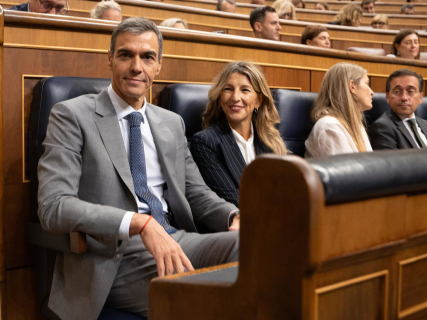
Pedro Sánchez only has one way: to rebuild the block of 23J

Sánchez depends on reassembling parliamentary support after the 23J to sustain his majority.

3 minutes

fotonoticia 20261002144120 1920

fotonoticia 20261002144120 1920

Add DEMÓCRATA to Google

Ask FREN

Published

Last updated

3 minutes

Most read


Does the most voted win or the one who forms the Government? Probably, the answer will be different if you ask Sánchez or Feijóo. Although both could change their minds and sell themselves as winners, whatever happens in the general elections of November 29. But one thing is clear: it is not necessary to be the one who receives the most support at the polls to be president. The last example was the 2023 elections: the PP won then with 137 deputies, but PP and Vox remained at 170, below the 176 of the absolute majority. Four months later, Sánchez obtained 179 votes in his investiture by gathering the PSOE, Sumar, ERC, Junts, EH Bildu, PNV, BNG, and Coalición Canaria.

The problem for the PSOE is that the arithmetic that allowed that operation has changed. The average of polls from DatosRTVE  now places PP and Vox at 202 seats, while the forces that participated in Sánchez's investiture in 2023 would sum around 145. The distance between both photographs is 57 deputies.

Therefore, more than repeating exactly the electoral result of 2023, the PSOE would need to rebuild the parliamentary conditions that made that investiture possible: that PP and Vox do not reach the absolute majority on their own and that the set of forces willing to support or facilitate a Sánchez Government has enough representation to make it viable.

The problem for Sánchez is in the 152 seats contributed by PSOE and Sumar

In the investiture of 2023, PSOE and Sumar contributed 152 of the 179 favorable votes: 121 socialist deputies and 31 from Sumar. The current average from DatosRTVE reduces that representation to 117: 104 deputies for the PSOE, ten for Sumar, and three for Podemos. That is 35 seats fewer than those held by PSOE and Sumar after the 2023 elections.

This decline is more significant for a potential investiture than the mere comparison between voting percentages. The PSOE can maintain several of the territorial parties that were already decisive in 2023 as interlocutors, but it needs to enter the subsequent negotiation with a sufficient parliamentary base.

The photograph of the territorial partners does not explain the decline of the bloc by itself. ERC, Junts, EH Bildu, PNV, BNG, and Coalición Canaria summed 27 deputies in 2023 and appear with 28 in the current average: eight, four, seven, six, two, and one, respectively.

That is to say, the joint representation of those six forces barely changes. The loss of weight is concentrated mainly in the PSOE and in the space to its left.

The PSOE would have to recover seats where it lost them

The loss of representation also has a translation in votes. The PSOE obtained 31.7% of the votes in 2023 and the current average places it at 26.3%. Sigma Dos puts it at 25.6% and 40dB at 27.4%.

The data from 40dB also shows that the PSOE retains 68.4% of its voters from 2023. Among those who then voted socialist, 5.4% now lean towards the PP and 4.8% towards Vox. 5.3% of those who abstained in 2023 currently declare an intention to vote for the PSOE.

The question, therefore, is not simply about mobilizing those who did not vote three years ago. The PSOE also needs to recover part of the voters who have changed their option and retain those who remain in its space. And those votes only translate into parliamentary recovery if they manage to produce seats in the constituencies where they are contested.

The electoral system thus adds a second variable to the national arithmetic. The 350 deputies are not distributed in a single constituency: each province functions as a different competition and the limited number of seats means that part of the vote may not translate into representation.

Rebuilding the block of 23J involves three movements

To reproduce an investiture like that of 2023, the PSOE would have to face three consecutive parliamentary problems. The first is to prevent the PP and Vox from reaching 176 deputies. The second, to recover a substantial part of the representation lost by the PSOE and its left. And the third, to find again a combination of supports and abstentions among the forces that allowed the previous investiture.

The territorial parties maintain, at least in the current average, a joint weight very similar to that of 2023. This makes the evolution of the PSOE and its immediate political space one of the central variables of the arithmetic of the next Congress.

The key, therefore, is not solely in whether Sánchez is ahead of or behind the PP. It is in whether the result of 29-N produces a Congress in which the PP and Vox cannot resolve the investiture by themselves and in which the PSOE retains enough representation to build a majority with other forces.

That was the mechanism that allowed Sánchez to govern in 2023 despite not winning those elections. The current average of polls starts from a very different configuration and leaves the PSOE facing the need to rebuild, with a smaller starting representation, a parliamentary majority that then reached 179 votes.

More key points, information and questions with FREN

AI-GENERATED CONTENT

What is the current status of the possible processing of post-electoral pacts in the Congress after the upcoming general elections?

There is no formal and regulated "processing" of post-electoral pacts as such in the Congress of Deputies. What is strictly regulated are the institutional steps that follow a general election (constitution of the Chamber, election of the Board, formation of groups, and investiture sessions), and within that legal framework is where political agreements between parties are inserted, which are essentially extra-parliamentary negotiations.

After the elections are held, the Congress Regulations set a clear calendar and milestones:

  • Article 1 provides that, once the elections have been held, the Congress will meet in a constitutive session on the date and time set in the Royal Decree of convocation.
  • According to articles 2 to 5, this session opens under an Age Board, the Royal Decree and the list of elected members are read, and it immediately proceeds to the election of the Congress Board, following the procedure detailed in article 37.
  • Once the vote is concluded, the oath or promise to uphold the Constitution is taken, and the Presidency declares the Congress constituted, communicating it to the King, the Senate, and the Government.

The election of the Board (Presidency, Vice Presidencies, and Secretariats) is regulated in articles 30 to 38. Article 36 establishes that the Plenary elects the Board in the constitutive session; article 37 details the voting system (absolute majority for the Presidency in the first vote, and simple majority between the two most voted if necessary; simultaneous election of the other members by number of votes).

In practice, this election is the first formal reflection in Congress of the post-electoral pacts: agreements between parties to support one or another candidacy for the Presidency of Congress or to distribute Vice Presidencies and Secretariats are negotiated beforehand politically, but the Regulations only regulate how the vote is conducted and how the election is made, not the contents or form of those pacts.

Next, Title II of the Regulations regulates the Parliamentary Groups (arts. 23 to 29). After the constitutive session:

  • Article 23 sets the numerical and vote requirements to constitute a group.
  • Article 24 indicates that the constitution of groups is done within five days following the constitutive session, by written notice to the Board, indicating denomination, members, and spokesperson.
  • Those not integrated into a group join the Mixed Group (art. 25), and the figure of "associated" deputies to a group is foreseen (art. 24.3).

Again, what the Regulations do is establish the legal requirements and deadlines; how groups are "distributed", who integrates where, what coalition or cooperation agreements are closed between parties, is pure political negotiation that is then formalized through the writings sent to the Board.

The core of the post-electoral pacts is finally projected in the investiture of the President of the Government, regulated in Title VIII, Chapter One (arts. 170 to 172):

  • Upon receiving the candidate proposal from the King, the Presidency of Congress calls the Plenary (art. 170).
  • Article 171 details the debate development: unlimited time presentation of the Government program, speaking turns of the groups, replies, and counter-replies.
  • The investiture vote is held at the time set by the Presidency; an absolute majority is required in the first vote and, after 48 hours, a simple majority suffices in the second (art. 171.5). It is a public roll-call vote, according to the general voting regime (arts. 78 et seq.).
  • If no candidacy obtains confidence within two months from the first vote, the Presidency of Congress proposes to the King the dissolution of the Cortes and the calling of elections (art. 172.2).

The post-electoral agreements (government pacts, investiture supports, legislative agreements, etc.) do not have their own regulatory "file" nor a codified procedure in Congress. They are not registered or processed as initiatives. Their legal effectiveness is manifested only through:

  • Votes in the election of the Board and in the investiture.
  • The configuration of parliamentary groups and possible coalitions in the Board of Spokespersons.
  • Voting discipline in successive legislative and control votes.

Therefore, to the question of "what is the status of the possible processing of post-electoral pacts," the technical answer is that there is still no institutional processing in Congress, because pacts as such are not processed: they are negotiated between parties and only acquire legal visibility when materialized in formal votes and decisions (Board, groups, investiture, and subsequently, ordinary parliamentary support).

Can you detail how the configuration of the Congress Board influences governability and post-electoral pacts? What practical differences exist between a coalition pact and an investiture agreement from the perspective of Congress functioning? How are legislative agreements practically articulated within the Board of Spokespersons and the distribution of speaking times?

What are the powers and functions of the President of the Government according to the Spanish Constitution?

The Spanish Constitution regulates the figure of the President of the Government mainly in articles 97, 98, and 99, along with specific references in other provisions. Their powers and functions are articulated around four main areas: general political direction, Government coordination, relations with the King and the Cortes, and political responsibility.

1. Direction of domestic and foreign policy

Article 97 establishes that the Government directs domestic and foreign policy, the civil and military administration, and the defense of the State, and that it exercises executive function and regulatory power. Within that Government, the president is its highest political leader:

  • Sets the major orientations of Government action, both internally (economic, social, territorial policy) and in international projection (foreign relations, defense, European integration, etc.).
  • Establishes legislative and public policy priorities that the Government will present to the Cortes Generales through bills, plans, and programs.
  • Represents the Government in its most relevant political relations, especially with other heads of Government and international organizations, without prejudice to the King's role as Head of State.

Although the Constitution formally attributes these functions to the "Government" as a collegiate body, in practice it grants the president clear leadership over this overall political direction.

2. Direction and coordination of the Council of Ministers

Article 98.2 CE indicates that the president directs Government action and coordinates the functions of its other members. Several specific functions derive from this:

  • Calls and presides over the Council of Ministers, largely setting the agenda and guiding deliberations on bills, royal decree-laws, royal legislative decrees, and other governmental decisions.
  • Coordinates ministerial areas, resolving competence conflicts between ministries and ensuring that each department's action is coherent with the general political line.
  • Promotes and supervises the execution of Council of Ministers decisions, ensuring that agreements are effectively transferred to the Administration.

This internal direction function reinforces his position as the center of gravity of executive power, beyond being a "primus inter pares".

3. Relationship with the King, the Cortes, and Government formation

The Constitution confers the president a key role in articulating between the Crown, Parliament, and the Executive:

  • Appointment and dismissal of the president (art. 99): the King appoints him after the investiture process in the Congress of Deputies, where the candidate must obtain the confidence of the Chamber. The president, in turn, presents to the King the proposal for appointment and dismissal of ministers.
  • Responsibility before the Congress (arts. 108 and 113): the Government, particularly its president, is politically accountable before the Congress. Losing a motion of censure or a vote of confidence directly affects the president's continuity.
  • Power to dissolve the Cortes (art. 115): the president can propose to the King the dissolution of the Congress, the Senate, or both Chambers, and the calling of general elections, within the temporal limits set by the Constitution.
  • Signing and countersigning of acts of the King (arts. 64 and 62): certain acts of the Head of State in governmental matters, such as appointment and dismissal of ministers or calling elections, require the president's countersignature, who thus assumes political responsibility for those acts.

4. Appointment and dismissal of ministers

According to article 100, the other Government members (vice presidents and ministers) are appointed and removed by the King, at the president's proposal. This implies an important power to configure the government team:

  • Decide the Government's structure (which ministries exist, which portfolios are created or suppressed, how competencies are grouped).
  • Appoint and dismiss the holders of each ministry, thus configuring the political orientation and internal balance of the Executive.

5. Political responsibility and parliamentary control

The president personally assumes the Government's political responsibility before the Congress:

  • Is subject to continuous parliamentary control through control sessions, questions, interpellations, and appearances.
  • Can raise votes of confidence to obtain the Chamber's explicit support for his program or a relevant decision.
  • Is the direct target of the motion of censure (art. 113): if it succeeds, the president ceases and is replaced by the alternative candidate proposed by the motion.

In summary, the Constitution configures the President of the Government as the apex of executive power: directing general policy, coordinating other ministers, articulating the Government's relationship with the King and the Cortes, and assuming the highest political responsibility before the Congress of Deputies.

What differences does the Constitution establish between the functions of the King and those of the President of the Government? How is the investiture procedure of the President of the Government exactly developed step by step? What mechanisms does the Constitution provide to dismiss the President of the Government before the legislature ends?

What results did the PSOE obtain in the last general elections and what is the current composition of the Congress by parties?

In the last general elections held in Spain, on July 23, 2023 (23J), the PSOE obtained 121 seats in the Congress of Deputies and around 31.7 % of the valid votes cast nationwide. According to various post-election demographic and political analyses collected by the newspaper Demócrata, these figures have been repeatedly used as a reference to compare the party's evolution: the articles themselves explicitly state that "the PSOE obtained 121 deputies and 31.7 % of the votes in the last general elections," and take that result as a starting point to measure the electoral wear or resistance of the socialists against the PP and Vox.

Politically, that result made the PSOE the second force in votes and seats, behind the Popular Party, which achieved 33.1 % and 137 deputies, but placed Pedro Sánchez in a position to articulate an alternative majority in Congress thanks to his left-wing partners (Sumar) and nationalist and independentist supports. The analyses published later by Demócrata emphasize that the sum of the investiture bloc (PSOE, Sumar, and several nationalist and regionalist formations) was key for Sánchez's re-election despite not having won the elections in votes or seats.

Since then, there have been numerous individual resignations and replacements of deputies—due to resignations, appointments to other positions, or judicial causes—but these replacements are always made by covering the seat with the next person on the list of the same candidacy, so that the distribution of seats by party is not altered. A recent example is the case of José Luis Ábalos: upon resigning as deputy, as Demócrata reports in the information "Ábalos leaves his seat in Congress after failing his appeal against imprisonment," the Congress Board notified the Central Electoral Board to call the next PSOE candidate for Valencia, which will allow the Socialist Group to recover and maintain its 121 votes in the Plenary.

With that caveat (changes of names and faces, but not of seats by party), the political composition of the Congress of Deputies in the XV Legislature, arising from 23J and which remains the current reference until the early elections of November 29, 2026, can be summarized as follows, according to data repeatedly used in Demócrata's analyses and other media cited in their pieces:

  • PP (Popular Party): 137 seats.
  • PSOE (Spanish Socialist Workers' Party): 121 seats.
  • Vox: 33 seats.
  • Sumar: 31 seats.
  • ERC (Republican Left of Catalonia): 7 seats.
  • Junts per Catalunya: 7 seats.
  • EH Bildu: 6 seats.
  • PNV (Basque Nationalist Party): 5 seats.
  • BNG (Galician Nationalist Bloc): 1 seat.
  • Canary Coalition: 1 seat.
  • UPN (Navarrese People's Union): 1 seat.

These data are complemented with other relevant qualitative information provided by Demócrata in its analysis "The rarity of a Royal Decree-law being repealed: five repeals since 1977" (Demócrata). That text recalls that, in the XV Legislature, PSOE and Sumar together have 147 seats, while PP, Vox, and UPN reach 171. The absolute majority is set at 176 deputies, so the Government needs in each major vote to obtain additional support from among ERC, Junts, EH Bildu, PNV, BNG, or Canary Coalition to surpass the absolute majority threshold and counterbalance the sum of the right and far-right.

This arithmetic explains much of the parliamentary dynamics of the legislature: the Executive starts from a reinforced but insufficient minority, the PP–Vox–UPN bloc falls a few seats short of the absolute majority, and the weight of nationalist, independentist, and regionalist parties is decisive in each decree-law ratification, each bill, and, in general, any significant initiative. But, regarding your question, the key data are clear: PSOE emerged from 23J with 121 seats and 31.7 % of the vote, and the Congress has maintained that overall distribution of seats by parties until the early election, despite the notable turnover of deputies throughout the legislature.

Can you explain how parliamentary groups are formed in Congress based on these election results? What specific majorities does the Government need to approve organic laws or reform the Constitution with this Congress composition? How has electoral support for the PSOE varied in polls from the 2023 elections until now?

Play

Test your knowledge with FREN!

How much do you know about this topic? Answer the following 3 questions.

How many favorable votes did Pedro Sánchez gather in his 2023 investiture?

Question 1 of 3

Which two parties add up to the majority of seats according to the current average of DatosRTVE polls?

Question 2 of 3

What percentage of its 2023 voters does PSOE currently retain according to 40dB data?

Question 3 of 3