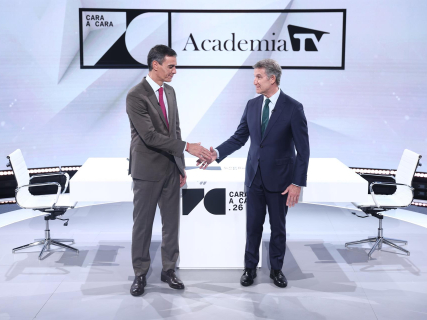

With an average of 10,152,000 viewers and a 70.8% audience share, the face-off between Pedro Sánchez and Alberto Núñez Feijóo turned this Thursday, November 19, into the sixth most-watched election debate in the history of Spain. The meeting, broadcast simultaneously by 20 national and regional channels, managed to enter a ranking that continues to be led by the duel between José Luis Rodríguez Zapatero and Mariano Rajoy from 2008.
According to data from Fifty5Blue compiled by Barlovento Comunicación, 15,980,000 people connected at some point to the broadcast of the debate organized by the Academia de Televisión and moderated by María Casado. The minute with the highest follow-up occurred at 22:13 hours, when the audience reached 11.2 million viewers, with a 72.4% audience share.
Antena 3 surpasses La 1 and leads the debate audiences
Among national channels, Antena 3 was the preferred option for following the face-to-face, with 2,461,000 average viewers and a 17.1% audience share. It was followed by La 1 of TVE, which brought together 2,168,000 viewers and obtained 15.1%.
Cuatro achieved third position, with 1,273,000 viewers and an 8.9% audience share, ahead of La 2, which gathered 1,217,000 people and 8.5%. Telecinco got 898,000 viewers and 6.3%, while laSexta and La Séptima obtained audience shares of 5.4% and 5%, respectively.
The 10 most-watched election debates in the history of Spain
Since Felipe González and José María Aznar starred in May 1993 in the first televised election debate between candidates for the Presidency of the Government, the major political events have brought together millions of viewers. However, no meeting has yet managed to surpass the 13,043,000 viewers who watched the first face-to-face between Zapatero and Rajoy in 2008.
With the data from this Thursday, Sánchez and Feijóo enter sixth place in the historical ranking, ahead of the confrontation between Sánchez and Rajoy from December 2015 and by 344,000 viewers ahead of the four-way debate held in June 2016.
| Position | Date | Protagonists | Viewers |
|---|---|---|---|
| 1 | 25/02/2008 | Zapatero and Rajoy | 13.043.000 |
| 2 | 07/11/2011 | Rubalcaba and Rajoy | 12.005.000 |
| 3 | 03/03/2008 | Zapatero and Rajoy | 11.952.000 |
| 4 | 31/05/1993 | González and Aznar | 10.529.000 |
| 5 | 13/06/2016 | Rajoy, Sánchez, Rivera and Iglesias | 10.496.000 |
| 6 | 19/11/2026 | Sánchez and Feijóo (2026) | 10.152.000 |
| 7 | 14/12/2015 | Sánchez and Rajoy | 9.728.000 |
| 8 | 24/05/1993 | González and Aznar | 9.625.000 |
| 9 | 23/04/2019 | Sánchez, Casado, Rivera and Iglesias | 9.477.000 |
| 10 | 07/12/2015 | Sánchez, Rivera, Iglesias and Sáenz de Santamaría | 9.233.000 |
Source: compilation by DEMÓCRATA based on the historical report of Barlovento Comunicación and on the audience data for 19 November 2026. The figures correspond to the average audience of the set of channels that broadcast each debate.
Sánchez and Feijóo add 4.2 million more viewers than in 2023
With regard to their previous televised face-off, held on 10 July 2023, Sánchez and Feijóo achieve this time 4.241.000 more viewers on average. That meeting, broadcast by Antena 3 and laSexta, brought together 5.911.000 people and obtained a 46.5% share of screen.
The difference is also considerable in terms of share, with 24.3 points more in the 2026 debate. It is worth bearing in mind, however, that the broadcast conditions were different: while the 2023 meeting was offered on two channels, the one from this Thursday could be followed simultaneously on about twenty televisions.
Despite the increase in audience, the historical highs are still far away. The debate between Zapatero and Rajoy on 25 February 2008 continues in first place, with 13.043.000 viewers, followed by the face-off between Mariano Rajoy and Alfredo Pérez Rubalcaba in November 2011, which attracted 12.005.000 people. Both precedents surpassed the figures of the 2026 face-to-face.