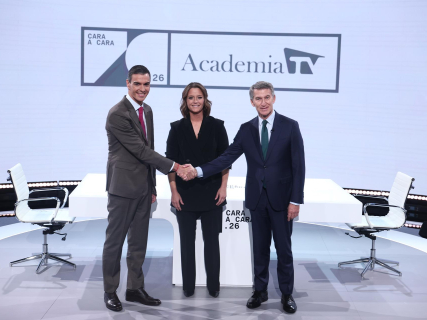

There is rarely so much unanimity about who has won an electoral debate. The restrained strategy of Pedro Sánchez (something rehearsed, as they claim on his team) has not convinced analysts, who believe that the candidate Alberto Núñez Feijóo was the winner of the face-to-face encounter. The debate hangover shows that the conservatives are still using their euphoric tone, while the PSOE calls Feijóo “liar”.
Initially, the PSOE opted to recover Sánchez’s final message. The party circulated a poster with a drawing of him with his fist raised and the phrase: "Whoever can vote should vote. Vote with all your soul". However, afterward it removed this post and showed another with the hashtag #FeijóoMentiroso, along with a video of the conservative candidate last night in Génova saying that he did not lie, and a graphic showing the number of falsehoods that, according to the socialists, each candidate said in the debate.
#FeijóoMentiroso pic.twitter.com/x6TW3CwE3g
— PSOE (@PSOE) November 20, 2026
For its part, the PP has published a photograph of its candidate walking the dog.
Buenos días 😉 pic.twitter.com/UsWfWdTYVH
— Partido Popular (@ppopular) November 20, 2026
Experts analyze the candidates’ strategy and gestures
The day after the face-off between Sánchez and Feijóo, the analysis continues. In the Cadena SER, Antonio Ruiz Valdivia has summarized the meeting as two separate debates: one Feijóo “being a machine gun” and one contained Sánchez. According to his interpretation, the popular candidate sought to win over Vox’s electorate with his accusations and the president tried to move closer to the moderate voter. Ruiz Valdivia also points out that in the PSOE they had expected a more forceful response from Sánchez and that the party wants to move past the debate in order to recover the tone of its rallies.
RTVE has put the focus on nonverbal communication. The specialists consulted note that Feijóo was gaining confidence during the meeting and managed to set the pace of the confrontation. Regarding Sánchez, they highlight his self-control and the use of silences and direct looks, although some interpret his body position as a sign of discomfort. Euprepio Padula believes that the popular candidate imposed his playing field and forced the president to react to his attacks.
La Vanguardia publishes the conclusions of 10 analysts and the majority considers that Feijóo was firmer during the face-to-face. Isabel García Pagan summarizes the contrast with the image of “one outgoing president and another incoming”: she describes Sánchez as apathetic and Feijóo as a candidate who acted “in machine-gun mode.” Josep Martí Blanch goes further and argues that the popular leader prevailed “in all the blocks,” in attitude, energy, and ability to bring the discussion onto his own ground. However, he recalls that the result of a debate does not necessarily determine the electoral outcome.
Marta Rebón interprets that Feijóo opted for “summary judgment,” with figures, repeated questions and accusations, while Sánchez avoided getting into that dynamic and ended up addressing voters directly. Her conclusion is that “one judged, the other mobilized.” Félix Riera expands the focus and considers that the main result was the staging of a bipartisanship that continues to seek centrality in Spanish politics.