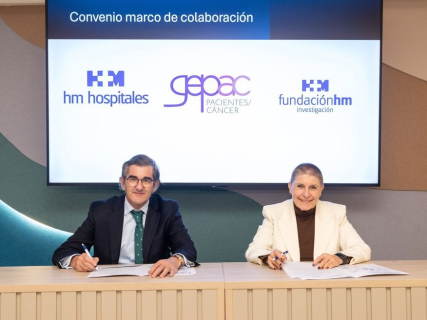

The presidents of the HM Hospitales health group, the doctor Juan Abarca Cidón, and of the Spanish Group of Patients with Cancer (GEPAC), Begoña Barragán, have signed a collaboration agreement through which the HM Hospitales Research Foundation (FiHM) and the patient organization will encourage the involvement of people affected in the areas of care, scientific matters, and quality of healthcare.
The agreement also includes the development of joint initiatives aimed at strengthening the information, training, and support of people with cancer and their loved ones, with the aim of moving toward a more participatory cancer care, in which the needs and viewpoints of patients are integrated into improving care pathways.
"Collaboration with patient associations is essential to move toward cancer care that takes into account the clinical aspects of the disease and the needs and experiences of the people who face it," Abarca Cidón said during the signing ceremony, held at the HM University Center of Health Sciences (CUHMED), together with the Hospital Universitario HM Montepríncipe in Boadilla del Monte (Madrid).
In the presence of the director of the Clara Campal Comprehensive Oncology Center (HM CIOCC), the doctor Antonio Cubillo; the coordinator of the Comprehensive Care Unit for Oncology Survivors, the doctor Carlota Santolaya; the FiHM manager, Francisco Aldea; the foundation’s scientific coordinator, the doctor César Muñoz; and the Strategy and Innovation director of GEPAC, Fernando Calderón; the president of HM Hospitales emphasized that the alliance "will make it possible to strengthen that participation in order to better understand the reality of people with cancer and contribute to improving their care".
"Patients have a great deal to say about how we are treated, and this agreement gives us a place to say it within the hospital, in improving quality, in the accreditation of services, and in research," Barragán highlighted in turn, who stressed that no one knows better than the people affected themselves "what works and what fails day to day, and having that experience helps patients and also professionals".
The understanding text sets out a stable framework of collaboration to promote activities of shared interest with a positive impact on patients, healthcare professionals, and society. Among the main lines are joint participation in congresses, conferences, and scientific meetings promoted by both entities; the development of informational and outreach materials; cooperation in awareness campaigns; and the drafting of recommendations and guides that integrate the perspective of those who live with cancer.
Likewise, it is planned to systematically incorporate the experience of patients into processes for improving the quality of care, and health certification and accreditation. This cooperation will be structured through specific projects and actions in which objectives, responsibilities, and resources will be defined in each case. In addition, a joint monitoring commission will be created, tasked with coordinating initiatives, assessing their progress, and identifying new opportunities for joint work.
Observatory of Cancer Survivors
"After overcoming an oncology process, many of us continue with fatigue, pain, fear of recurrence, or problems returning to work," explained the president of GEPAC, who added that "for a long time, this has not been studied properly and what is not known cannot be addressed." "That is why, we are going to help ensure that the Observatory reaches all the people who can contribute their experience, so that what they share becomes real changes in care," she said in relation to the Observatory of Cancer Survivors, a project driven by the FiHM to deepen understanding of the needs of those who have overcome an oncology process.
The existence of this Observatory is based on the fact that increased survival creates new healthcare challenges that go beyond disease control and detection of recurrences. Many people continue to suffer physical, emotional, and social effects that significantly condition their daily lives. In light of this reality, the aim is to identify unmet needs, study the impact of aftereffects, and generate evidence that can serve as a basis for guiding future support measures and improvements in care.
In this context, the HM CIOCC has the Comprehensive Care Unit for Cancer Survivors, designed to offer a multidisciplinary and personalized response to those who have completed the primary treatment or who are in a phase of remission and follow-up. The unit addresses both the physical sequelae and the psychological and social repercussions of cancer through a coordinated team of specialists in Oncology, Clinical Psychology, Rehabilitation and Physiotherapy, Nutrition and Endocrinology, Gynaecology, Urology and pain management, among other disciplines that are incorporated according to the needs of each case.
The care pathway begins with a review of the medical history and the treatments administered, followed by an integral assessment of the physical, emotional and social state. Based on this evaluation, the needs that require intervention are determined and an individualized follow-up plan is developed, with specific recommendations for each person. This approach complements the usual monitoring carried out by the oncologist and the referring physician, placing the focus on recovery of well-being and quality of life.
All this work is reinforced by the FiHM’s translational biomedical research activity, aimed at transferring scientific advances to clinical practice and responding to patients’ real needs. In this way, the Foundation supports the work of HM Hospital centers throughout the territory, facilitating the participation of professionals and patients in projects aimed at improving the prevention, diagnosis and treatment of different diseases.