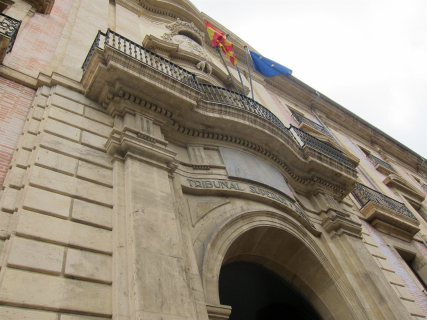










The second section of the Contentious-Administrative Division of the Superior Court of Justice of the Valencian Community (TSJCV) has issued a ruling by which it orders the Conselleria de Sanidad to indemnify with 125,000 euros, plus the interest and updates that are appropriate, the relatives of a patient who died and in whom an aortic aneurysm was not detected in time.
The man, whose family has been represented by the lawyer Ica Aznar, from the legal services of El Defensor del Paciente, had suffered since June 2022 from persistent pain in the lumbar and dorsal area. Despite going on several occasions to different care resources, no imaging test was carried out that would have made it possible to discover the large abdominal aortic aneurysm that he had, as the entity has reported in a statement.
On 2 December 2022, the patient presented himself at the Bellreguard Health Center after an episode of dizziness with loss of consciousness. It was found there that he had an extremely low blood pressure of 52/30 mmHg, so it was decided to transfer him to the Emergency Department of the Hospital Francesc de Borja de Gandía.
During his stay in the Emergency Department, the patient stated that in the days prior he had had abdominal and back pain, a circumstance that was expressly recorded in the medical report of the urgent care.
Despite the symptoms described, the professionals focused the diagnostic study on ruling out a possible pulmonary thromboembolism and he underwent an angioTAC of the pulmonary arteries, which was negative.
According to the association, the doctors did not address the patient’s complaints about abdominal pain and no imaging test of the abdominal area was requested to exclude other causes that could explain the syncope, the severe hypotension and the referred abdominal and lumbar pains. "Inexplicably, the patient was discharged without the cause of the loss of consciousness having been identified or the existence of an abdominal aortic aneurysm having been ruled out," the entity has pointed out.
On the following day, the man had to return again to the Hospital de Gandía after suffering another episode of loss of consciousness, this time with a notable worsening of his overall condition, very intense abdominal pain and analytical abnormalities compatible with a hemorrhagic condition. At that time, it was decided to carry out an abdominal angioTAC, which confirmed the rupture of an abdominal aortic aneurysm.
Given the severity of the diagnosis, the patient was urgently referred to the Hospital General de Valencia, where he underwent endovascular surgery, since the Hospital de Gandía does not have this type of specialized service. He remained admitted for around a month and suffered several complications; finally, on 4 January 2023 he suffered a cardiorespiratory arrest that caused his death despite resuscitation efforts.
The family filed a claim for patrimonial liability against the Conselleria de Sanidad, understanding that there was an unjustified diagnostic delay and that, had the relevant tests been requested at the first hospital visit, the aneurysm could have been diagnosed before the serious clinical deterioration and the condition could have been treated under better conditions.
The association emphasizes that "it is especially striking that the Conselleria de Sanidad's own Medical Inspection recognized that the healthcare provided had not been adequate and that patrimonial liability of the Administration should be assumed and concluded that, in a patient who presents with abdominal or lumbar pain, syncope and hypotension, it is necessary to carry out a differential diagnosis that includes the possibility of an abdominal aortic aneurysm." In the same report, it was indicated that not all the available clinical data were assessed and that discharge was given in a precipitate manner, without correctly ruling out this condition.
Despite that criterion of the Medical Inspection, the Conselleria de Sanidad rejected the claim of the family members, denying that the lex artis médica had been violated. The Administration maintained this position throughout the judicial process, relying on expert reports that argued that there were not sufficient signs to suspect an abdominal aortic aneurysm.
The court, however, dismisses these arguments and considers proven that the patient had communicated abdominal and lumbar pain in the days prior to the hospital care of 2 December 2022, an assertion that was stated literally in the Urgencias report.
The ruling emphasizes that the core of the debate was not a mere difference of criteria between professionals, but rather clarifying whether the clinical presentation required carrying out an abdominal diagnostic test, and concludes that it should have been done in that way.
In this sense, the court states: "The abdominal CT scan test that would have revealed the true pathology the patient was suffering and that would have allowed his treatment already at that moment should have been carried out for the patient, significantly increasing his chances of survival".
Thus, the Chamber declares that the healthcare action violated the lex artis by not using the appropriate diagnostic means in a case with clear warning signs compatible with a potentially deadly vascular pathology. The omission of this test deprived the patient of access to an earlier diagnosis and treatment, which would have increased his chances of survival in a notable way.
As a consequence, the court orders the Conselleria de Sanidad to pay a total compensation of 125,000 euros to the relatives of the deceased, distributed as 60,000 euros for the widow, 30,000 euros for each of the two children and 5,000 euros for the son-in-law, who also lived with the patient.