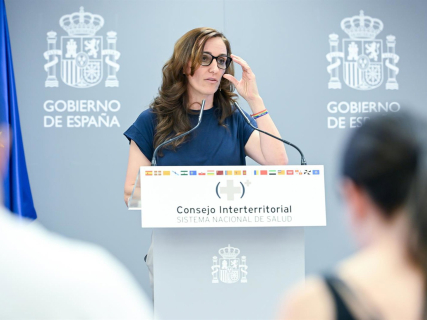

The Minister of Health, Mónica García, has expressed her confidence that the parliamentary groups will support the tobacco bill and act as "true" representatives of the citizenry to reinforce public health protection. At the same time, she has defended that health functions as a "binder" of the different political forces.
"I understand that the parliamentary groups, as good representatives of the citizens, will want or wish for their citizens to be healthy, to be protected against that 30 percent of cancers caused by tobacco, the 140 deaths it causes daily, in addition to all cardiovascular and pulmonary diseases," García pointed out in statements to 'Al Rojo Vivo' of La Sexta, collected by Europa Press, when asked about the support of the groups for the bill.
In this line, the head of Health has emphasized that the legislative initiative also has the support of the citizenry, which, in her view, took note of the regulation approved in 2010. "And I believe that we also have a leaden truth, 50,000 deaths a year are due to tobacco consumption," she pointed out.
"We are very proud that Spain is once again at the forefront and is a country that has anticipated the rest of the European countries by approving this law," she noted.
García warns of tensions in the National Health System
Questioned about the episodes of collapse in certain hospitals in the country, García has emphasized that there are "serious difficulties" in adequately providing resources to the National Health System (SNS) during periods of greater care pressure, such as summer and winter, reminding that the organization of care falls on the autonomous communities.
"I have always said that we have a National Health System equipped for autumn and spring, but we have serious difficulties due to underfunding in summer and winter, when the flu epidemic arrives. And, in case anyone has any intention of blaming the Ministry of Health, this requires the competencies of the autonomous communities," she declared.
Next, the minister highlighted that the Executive has increased budget transfers to the autonomous communities by 53 percent, although she specified that not all communities have chosen to allocate those resources to strengthen public health.
"Each community has the political decision to know where that money transfer goes, but there is no doubt that there are now more professionals than ever, specialized health training has been provided more than ever, and there are more transfers than ever. There are communities that have decided that those transfers will not be allocated either to improve the conditions of professionals or to reduce the saturation of emergencies and waiting lists," he concluded.