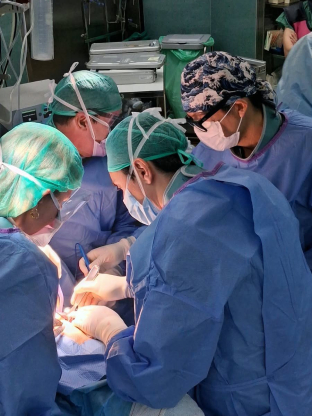

The Complejo Hospitalario Universitario de Canarias (HUC), a center dependent on the Consejería de Sanidad of the Gobierno de Canarias, has carried out for the first time in the archipelago the implantation of the "ReCerf" hip resurfacing prosthesis, an advanced ceramic-ceramic joint resurfacing system.
According to the HUC itself in a statement, this is the first time this model has been used in Canarias.
Unlike the classic total hip prosthesis, in which the femoral head is completely replaced and a stem is inserted into the femur, the resurfacing prosthesis allows most of the femoral head and neck to be preserved, which are coated with a ceramic layer.
This preservation of the bone is considered an important advantage, especially in young people who, presumably, could require another surgery over the course of their lives.
The device incorporates ceramic-ceramic joint surfaces, which avoids the drawbacks associated with the release of metal ions that conditioned the use of the old metal-metal resurfacing prostheses.
The first two surgeries were performed with the participation of Dr. Luis Novoa, from the Clínica CEMTRO in Madrid, a specialist with extensive experience in this technique, who traveled to the HUC to provide training and technical support to the team in the implementation of the procedure.
At present, the HUC team already performs these interventions autonomously and has incorporated them into its usual portfolio.
The technique is mainly aimed at relatively young and active patients, who practice sports frequently or carry out physically demanding jobs, and who present advanced hip osteoarthritis with good bone quality.
Among the possible benefits are the conservation of the femoral bone, a biomechanics closer to the physiological one and the option of maintaining a high level of physical activity.
All the same, the indication must be assessed individually and does not displace conventional total prostheses, which continue to show very satisfactory clinical results and a long proven survival.
The operations have been carried out through direct anterior hip approach, which allows access to the joint through an intermuscular plane and favors the preservation of the periarticular musculature.
The adoption of this technology broadens the range of surgical options at HUC and represents an advance in the incorporation of bone-preserving techniques for the management of hip osteoarthritis.
Although the initial published clinical data are encouraging, prolonged follow-up is still needed to confirm its benefits compared with traditional total prostheses.
The implementation of this technique has been promoted by the hospital’s hip surgery unit, led by doctor José Luis Pais, and has involved the participation of doctors María Trinidad Fernández and Julio Morales, specialists in Orthopedic Surgery and Traumatology.