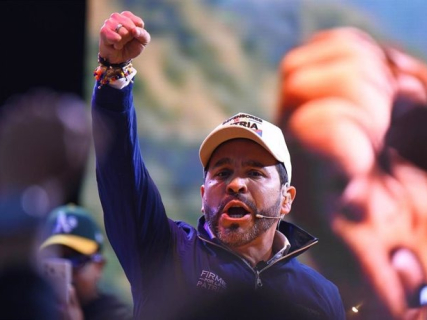


A lawyer known for his appearances on television sets. Until not long ago, a television extravagance, a man characterized by his flashy suits and his habit of going without socks, who hardly seemed like a credible candidate for the Presidency of Colombia.
Today, however, Abelardo de la Espriella leads the polls and is one step away from conquering the Casa de Nariño (Colombia), culminating one of the most surprising political breakthroughs in the country's recent history.
With more than ten million votes in the first presidential round, the candidate of Defensores de la Patria has become the main Colombian exponent of radical populist right-wing politics.
His proposals mix a firm hand against crime, outright rejection of the left, cultural conservatism, nationalism, and a calculated anti-establishment image, even though he has support from a good part of that economic elite he claims to fight.
The Candidate Built Against Petro
It is difficult to understand De la Espriella's rise without analyzing the wear and tear of the Colombian president, Gustavo Petro.
Beyond the specific measures of his government, the lawyer has managed to capitalize on the rejection that the leftist leader arouses in broad sectors of society. For millions of Colombians, Petro symbolizes both economic frustration and the deterioration of security and the permanent polarization that has marked the country's political life in recent years.
De la Espriella has turned this sentiment into electoral fuel. His campaign revolves around a simple idea: everything that Petro represents must be reversed.
It is no coincidence that his speeches are full of references to insecurity, drug trafficking, guerrillas, or the failure of the so-called "total peace." Nor is it a coincidence that he presents the elections as an existential battle between those who want to restore order and those who, according to him, have brought the country to the brink of collapse.
An 'Outsider' Who Doesn't Exactly Come From Outside
One of the most striking elements of his success is his ability to present himself as a candidate outside of traditional politics.
De la Espriella has never held public office and presents himself as a successful businessman who does not need to live off the state. This narrative connects particularly with a citizenry that deeply distrusts political parties and traditional institutions.
However, that image presents some contradictions. During the campaign, he has received the backing of historical figures of the Colombian right, former ministers from previous governments, and important regional political structures. Among those who have publicly expressed their support is former president Álvaro Uribe Vélez, while sectors linked to conservative governments have ended up aligning with his candidacy.
From the law firm to political stages
Before entering politics, De la Espriella was already one of the best-known lawyers in Colombia.
Throughout his career, he has represented businessmen, celebrities, political leaders, and individuals involved in some of the country's most high-profile legal cases. His figure has always been surrounded by controversy due to the nature of some of his clients and his confrontational style.
His business career is also an essential part of the political brand he has built.
The candidate boasts of having built an economic empire with investments in various sectors, from livestock to real estate. His fortune constitutes a central part of his electoral message, as he presents himself as living proof that economic success is possible without depending on the State.
The mirror of Trump, Milei, and Bukele
The parallels with other American leaders are inevitable.
Like Donald Trump, he exploits an image of a successful businessman opposed to traditional elites. Like Javier Milei, he promises drastic cuts in public spending and uses aggressive rhetoric against the political class.
And like Nayib Bukele, he makes security the absolute axis of his political project.
It is no coincidence that he has promised to build mega-prisons, toughen the fight against drug trafficking, fumigate illegal crops, and strengthen military cooperation with the United States and Israel. A good part of his program rests on the idea that Colombia needs to regain authority through exceptional measures.
Conservatism, religion, and culture war
Another pillar of his rise is the cultural and ideological component. De la Espriella presents himself as a defender of the traditional family, holds very critical positions on abortion, and has been involved in various controversies due to statements considered sexist or homophobic by his detractors.
Paradoxically, he who for years defined himself as an atheist has become one of the politicians who incorporates the most religious references into his public appearances.
The constant appeal to Christian values connects with a significant part of the Colombian electorate and allows him to consolidate a particularly mobilized conservative base.
The De la Espriella phenomenon also acquires a territorial dimension. Although born in Bogotá, he grew up in Montería and has made his Caribbean identity one of his main political banners.
For years, broad sectors of the Colombian coast have denounced the political and economic centralism exercised from Bogotá. The "Tigre" campaign has exploited this sentiment by presenting him as a leader capable of challenging the traditional elites of the interior of the country.
The slogan "coastal votes for coastal" has found an echo in regions where the right historically found greater difficulty in imposing itself.
The aspirational candidate
Perhaps the most undervalued key to his success is the image of prosperity he projects.
Mansions, private jets, properties abroad, luxury clothing, and a life unashamedly displayed on social media are part of his narrative.
While other leaders try to hide or minimize their wealth, De la Espriella turns it into an electoral argument.
For his followers, he represents the example of the successful businessman who has achieved everything that many aspire to. For his critics, he symbolizes a politics turned into a spectacle where image weighs more than proposals.
Beyond who finally wins the elections, which will take place next Sunday, June 21, the political phenomenon has already left a conclusion that is difficult to ignore. Colombia has ended up joining a wave of right-wing populism that now threatens to reach the Colombian presidential palace as well, at the hands of the self-proclaimed "Tigre".