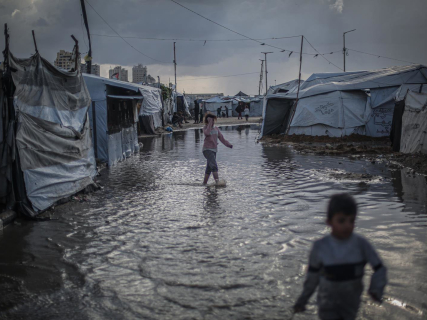

The foreign ministers of Australia, Canada, Italy and the United Kingdom have demanded this Monday that the Israeli government immediately lift the blockades at border crossings and enable the "rapid and unhindered" delivery of humanitarian aid to the Gaza Strip, after denouncing that 150,000 tents and essential supplies remain immobilized at the border as the crisis worsens with the arrival of winter.
In a joint statement released by their foreign ministries, the four governments warned that the situation in the Palestinian enclave is "critical" and has been made worse by the flooding caused by "the first winter storm".
"The population of Gaza desperately needs shelter and humanitarian assistance. However, 150,000 tents and other vital supplies are being held at the border and their entry into Gaza is being prevented," the foreign officials said, stressing that this reality is "entirely reversible" if action is taken before winter is fully established.
In this context, the four countries have asked the Israeli authorities to reopen crossings, authorize the entry of shelters and allow the access of indispensable dual-use items for humanitarian operations and early recovery efforts "before it is too late". They have also urged all parties to implement the Comprehensive Plan for Gaza, complying with the ceasefire and its commitments under International Humanitarian Law.
This statement coincides with the warning issued on Saturday by the UN Humanitarian Team (HCT) for the Occupied Palestinian Territory, which linked deaths and the destruction of thousands of shelters following the latest rains to both the storm and to political decisions that hinder the emergency response.
According to the United Nations, most of those more than 150,000 tents acquired by member states and humanitarian organizations remains blocked in the Egyptian city of Al Arish, about 50 kilometers south of Gaza, due to strict authorization procedures and the limited capacity of the border crossings, while the organization reminds Israel of its responsibility as an occupying power to ensure the basic needs of the civilian population.