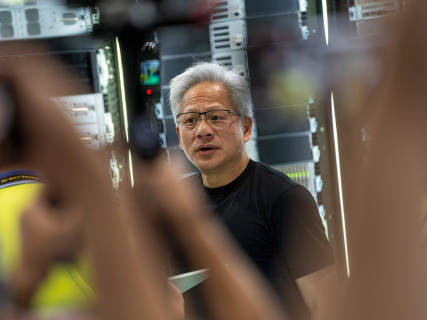

California Attorney General Rob Bonta has issued this Thursday a civil investigative subpoena addressed to the U.S. semiconductor manufacturer Nvidia in connection with the scandal over the extramarital relationship of its former chief executive officer, Jensen Huang, with a suspected Chinese spy.
As detailed by the California Department of Justice in a statement, the request is intended to clarify whether Nvidia’s actions or those of its former top executive led to the transfer of advanced chips or sensitive information to China, as well as to determine whether the company "misled investors and the public" regarding these risks, violating California securities regulations.
"Nvidia’s conduct and that of its former chief executive officer raise serious warning signs, including the ways in which the company may have induced investors to be misled," Bonta said, stressing that although the multinational faces "a complex transnational situation," the basic principle of the law is unequivocal: "Companies cannot mislead their investors."
The opening of this investigation coincides with the declassification in the U.S. Congress of documents showing the official approval of sales of nearly 880,000 artificial intelligence (AI) intelligence chips to Chinese firms linked to the military sector.
Chip sales to Chinese tech giants
The House Committee on Foreign Affairs of the United States, headed by the Republican Brian Mast, released this Thursday records from the Bureau of Industry and Security (BIS, for its English-language acronym) of the Department of Commerce that include Nvidia and AMD requests to place in China 3.4 million advanced integrated circuits by May 2026, of which export was approved for 879,868 units.
Among the authorized operations are shipments directed to companies cataloged by the Department of Defense as Chinese military companies, including 75,000 chips for Alibaba, 150,000 for Tencent, 43,000 for Baidu and 4,000 for BYD, as well as an additional Nvidia request in December 2025 to export 445,000 H200 processors to Tencent.
After these documents were made public, Gregory Meeks, the top Democrat on the committee, criticized that the management of export controls during the Trump Administration “has put our national security and our technological advantage at risk” by granting licenses for advanced chips “with little scrutiny,” and therefore he has called for the holding of public hearings with the Secretary of Commerce, Howard Lutnick, and the BIS Undersecretary, Jeffrey Kessler.
These investigations at the state level and in Congress are taking place after the resignation last week of Jensen Huang, after it became known that at least three extramarital relationships, one of them with Alice Huang, were being monitored by U.S. intelligence services for its alleged links to Beijing. The former executive has agreed to appear voluntarily before three House committees next December 1, and a day later, Nvidia’s general counsel, Tim Teter, will do the same.
Meanwhile, this Thursday, U.S. President Donald Trump called Huang’s departure a “tragedy,” with him being provisionally replaced by Chief Financial Officer Colette Kress, and he downplayed the allegations of espionage in an interview with the Fox News chain, in which he praised the former CEO as “a brilliant man” and said that he had received no report pointing to a threat to national security.